WomenInTech. Stories of successful women from Tajikistan and Uzbekistan who are building careers in IT
The Tech AI
Get the key points in seconds - a short summary from The Tech AI.
Umedakhon Pulatova (Khujand) and Dilafrooz Nurdzhabova (Tashkent) shared their journeys into IT. Pulatova founded the ITRun school and the Anbor.tj startup, challenging stereotypes against girls learning programming. Nurdzhabova is a lecturer at Amity University, researching bioinformatics and AI. Both note the decreasing barriers for women in the profession and advocate for continuous learning.
Women in IT are developing not only as developers but also as entrepreneurs, educators, researchers, and project managers. In a new interview, young women from Uzbekistan and Tajikistan shared their journey in technology, stereotypes, professional barriers, and why continuous learning remains an important part of an IT career.
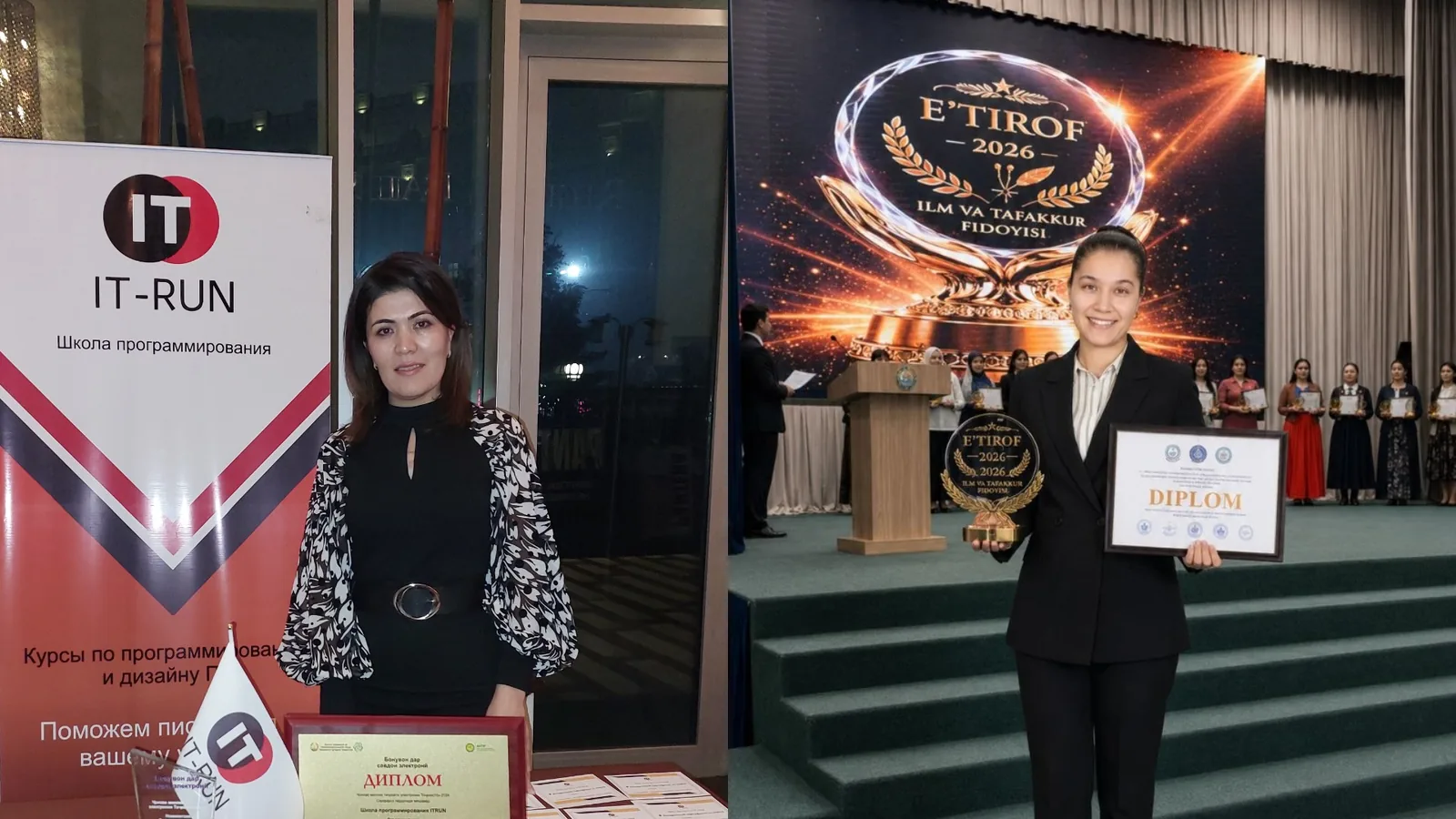
Umedakhon Pulatova, city — Khujand, co-founder and CEO of ITRun programming school, co-founder of Anbor.tj startup, LinkedIn, Instagram
About Me
I am the co-founder and CEO of ITRun programming school. ITRun is a brand, and our company is legally registered as LLC "New Algorithm." It is the first school in Tajikistan offering IT, computer literacy, and programming education for children and teenagers aged 7 to 17. We also have programs for retraining and teaching adults programming with subsequent employment. The school operates in Dushanbe and Khujand, with offline classes.
I am also the founder and director of the Anbor.tj startup, which entered the market in January 2026 and began attracting clients. This is a cloud solution for automating accounting, warehouse management, finance, and other business processes, developed with consideration for market demands and the legislation of the Republic of Tajikistan.
How I entered the IT profession
By education, I am an economist. After school, I studied business and investment attraction for three years at a college in the US. Then, upon returning to Tajikistan, I obtained a bachelor’s degree in accounting and auditing.
After university, I worked in a bank for six years, then received a full scholarship and entered the master’s program at the OSCE Academy in Bishkek, specializing in economics and management.
I entered the IT field thanks to my son. When he was about seven years old, I asked him what he wanted to become. He replied that he wanted to be a programmer. At that time, I decided to prepare the ground in advance and started looking for educational centers in Khujand where he could study IT. Unfortunately, I did not find such a place.
Thus, the idea to create our school, ITRun, emerged. IT is developing everywhere, and programmers are needed in many fields. I realized that such education was necessary not only for my son but also for other young people.
I am also a graduate of the US Embassy’s IVLP program in entrepreneurship and IT. In 2024, I visited the US and saw how startups and business incubators in the IT sector are supported there.
After returning, I became a mentor at Technovation Girls and the US Embassy’s AI and IT Entrepreneurship program. One of our IT startups became a finalist in the program.
In addition to paid courses, we organize many free programs as part of joint projects with international organizations, including opportunities for subsequent employment.

About Stereotypes
We have encountered stereotypes specifically in the IT field. Based on this, at ITRun, we started organizing courses for girls.
When we opened ITRun in March 2020, the first trial lesson was always free. The whole family could come with their children, participate in the lesson, and then choose a suitable course. We invited parents to bring all their children. As you know, in Tajikistan, there are many large families, with three to four children in each family.
So, once, boys and girls came to the trial lesson with their parents. After the class, the parents decided to enroll only their sons, believing that programming was a more suitable field for boys. They also assumed that a girl might not work after marriage.
I explained to the parents that IT skills give girls the opportunity to maintain professional independence and work remotely even after marriage or during maternity leave. Moreover, a girl’s education affects not only her own career but also the future of her children and family.
Such situations showed us that girls are interested in IT, but they often need additional support from their families and society. Therefore, we began to pay special attention to educational programs for girls.
After that, we started organizing joint programs with international organizations where training was exclusively for girls. We had many such courses, where we trained 120 girls in IT, web design, and Frontend. Today, these girls are already working as leading IT specialists.
Barriers for Women in IT
However, barriers remain at the employment stage. Not all companies looking for IT specialists actively consider women. First of all, they may say that a girl will get married, have a child, and take maternity leave.
There are obstacles from the girls themselves and their families as well. In some families, husbands do not allow girls to work in a mixed-gender team. Sometimes this is related to having small children. If a girl is not married, her parents may also not allow her to work.
But today, we have many girls who studied with us and are now working in the IT field—in banks and IT companies. Perhaps one or two out of ten girls face some family issues.
Each year, these obstacles are decreasing. In Tajikistan, most companies have already adopted a gender equality strategy so that women are also represented in this field. Conversely, women in IT are sometimes given advantages during hiring.
I know that in Kazakhstan, there are also programs that attract girls to IT from a young age, such as Technovation Girls, Women in Tech, and TechnoWomen. The success stories of these girls motivate both parents and the girls themselves. Therefore, obstacles are becoming fewer each year.
Recommendations for Those Just Starting Their Journey
I recommend children start with computer literacy, then move on to Scratch, App Inventor, and Frontend. After completing the HTML and CSS course, students present their first projects and receive a certificate. Based on the results, it becomes clear which direction suits them—for example, developing Frontend if they are more interested in design and website creation.
There are many educational centers and courses on the market now, so it is not worth constantly changing directions after one course—Frontend, Backend, Python, UX, or Data Analytics. It is better to gradually and consciously choose your path and move forward.
It is important for programmers to constantly develop: study new technologies, read, write code, and work on themselves. Every few years, new technologies and requirements appear, and one must be ready for this.
Do not be afraid of internships and practice. In courses, you gain basic experience, but in a real workplace, everything happens differently. Moreover, today, a programmer needs not only technical skills but also soft skills—the ability to work in a team and listen to each other.
For adults, we focus on the market and in-demand specialties in IT companies, forming courses and guiding students based on this.
Many think that programming is difficult, but there are many opportunities in IT for everyone. Programming knows no gender. This is a field that is constantly developing, so I encourage girls and everyone else not to be afraid to learn. Even working from home, one can continue to develop, take care of children, and earn money.
Dilafroz Nurdzhabova, city — Tashkent, Assistant Professor, Instagram

About Me
I am a teacher and researcher in the field of information technology, programming, mathematical modeling, bioinformatics, and Biomedical Engineering. Currently, I work as an Assistant Professor at Amity University in Tashkent.
My professional activity is not only related to teaching but also to scientific research and the development of IT solutions in the field of bioinformatics and medicine. I use mathematical modeling and numerical methods, specifically for studying blood flow and the cardiovascular system. We investigate pressure and processes in the vascular system, developing mathematical models that can later be used by doctors. I also plan to apply artificial intelligence—overall, my scientific interests are related to AI and its application in medicine.
How I entered the IT profession
My career path began even during my studies at a specialized lyceum in Karshi. There, we studied informatics, Pascal, and Delphi, and it was then that I became interested in programming. I realized that I wanted to connect my education with information technology.
After the lyceum, I entered the Tashkent University of Information Technologies, Karshi branch. During my studies, I started working as a system administrator, and later I moved into teaching, developing simultaneously in pedagogical and scientific activities.
After obtaining my bachelor’s degree, I continued my studies in the master’s program at TUIT in a field related to biotechnical systems and hardware-software engineering. Returning to Karshi, I continued working at TUIT and progressed from a teacher to a Senior Lecturer.
Gradually, I realized that IT can solve practical tasks in various fields. Thus, I combined information technology with mathematical modeling and medicine, focusing on modeling blood vessels and the cardiovascular system. For me, IT is primarily a tool for creating practical solutions.
Then, I continued my development as a researcher and PhD student, working on mathematical modeling of biomedical systems, blood flow, and vascular processes. I participated in international conferences and projects.
Today, I work at Amity University in Tashkent, where I collaborate with foreign professors on research projects, participate in international conferences, and academic initiatives. Recently, together with foreign colleagues, we prepared a book Data Structures and Algorithms, which is currently being prepared for publication.
About Stereotypes
If we compare with what was happening 10 years ago, there are significantly more women in IT. When I just started, only two or three girls studied in our department, and even fewer in the master’s program. At the department where I worked, I was the only woman among male colleagues for some time.
This is especially felt when a woman works simultaneously in technical, scientific, and academic spheres. I tried not to perceive this as a limitation. For me, the strongest response has always been knowledge, professional results, and constant development. I believe that competence does not depend on gender. A woman can simultaneously develop professionally, work, take care of her family, and help her parents.
It is also important to me that work in IT gives women the opportunity to be financially independent. It is not only men who can earn and support the family. A woman can also independently build her career, create sources of income, support herself, and help her parents.
Therefore, I believe that girls should not be afraid of difficulties and their own fears. Sometimes something may not work out the first time, but this does not mean you should stop. It is important to keep moving forward and try again.
Barriers for Women in IT
One of the first obstacles for me was fear and lack of self-confidence. Over time, I learned to cope with this and not let fear become a limitation.
I see a similar problem among beginner programmers, including girls. For example, a student may study Full Stack but be afraid to move on to Backend because they believe they will not be able to figure out the new topic. In reality, it is not necessary to understand everything at once. It is important to move gradually, study one topic at a time, and connect knowledge together.
To become a good programmer, it is important to develop logical thinking and not set limitations for yourself. For example, when studying object-oriented programming, you can first understand classes, and then gradually move on to the next concepts and build connections between them.
For women in IT, there are other difficulties as well. One of them is the need to constantly prove their professional competence while simultaneously juggling multiple roles and responsibilities.
Recommendations for Those Just Starting Their Journey
Constant learning, participation in conferences, publications, international programs, and professional networking help me. If you have created a product or development, it is important to talk about them at conferences, seminars, and workshops and not be afraid to present your work.
For me, the main principle is to learn, try, make mistakes, and try again. You can even start with a small project: if you have an idea and a desire to develop it, through professional networking, you can find people who will help you move forward.
I did not expect myself to actively participate in international organizations and professional communities. Now I participate in the activities of IEEE and develop professional networking for women. I also worked as a volunteer at the Research Women Foundation in Nigeria, which unites participants from different countries. We help attract girls from Uzbekistan and other countries to such initiatives and develop their professional and soft skills.
Such international communities help find professional partners, participate in competitions and projects, and open up opportunities for collaboration.
I would advise girls not to be afraid to try new things. If something does not work out the first time, you need to keep moving forward. Sometimes the result comes when you least expect it.
Currently, my main priority is to complete my PhD and defend my dissertation. In parallel, I am working on patenting: on the topic of my dissertation, I have already received a patent for a utility model in India and want to further develop this work—both in a scientific and applied direction. After defending my PhD, I want to engage more in professional networking, teach girls, develop new projects, and continue working in the field of Women in Tech.
The Tech on Telegram Follow The Tech on Telegram
Keep up with the latest technology and startup news.
Related reading






More from this author

Article Useful
How to protect your accounts from hacking: 8 settings you should check today
The Tech

Article Useful
500 Global: How the Accelerator Works and Who Can Receive Investments
The Tech

Article Interviews
Game Development in Central Asia: Arkady Moldavski on Developing Reverb and the Growth of the Industry
The Tech

Article Useful
Google, Tesla, BlackRock, and the IMF: Where to Apply for an Internship in Fall 2026
The Tech

News IT
Tesla unveiled the flying electric car Roadster
The Tech

News IT
Intero Biosystems startup won the Startup Battlefield at TechCrunch Disrupt 2026
The Tech