Venture capital is available, but founders are lacking: why venture education should start at the university
In his new article for The Tech, Azizbek Kurbanov examines one of the main challenges of the growing venture market: there is more money and more funds, but there is still a shortage of quality founders. Why this issue needs to be addressed starting with universities — read the full version of the article.

The Tech AI
Get the key points in seconds - a short summary from The Tech AI.
Azizbek Kurbonov, an IT entrepreneur from Tashkent, proposes systematically addressing the founder shortage through higher education. He has implemented two precedents: a joint program with Turin Polytechnic Institute and Yoshlar Ventures, where the university became a co-investor, and a project at TEAM University, where investors evaluated diplomas. These models connect universities with the market to ensure a steady influx of quality startups.
Azizbek Kurbonov, city — Tashkent, IT entrepreneur, LinkedIn
In recent years, the local venture market has evolved from near-total absence to the emergence of dozens of funds and development institutions ready to invest in startups. However, as more capital enters the market, another problem becomes increasingly acute — there is simply a shortage of high-quality founders on the market. Funds are competing not for the best deals, but simply to find projects to invest in.
I am convinced that this problem cannot be solved through targeted hackathons and one-off accelerators. The influx of new, prepared startup founders must be formed systematically — and this process should begin at the level of higher education. Fundamental knowledge about venture capital — how a fund works, what a pitch is, business models, unit economics, and fundraising — should be taught to students as systematically as marketing or finance.
Why am I talking about this
I approach this topic not as an outside observer, but as someone who has gone through the entire journey from the inside — from both sides of the venture market.
I was a founder of Sug’urta Bozor myself, raising investments — both from local and foreign funds. I went through several international accelerator programs, so I know the process not from textbooks, but from personal experience. Later, I moved to the other side of the deal — I served as the CEO of a venture fund, and today I act as an advisor at Yoshlar Ventures.
Additionally, I am the author of the course The Art of The Pitch, where I have trained over 500 founders across Uzbekistan. I organize venture ecosystem development programs in collaboration with the UNDP, and I run an accelerator for the Taqdimot show with the support of Aloqa Ventures. I have established connections with foreign universities by completing executive programs in venture capital and entrepreneurship at Yale and Cornell.
It is precisely this position “at the intersection” — as a founder, fund manager, mentor, and teacher — that led me to work with universities: I see the gap between what is taught in universities and what the market actually requires, and I try to bridge it in practice.
Over the past year, I managed to implement two projects that, in my opinion, have become true precedents for the higher education system in Uzbekistan in this area.
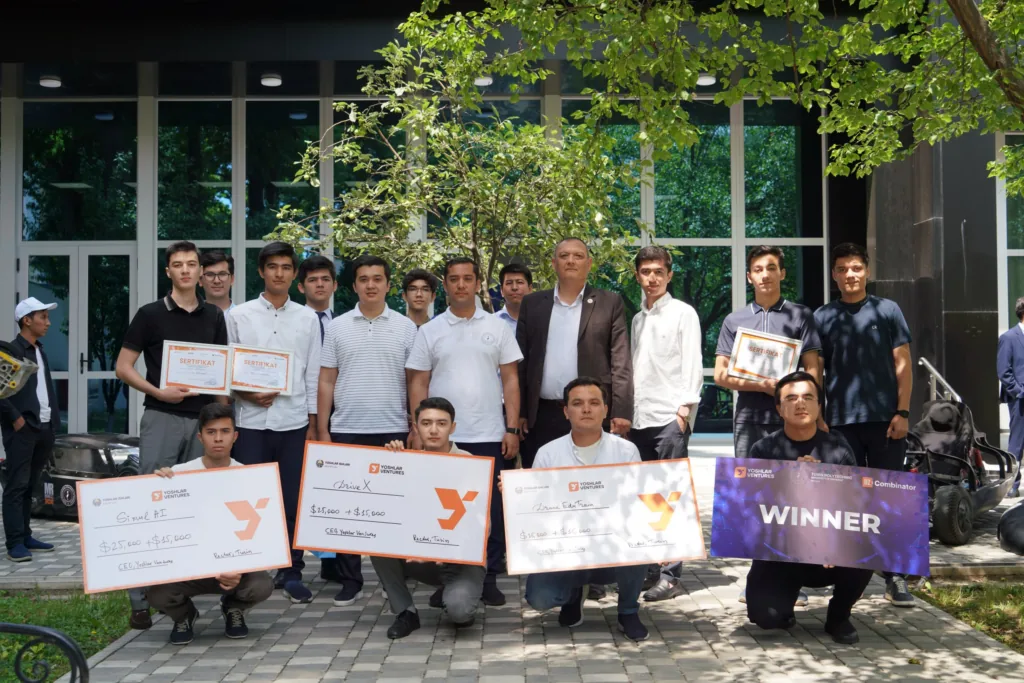
Precedent No. 1: University as a co-investor alongside a venture fund
Together with the Turin Polytechnic Institute in Tashkent and the venture fund Yoshlar Ventures, we launched a pre-acceleration program for students. I served as its organizer, program coordinator, and mentor simultaneously — from developing the program structure and selecting participants to the final demo day.
As a result of the program, the Yoshlar Ventures fund invested in four startups that went through it. But even more important is the fact itself, which had not been encountered on the market before: the university did not just provide a venue and students, but directly invested in these startups alongside the fund.
This is a fundamentally new model. For the fund, I essentially performed the role of a scout — helping to identify promising founders at the very earliest stage, before they appeared on the radar of traditional accelerators. For the university, my role was different: I helped it share investment risk with a professional venture fund, rather than bearing it alone. For the first time, the university acted not as an observer of the educational process, but as a full-fledged participant in the deal — with money and with real risk exposure.
Precedent No. 2: A diploma that includes market evaluation
The second precedent was created in collaboration with TEAM University. Here, the idea was different: fourth-year students spent the entire academic year creating and developing their own startup — not as a one-off course project, but as a full-fledged endeavor spanning two semesters.
I served as the program coordinator and developed the curriculum from scratch together with the university’s dean, Azamat Nurmato, adapting it specifically for this university — its specifics, students, and academic plan. The key difference of this precedent is that the final evaluation of the startups was conducted not by professors, but by real players in Uzbekistan’s venture market — representatives of funds and active investors. And this evaluation was directly reflected in the students’ diplomas.
In other words, the assessment of a student’s knowledge was no longer limited to the university’s framework — it extended to the market and was validated by those who make investment decisions daily.
Why this should become a system, not an exception
Both of these cases share one thing: the “university plus market” connection, where I act as the linking link. I come to a specific university, develop a program tailored to its specialization and specifics, find speakers and mentors among practicing investors and entrepreneurs, and finally conduct a demo day end-to-end — so that the output is not abstract course presentations, but projects that funds are genuinely interested in.
Currently, such programs exist as separate pilots in individual universities. But the problem they solve — the shortage of founders amid an excess of capital — concerns the entire market. If venture literacy becomes part of higher education systematically, rather than episodically, local funds will finally have what they truly lack today: a steady and high-quality influx of new startups and entrepreneurs ready to build them.
The Tech on Telegram Follow The Tech on Telegram
Keep up with the latest technology and startup news.
Related reading




More from this author

Article Useful
How to protect your accounts from hacking: 8 settings you should check today
The Tech

Article Useful
500 Global: How the Accelerator Works and Who Can Receive Investments
The Tech

Article Interviews
Game Development in Central Asia: Arkady Moldavski on Developing Reverb and the Growth of the Industry
The Tech

Article Useful
Google, Tesla, BlackRock, and the IMF: Where to Apply for an Internship in Fall 2026
The Tech

News IT
Tesla unveiled the flying electric car Roadster
The Tech

News IT
Intero Biosystems startup won the Startup Battlefield at TechCrunch Disrupt 2026
The Tech