In Kazakhstan, the National Strategy "Digital Qazaqstan" until 2029 has been adopted.
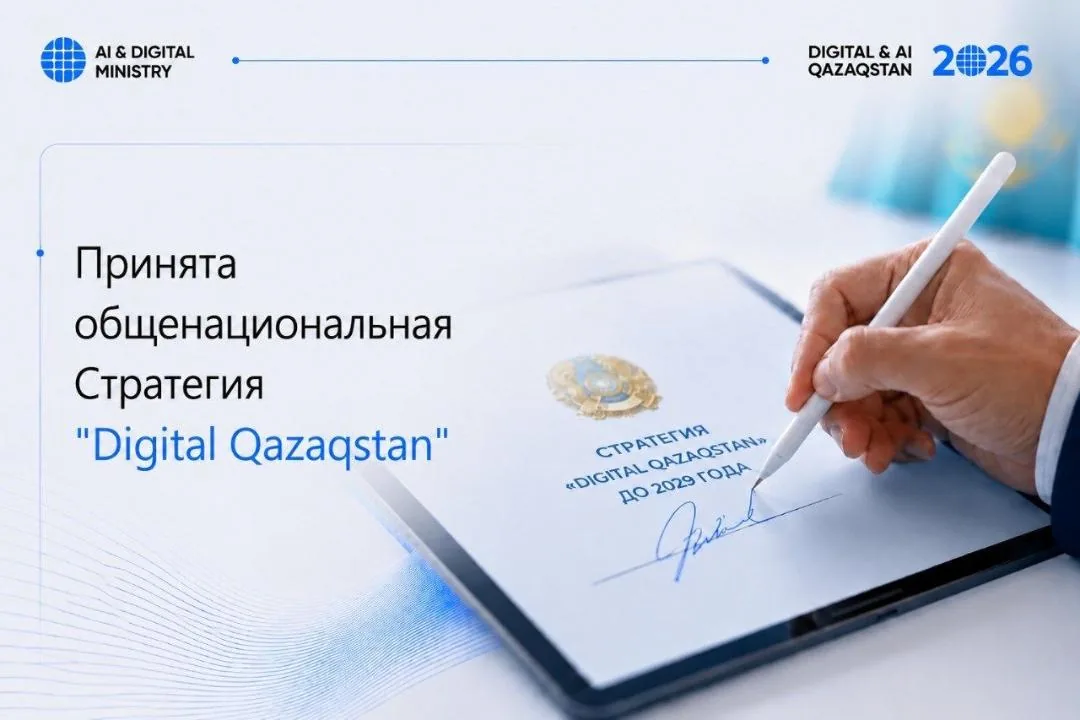
The President of the Republic of Kazakhstan signed a Decree approving the National Strategy for Large-Scale Digitalization and Implementation of Artificial Intelligence Technologies, Digital Qazaqstan, through 2029.
The document becomes the main guideline for the country's technological development in the coming years and defines a new stage of modernization of the state, economy, and society in the context of global digital transformation. The strategy completes the formation of a cycle of institutional documents defining the state's course of action in this area.
Digital Qazaqstan signifies Kazakhstan's transition to a new development model, where data, artificial intelligence, and modern technologies become the foundation of state governance, and the country's digital ecosystem shifts from automating individual services to comprehensive data-driven management.
The new Strategy aims to scale accumulated experience across all key industries. It is expected that the widespread implementation of artificial intelligence and the digitalization of industry, mining, logistics, and energy will provide an additional contribution to GDP of approximately 1.5 percentage points per year on average by the end of 2029, while the forecasted volume of market investments over a three-year period will range from $10.5 to $16.5 billion.
By 2029, Kazakhstan plans to enter the ranks of the most technologically advanced states in the world, strengthening its positions in international rankings of digital competitiveness.
The Head of State of Kazakhstan has set a strategic task to transform Kazakhstan into a full-fledged digital country within three years.
Zhaslan Madiev, Deputy Prime Minister — Minister of Artificial Intelligence and Digital Development of the RK
We are transitioning from the digitalization of individual services and processes to the creation of a holistic digital architecture. For citizens, this means a more convenient and personalized state; for business, increased productivity and reduced costs; for the economy, new industries and enhanced competitiveness. Today, leaders are countries that build a complete artificial intelligence ecosystem — from energy and computing power to national language models and applied services. This architecture is called the AI Economy Stack and includes five levels: energy and infrastructure, computing power, data and large language models, digital platforms, and applied AI services. The creation of such a system is provided for by the Digital Qazaqstan strategy.
Within the framework of the strategy, digital transformation will affect three key areas.
The first area is digitalization for the benefit of citizens. A transition to a continuous life trajectory for individuals is planned, where government services are adapted to the individual needs of each Kazakhstani. Social payments, predictive analytics in healthcare, and pharmaceutical supply management will be consolidated around the "Social Wallet" ecosystem. In education, personalized AI development pathways for children will be launched from an early age, and the level of proficiency in generative artificial intelligence among the population is expected to reach at least 20%.
The second area is for the benefit of business and the new economy. The strategy provides for deep digital transformation of the agro-industrial complex, construction, financial sector, oil and gas industry, and small business through the implementation of artificial intelligence, digital twins, and intelligent platforms. Simultaneously, conditions will be created for the development of robotics, unmanned systems, digital assets, and space technologies.
The flagship project of this area will be the creation of a sovereign AI Hub — a full-fledged "Data Center Valley," which will combine computing power, research institutes, and technology companies. The installed capacity of data centers included in it will be increased to 1 GW. The strategy involves attracting private investments, international companies, and development institutions, which will allow doubling the export of Kazakhstani IT services and bringing at least three domestic "unicorn" companies to the global market.
For the benefit of the state apparatus, a reform of management and a transition to a service-oriented work model are provided, where key government services are delivered proactively and invisibly to the applicant. The process of making government decisions will be shifted to big data analysis, minimizing human factors and managerial errors, and the allocation of budget funds will receive a system of end-to-end digital control.
Great attention in the strategy is paid to cybersecurity: the creation of fault-tolerant digital infrastructure, the implementation of advanced encryption standards, and the protection of critical infrastructure are provided. Smart city standards will cover at least 70% of the urban population, incident response time will be reduced by one-third due to artificial intelligence and video analytics, and a national ecosystem for protecting citizens from online fraud will be deployed.
The Digital Qazaqstan strategy represents Kazakhstan's strategic choice in favor of technology, knowledge, and innovation, creating a foundation for long-term economic growth and strengthening the country's competitiveness in the era of artificial intelligence.
Source: gov.kz
The Tech on Telegram Follow The Tech on Telegram
Keep up with the latest technology and startup news.
Related reading




More from this author

Article Useful
How to protect your accounts from hacking: 8 settings you should check today
The Tech

Article Useful
500 Global: How the Accelerator Works and Who Can Receive Investments
The Tech

Article Interviews
Game Development in Central Asia: Arkady Moldavski on Developing Reverb and the Growth of the Industry
The Tech

Article Useful
Google, Tesla, BlackRock, and the IMF: Where to Apply for an Internship in Fall 2026
The Tech

News IT
Tesla unveiled the flying electric car Roadster
The Tech

News IT
Intero Biosystems startup won the Startup Battlefield at TechCrunch Disrupt 2026
The Tech