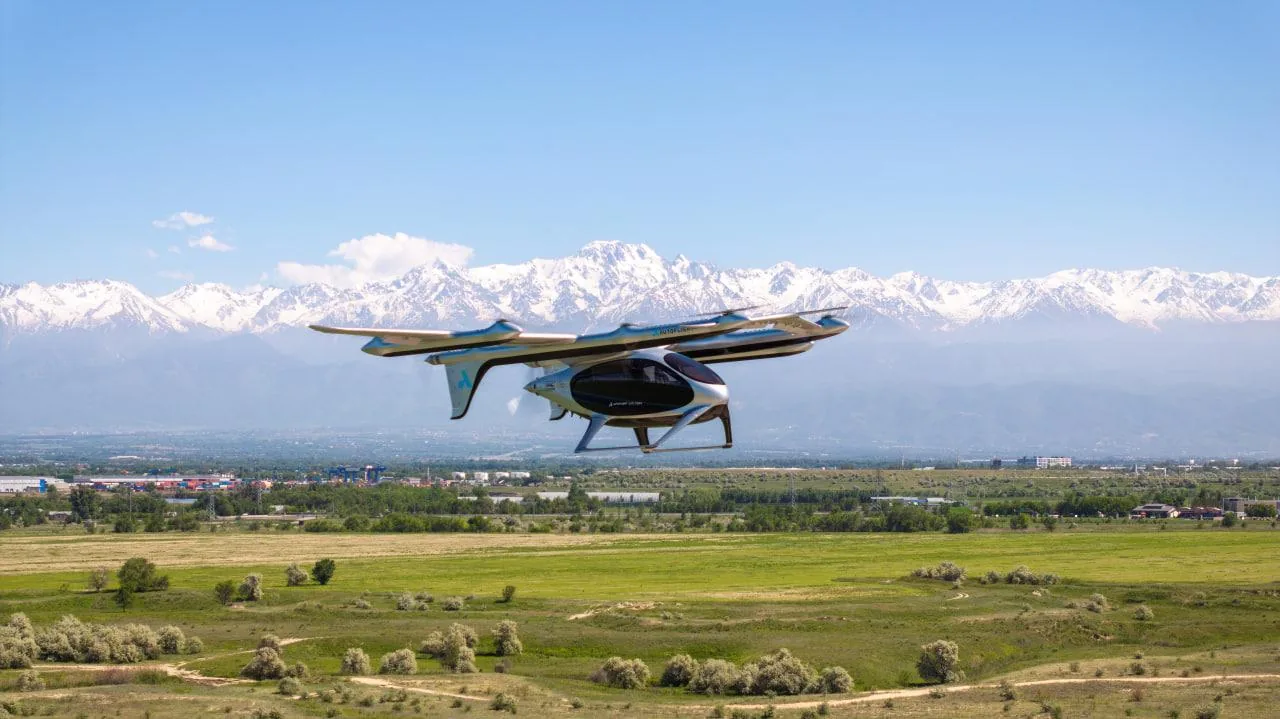
The first demonstration flight of the eVTOL air taxi took place in Alatau City.
Jaslan Madiev, Prime Minister and Minister of Artificial Intelligence and Digital Development Today, Kazakhstan is taking an important step in the development of next-generation transportation. Demonstration flights of eVTOLs show that breakthrough technologies in urban air mobility are gradually transitioning from concept to practical application.
Kazakhstan was the first in the region to present a comprehensive urban air mobility ecosystem: air taxis, delivery drones, and digital navigation.
Kazakhstan has taken an important step toward a technological future: at the Alatau City site, with the support of the Ministry of AI and Digital Development of the Republic of Kazakhstan, the first demonstration flight of an innovative electric vertical takeoff and landing (eVTOL) aircraft, better known as an air taxi, took place.
The project is fully funded by private investments from the Kazakh company Alatau Advance Air Group Ltd. in partnership with leading technology players from the United States, China, South Korea, and Italy. The total investment in the development of urban air mobility in the region is estimated at $300 million.
The highlight of the presentation was the flight of the AutoFlight Prosperity passenger aircraft, designed for one pilot and five passengers. It is equipped with 13 electric motors, reaches speeds of up to 200 km/h, and can cover up to 200 km on a single charge. Unlike traditional aviation, this transport operates almost silently and produces no harmful CO₂ emissions. In accordance with strict international safety requirements, the first test flight was conducted without people on board.
The development of innovative, eco-friendly transport directly aligns with the country’s long-term strategy for digitalization and technological leadership.
For Alatau City, this represents the formation of new smart city infrastructure. We are talking about creating an entire ecosystem—from air taxis and vertiports to digital navigation and cargo drones. This is how the "economy of low altitudes" begins to develop in Kazakhstan.
We are creating conditions for such solutions to enter the country, adapt to our cities, and improve the quality of life for citizens, support business development, and enhance Kazakhstan’s technological competitiveness.
Organizers emphasize that this is not merely about using individual aircraft, but about creating a new industry—the "economy of low altitudes." The event also featured unmanned cargo delivery systems from Keeta Drone and A2Z, managed by the UATM digital navigation platform developed by Korean and Chinese companies. According to forecasts from leading global analysts Morgan Stanley and McKinsey, urban air mobility will become one of the key sectors of the global economy in the coming decades.
To integrate air taxis into the daily life of the region, construction has already begun on the first vertiport in Alatau City—a compact and technologically advanced ground facility for takeoff, landing, and charging aircraft. The design is being handled by the international company UrbanV. In the future, a unified air network will connect Alatau City, Almaty, and key tourist destinations in the Almaty Region. For example, the estimated travel time from Almaty Airport to the high-altitude resort of Medeu will be just 10–12 minutes.
A solid legal foundation has already been prepared for this major technological leap. On May 8, 2026, the Head of State signed the Constitutional Law "On the Special Legal Regime of the City of Alatau," which provides for the creation of experimental legal regimes and special air zones for Urban Air Mobility. Currently, AAAG, together with government agencies, is involved in drafting approximately 40 regulatory acts that form the "air code" of the new city, and corresponding amendments to national aviation legislation are already under consideration by the Mazhilis of the Parliament.
Parallel to the project's development, AAAG signed a memorandum with AutoFlight for the supply of 50 V2000/V5000 series aircraft. This agreement includes not only the purchase of equipment but also full technology transfer, training of Kazakh specialists, and the establishment of a regional technical maintenance and repair center.
Source: gov.kz
The Tech on Telegram Follow The Tech on Telegram
Keep up with the latest technology and startup news.
Related reading




More from this author

Article Useful
How to protect your accounts from hacking: 8 settings you should check today
The Tech

Article Useful
500 Global: How the Accelerator Works and Who Can Receive Investments
The Tech

Article Interviews
Game Development in Central Asia: Arkady Moldavski on Developing Reverb and the Growth of the Industry
The Tech

Article Useful
Google, Tesla, BlackRock, and the IMF: Where to Apply for an Internship in Fall 2026
The Tech

News IT
Tesla unveiled the flying electric car Roadster
The Tech

News IT
Intero Biosystems startup won the Startup Battlefield at TechCrunch Disrupt 2026
The Tech