Shadow AI in Kazakhstani companies: 80% believe in AI, 29% are ready to manage it
80% of CEOs worldwide understand that artificial intelligence will fundamentally transform their industry. Only 29% consider themselves ready to compete under these conditions. This Gartner statistic was presented by Arup Roy, an analyst, at the Kazakhstan Growth Forum '26 in Almaty, as noted in the forum's summary. A similar picture exists in Kazakhstan: according to forum participants, businesses are adopting innovations extremely slowly—only a few companies have revised their strategies up to 2030, taking the AI factor into account.

The Tech AI
Get the key points in seconds - a short summary from The Tech AI.
Aigerim Beisen (PR Manager of Bitrix24 Kazakhstan) explains that the gap between belief in AI (80%) and safe usage (29%) creates "shadow AI." Employees use neural networks as workarounds to speed up their work due to the lack of rules. To address this issue, it is proposed to implement a simple policy, legal alternatives, and start with secure processes, such as within CRM.
Aigerim Beisen, PR Manager at Bitrix24 Kazakhstan
The issue is not that businesses don’t believe in AI. They do—almost universally, as evidenced by the same 80% figure. The problem is that a gap has formed between belief and readiness, and nature abhors a vacuum: employees fill it themselves.
What is shadow AI and why this isn’t about technology
While leadership discusses strategy, a marketer is already pasting customer data into ChatGPT to write copy faster. An accountant uploads a spreadsheet with financial metrics to a neural network—just to have it reconcile the numbers. A manager copies client correspondence into the first AI tool they find because it’s quicker to respond. None of them intend to harm the company. Each is simply doing their job faster—using whatever means are available.
This is what’s called shadow AI: employees using neural networks in violation of company policies or entirely without rules, because the company hasn’t established any. Global research agrees on one thing: uncontrolled use of AI in the workplace is not a hypothetical risk, but something already happening in most companies that believe they’re “fine with AI for now.”
And this is fundamentally not a technical problem. Technology is the easiest part of this story. The difficult part is people, who ended up moving faster than the rules meant to guide them.
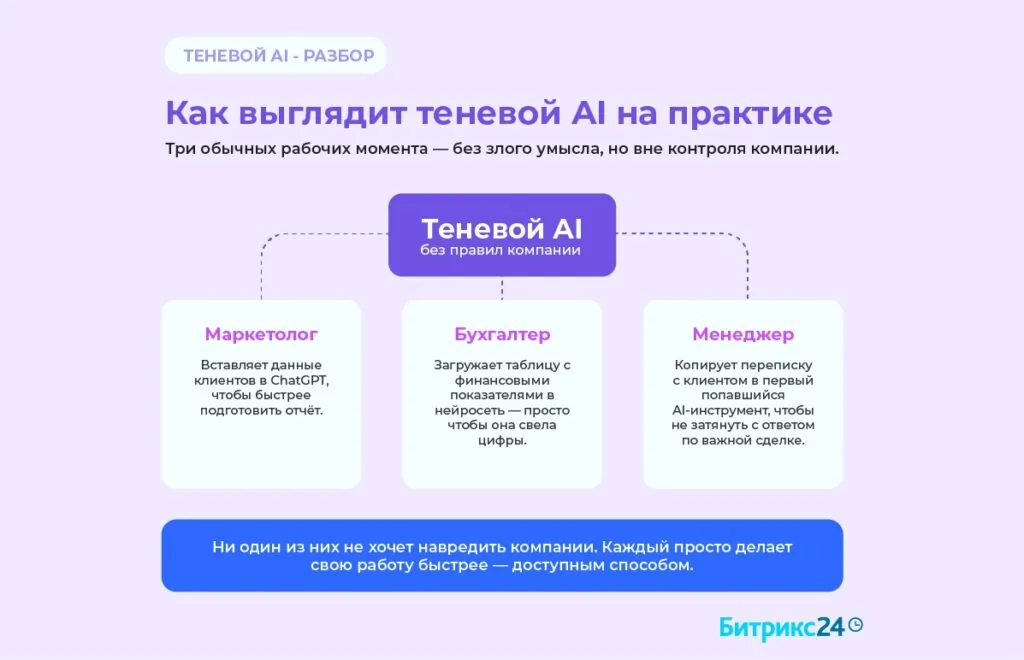
How the 80/29 gap looks in practice
The 80/29 gap is precisely the space where shadow AI lives. 80% believe that neural networks are necessary for business. Only 29% have established processes that allow these neural networks to be used safely. The remaining 51% don’t represent a rejection of AI; it’s AI without oversight.
And the more trendy the trend—vibe coding, autonomous AI agents, assistants that write code or handle client correspondence on their own—the faster employees start implementing it themselves, without waiting for the company to decide how to do it properly. The difference here is not between a company that implements AI and one that doesn’t. The difference is between a company that manages this process and one where it happens organically—without its involvement or control.
The first defines which data can be sent to neural networks and which cannot, and where the freedom of experimentation ends. The second simply waits for employees to figure it out themselves. They do. Just not always in the way one would wish.
What can be done about this right now
Closing the 80/29 gap does not mean banning employees from using AI—that’s precisely the path that exacerbates the problem: a ban doesn’t stop usage; it just removes it from leadership’s view. The opposite works:
— formulate a simple AI policy—not 20 pages long, but fitting on one screen: specify which data must never be uploaded to external neural networks under any circumstances, and ensure this is communicated to everyone who works with data, not just the IT department
— provide employees with a legal alternative instead of a ban. People turn to shadow AI not out of defiance, but because they simply lack an official tool. One approved AI tool integrated into existing work systems addresses the need more effectively than any regulation
— start with processes where AI operates within an already secured perimeter—for example, within a CRM, where customer data is already stored and processed according to company rules, rather than being sent to random external services with every employee request
— don’t leave this to a single department. The 80/29 gap is primarily a management gap: as long as only IT or marketing considers AI strategy, the rest of the company continues to address AI issues ad hoc.
AI CRM CONF 2026: a discussion on shadow AI — October 15
Tatiana Pitolina, CBDO of the Heartland product and technology bureau, will speak about this at AI CRM CONF 2026, in the session “Shadow AI: How to Break Your Business by Following Trendy Fads.” The speaker will explore not only the topic of shadow AI but also how to structure work with artificial intelligence so that it strengthens the business rather than creating risks that leadership discovers only after the fact.
AI operates in the shadows within a company not because employees are hiding something, but because no one told them what they could do openly. This is fixed not by bans, but by rules—provided they appear before employees find ways to bypass them.
The Tech on Telegram Follow The Tech on Telegram
Keep up with the latest technology and startup news.
Related reading




More from this author

Article Useful
How to protect your accounts from hacking: 8 settings you should check today
The Tech

Article Useful
500 Global: How the Accelerator Works and Who Can Receive Investments
The Tech

Article Interviews
Game Development in Central Asia: Arkady Moldavski on Developing Reverb and the Growth of the Industry
The Tech

Article Useful
Google, Tesla, BlackRock, and the IMF: Where to Apply for an Internship in Fall 2026
The Tech

News IT
Tesla unveiled the flying electric car Roadster
The Tech

News IT
Intero Biosystems startup won the Startup Battlefield at TechCrunch Disrupt 2026
The Tech