Bloom's Taxonomy and Engineer Development: Thinking, Efficiency, and Mentorship

The Tech author Muhammad Abdugafarov has previously explored how Bloom’s Taxonomy helps programmers grow consciously and how it can be mapped to engineering levels—from junior to senior. In this article, he takes the next step, showing how this model offers a fresh perspective on engineers’ cognitive development, team effectiveness, and mentoring, moving beyond traditional performance-based assessments.
Muhammad Abdugafarov, city: Khujand, Team Lead, Programmer at Silk Road Professionals, LinkedIn
Why Results Alone Are Not Enough
Most evaluation systems in software development still revolve around outcomes. How many features were shipped, how many incidents were resolved, what is the team’s velocity, and which goals were met—these are often the primary basis for discussions.
But behind all these numbers lies a more important question: How does the team actually think about their work?
Bloom’s Taxonomy, originally designed for education, surprisingly answers this question well in an engineering context. It allows us to look not just at the volume of work completed, but at the depth of thinking behind it. At the end of the article, I will share a link to an interactive website on this topic.
From Results to Thinking
Classic performance reviews encourage visible productivity. Reports show numbers: dozens of tasks, numerous code changes, participation in releases. These are useful signals—but they do not tell the whole story.
Two engineers with the same volume of results may be at completely different levels of thinking. One carefully repeats existing patterns and reacts to problems according to instructions. The other seeks root causes, considers consequences, and designs solutions with an eye toward the future.
Bloom’s Taxonomy provides a language to see and understand this difference.
At basic levels, an engineer memorizes interfaces and rules, understanding the system’s structure.
Next, they apply known approaches to new tasks, analyzing failures and complex situations.
At higher levels, they evaluate alternatives and trade-offs, creating new solutions, approaches, and tools.
And when a review shifts from asking “What did you do?” to “How did you reason through your decisions?”, it becomes entirely different.
A Map of Engineering Maturity
If we map Bloom’s levels onto an engineer’s career ladder, we get a clear map of expectations.
— Junior builds the foundation: memorizing and understanding technologies, terms, and system behavior
— Mid-level begins to take responsibility: applying knowledge independently and analyzing problems
— Senior increasingly works at the level of evaluation and creation: influencing design, decisions, and development direction.
This model is not theoretical. In real work, it becomes a tool for diagnosing and planning growth—for both the team lead and the engineer themselves.
A New Perspective on Reviews
In a review based on Bloom’s Taxonomy, everything starts with a simple action: we look at real examples of work and try to understand at what level of thinking they were performed.
Fixing a bug using a ready-made template is the “Application” level. Analyzing an incident by searching for a systemic cause is “Analysis”. A project proposal comparing several options is “Evaluation”. Creating a common tool or library is “Creation”.
If you look at work over several months in this way, consistent patterns quickly emerge.
Often, engineers reliably operate at the “Application” level: they implement tasks well, fix code carefully, and confidently handle typical problems.
The next step in their growth is not “doing more tasks”, but moving up the level of thinking: analyzing causes, taking responsibility for complex situations, formulating and defending solutions.
Sometimes reviews reveal imbalances. Someone may be good at coming up with new ideas but struggles to explain them. Someone may analyze deeply but avoids making final decisions.
In both cases, it becomes clear what exactly needs further development.
A Common Language for Goals and Feedback
Bloom’s Taxonomy provides a simple and clear vocabulary.
Instead of the abstract “Be more strategic”, you can say: “It’s time to move from executing tasks to analyzing inter-service issues and justifying architectural decisions”.
Such a formulation immediately translates into actions:
— analyzing causes
— comparing options
— explicitly stating selection criteria.
And feedback becomes specific:
— “You navigate the system well; the next step is independent work in new areas”
— “You reliably implement tasks, but growth now lies in analyzing causes, not just fixing symptoms”
— “Your analysis is strong; the next step is to take responsibility for decisions”.
Without vague words and unclear expectations.
Mentoring as Movement Through Thinking Levels
Mentoring becomes much more meaningful if you understand at what level a person is operating.
In early stages, explanations, repetition, and immersion in context are important. Later—practice, feedback, and gradual expansion of independence.
As an engineer grows in analysis, the mentor stops giving ready-made answers and starts asking questions: what changed, where else has this been encountered, what are the alternative explanations?
At higher levels, conversations turn into discussions of trade-offs, risks, and long-term consequences of decisions.
Each such conversation is a step up one rung.
A View of the Team as a Whole
If you look at a team or organization through this lens, collective weaknesses become noticeable.
Incidents are closed quickly but constantly repeat—meaning there is a lack of analysis. Features are released regularly, but the architecture gradually drifts—evaluation of decisions is weakly developed. The team uses others’ tools but creates almost nothing—there is no level of creation.
Bloom’s Taxonomy helps consciously design work so that the team develops:
— documentation strengthens the foundation
— internal talks develop understanding
— owning features develops application
— incident analysis—analysis
— project decisions—evaluation
— new initiatives—creation.
Self-Assessment and Responsibility for Growth
Although Bloom’s Taxonomy originated in education, it has long been used for self-assessment.
A simple attempt to honestly evaluate oneself across the six levels often yields unexpected results. You can see where you are truly strong and where you prefer to stay in your comfort zone.
And then the conversation about career changes. Instead of “I want to grow”, a more precise formulation appears: “I confidently analyze problems in my area and want to learn to make and defend decisions”.
This returns control over one’s own development to the individual.
A Culture of Thinking, Not Just Results
Ultimately, Bloom’s Taxonomy offers a quiet but important shift in engineering culture.
It says that it is important not only how much the team does, but at what level of thinking they work every day.
Teams stuck at basic levels handle routine but get lost in complex situations. Teams confident in analysis and evaluation navigate uncertainty better. Teams capable of creating new things become a source of development for the entire organization.
This shift is especially important in the context of the approaching era of active use of AI tools for writing code. As code generation, autocomplete, and template solutions become increasingly accessible, an engineer’s competitive advantage shifts from the ability to write code to the ability to think about code.
It is precisely Bloom’s levels above simple application—analysis, evaluation, and creation—that become critically important for competitiveness in the labor market. An engineer who understands causes, sees trade-offs, and can formulate new solutions remains in demand even when the routine part of work is automated.
Bloom’s Taxonomy does not replace familiar metrics. It explains them and complements them.
Interactive Website
Based on a series of articles, I prepared an interactive website with a short assessment test. Here you can visually see the competency map, match Bloom’s levels with career expectations, and check which stage you are at right now. This is a convenient way to move from theory to practice and outline the next steps for your professional growth.
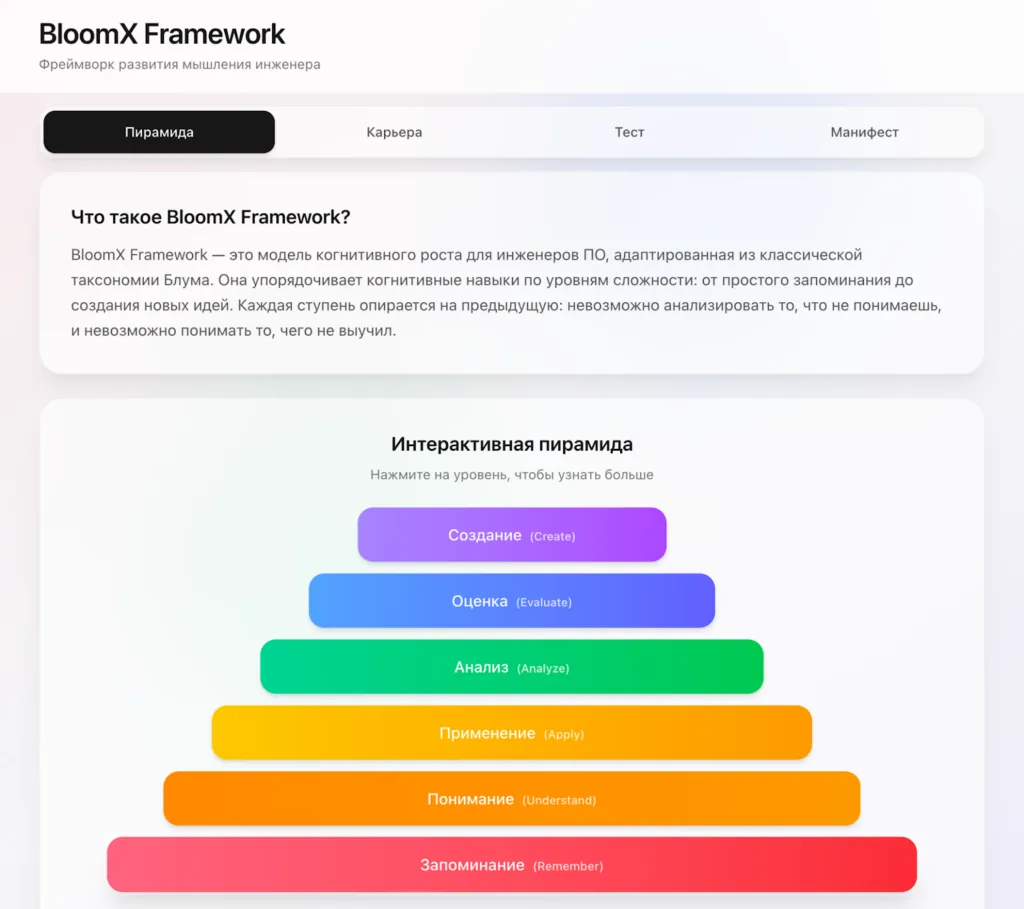
You can try the tool here: bloomx.muhammads.site
In a world where AI is increasingly involved in development, the ability to think deeply and meaningfully about software becomes the most resilient skill. And it is precisely in developing this thinking that this model suggests investing.
The Tech on Telegram Follow The Tech on Telegram
Keep up with the latest technology and startup news.
Related reading






More from this author

Article Useful
How to protect your accounts from hacking: 8 settings you should check today
The Tech

Article Useful
500 Global: How the Accelerator Works and Who Can Receive Investments
The Tech

Article Interviews
Game Development in Central Asia: Arkady Moldavski on Developing Reverb and the Growth of the Industry
The Tech

Article Useful
Google, Tesla, BlackRock, and the IMF: Where to Apply for an Internship in Fall 2026
The Tech

News IT
Tesla unveiled the flying electric car Roadster
The Tech

News IT
Intero Biosystems startup won the Startup Battlefield at TechCrunch Disrupt 2026
The Tech