A developer from Uzbekistan has created a service for automatic conversion of texts to the new Latin alphabet.

The Tech AI
Get the key points in seconds - a short summary from The Tech AI.
Azizullo Temirov created a free open-source service called Alifbo for converting Uzbek texts into the new Latin alphabet. The tool works in the browser, supports Word documents while preserving formatting, and allows conversion between Cyrillic, old Latin, and new Latin scripts. The service is free, requires no software installation, and has open-source code.
Azizullo Temirov, head of the Artificial Intelligence Department at the Ministry of Employment and Poverty Reduction of Uzbekistan, created a free open-source service Alifbo, which automatically converts Uzbek texts into the new version of the Latin alphabet. Alifbo is his personal project, unrelated to the activities of the Ministry. The tool works directly in the browser and also allows converting entire Word documents.
The service emerged against the backdrop of Uzbekistan's preparation for the transition to the updated Latin alphabet. It uses new designations for individual Uzbek letters and combinations: oʻ → ö, gʻ → ğ, sh → ş, ch → ç.
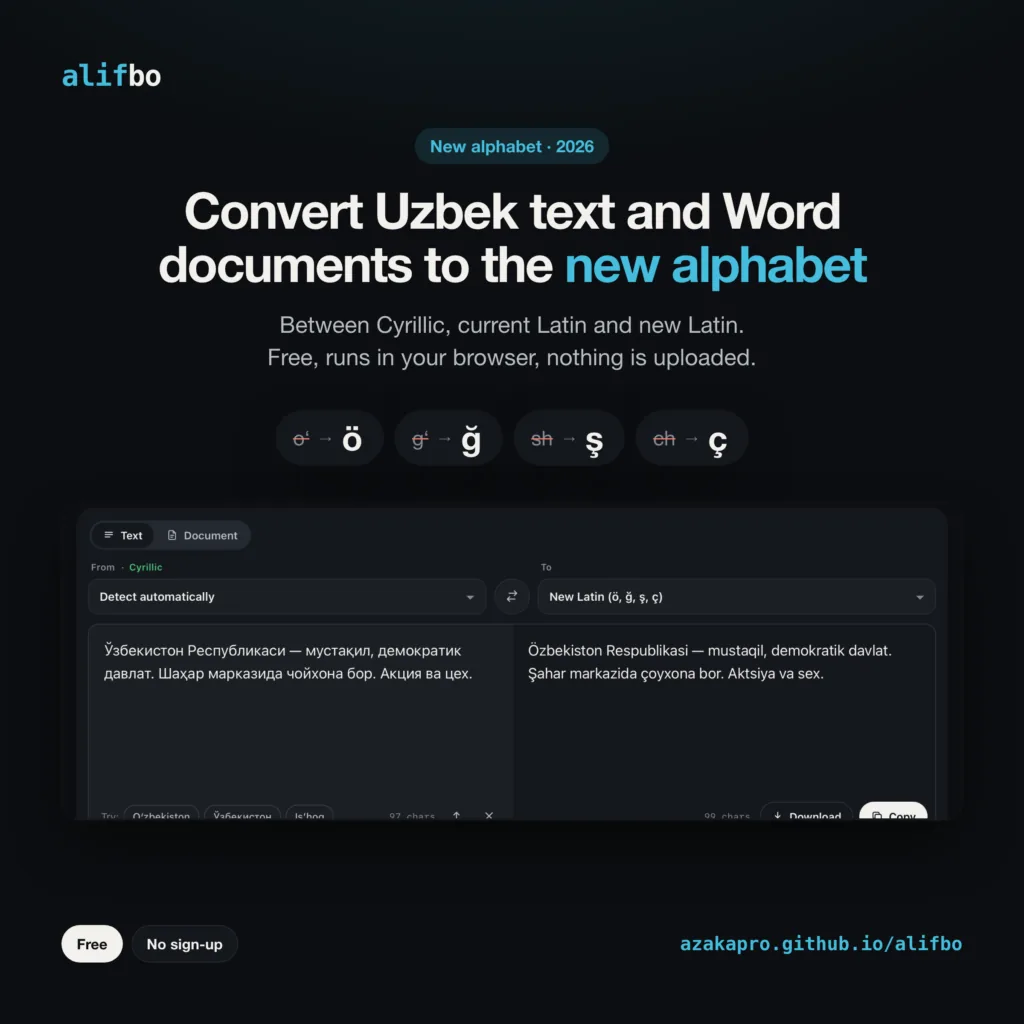
The idea for creating Alifbo came to Azizullo after the announcement of the transition to the updated Latin alphabet. In his assessment, this process will require a significant amount of manual work: thousands of pages of documents, websites, educational materials, and archives written in Cyrillic and the old Latin alphabet will need to be adapted.
Existing solutions did not fully meet these requirements: some require uploading files to third-party servers, others disrupt document formatting, are paid, or support only one direction of conversion.
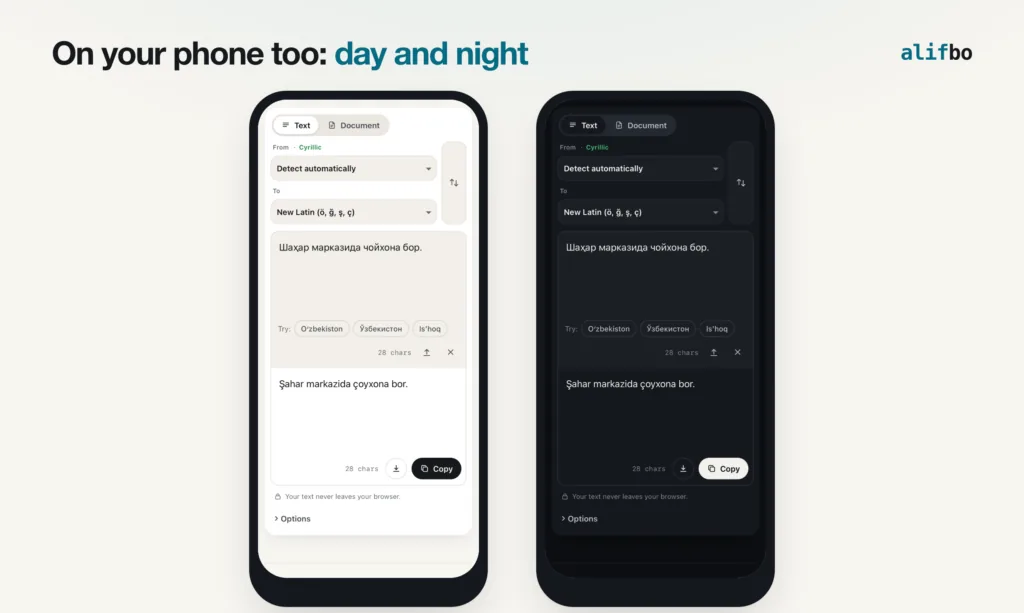
The service supports conversion between Cyrillic, the old Latin alphabet, and the new Latin alphabet in various directions. At the same time, documents do not leave the user's device—all processing occurs directly in the browser. When converting Word documents, the original formatting is preserved: headings, tables, highlights, and footers remain in place. The interface is available in Uzbek, Russian, and English.
The developer paid special attention to cases where automatic conversion might lead to errors. Some letters do not have a one-to-one correspondence between alphabets. For example, the Cyrillic "ts" can be rendered as s or ts depending on the context, and there is no single equivalent for "shch". In such cases, Alifbo highlights ambiguous areas and allows the user to choose the appropriate option manually.
Azizullo Temirov, author of the project Alifbo
The alphabet is a common heritage, not someone's product. The tool for working with it should be free and open so that anyone can check the code, fix errors, or integrate it into their own solution.
Alifbo can be useful for ordinary users, companies, and government organizations. Users can convert old documents, diplomas, resumes, family archives, posts, and other texts without the need to retype them manually.
Since the project's code is open, organizations and developers can independently study it, adapt it to their needs, fix errors, or deploy the system within their own infrastructure. Libraries in JavaScript and Python have also been released for developers, allowing them to integrate conversion into their own systems and process large archives automatically.
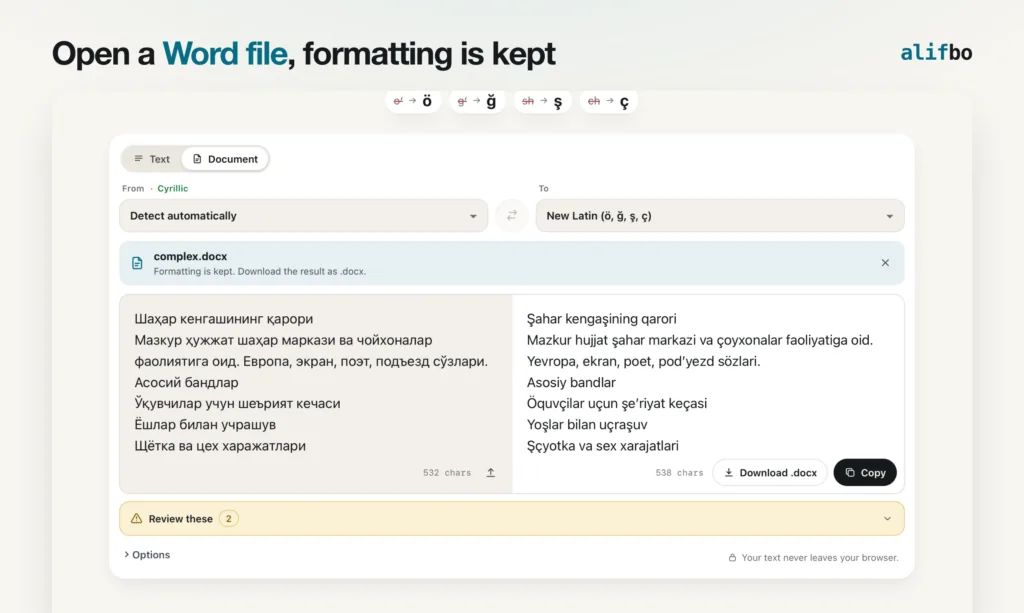
The service works for free and does not require installing additional software.
The service is available here.
The source code is available here.
The Tech on Telegram Follow The Tech on Telegram
Keep up with the latest technology and startup news.
Related reading




More from this author

Article Useful
How to protect your accounts from hacking: 8 settings you should check today
The Tech

Article Useful
500 Global: How the Accelerator Works and Who Can Receive Investments
The Tech

Article Interviews
Game Development in Central Asia: Arkady Moldavski on Developing Reverb and the Growth of the Industry
The Tech

Article Useful
Google, Tesla, BlackRock, and the IMF: Where to Apply for an Internship in Fall 2026
The Tech

News IT
Tesla unveiled the flying electric car Roadster
The Tech

News IT
Intero Biosystems startup won the Startup Battlefield at TechCrunch Disrupt 2026
The Tech