Teenagers from Kazakhstan created an app that outperformed Duolingo
Aleem is a startup that helps people learn English and makes the learning process as personalized as possible. Initially, the project was tested with a mini-app in Telegram, and then the product in the App Store attracted 150,000 users in just three days. Read our first major interview with the team.
Aldar Kuchukov, city — San Francisco, CEO of Aleem, Instagram
How it all started
I am from Almaty, but I have been living in the US for eight years. I have lived in Los Angeles, New York, and Washington, and recently moved to San Francisco, in Silicon Valley, to develop my startup.
The idea for Aleem emerged in the spring of 2025, when my best friend, Asylzhan Altai, moved to Boston. Previously, he created the largest online English language school in Central Asia — GetEnglish, with more than 4,000 students and $100,000 in net profit in 2024. We worked together on the project from August 2023 to February 2024; I handled operations and business processes. After achieving certain results at GETENG, Asylzhan continued to work on it, while I decided to focus on other projects.
A year later, we launched a speaking bot in Telegram. In the summer, we built an MVP — in one month, the mini-app gathered 40,000 users. The concept worked, and we began to develop the project further.
Launching the startup
Aleem offers speaking and writing practice on any topic, drilling tasks — flashcards and exercises — as well as a personalized roadmap. Users can learn words immediately or based on their interests.
By training several skills simultaneously, we collect more data about the user and build the most personalized learning experience possible. Most apps develop only one skill — speaking or drilling — and do not account for writing and reading. We, on the other hand, train all language skills.
We strive to create the experience of a personal tutor: users learn not only within the app but also outside of it — watching videos, reading news and books, communicating — everything becomes part of the practice. Afterward, individual assignments with feedback and error analysis are provided. This makes learning deeper and progress faster.
The app is currently completely free, and we want to keep it that way for as long as possible. It all depends on fundraising: if we succeed, Aleem will remain free. If we cannot maintain free access, a Premium model will be introduced; however, we are looking for monetization options without subscriptions.
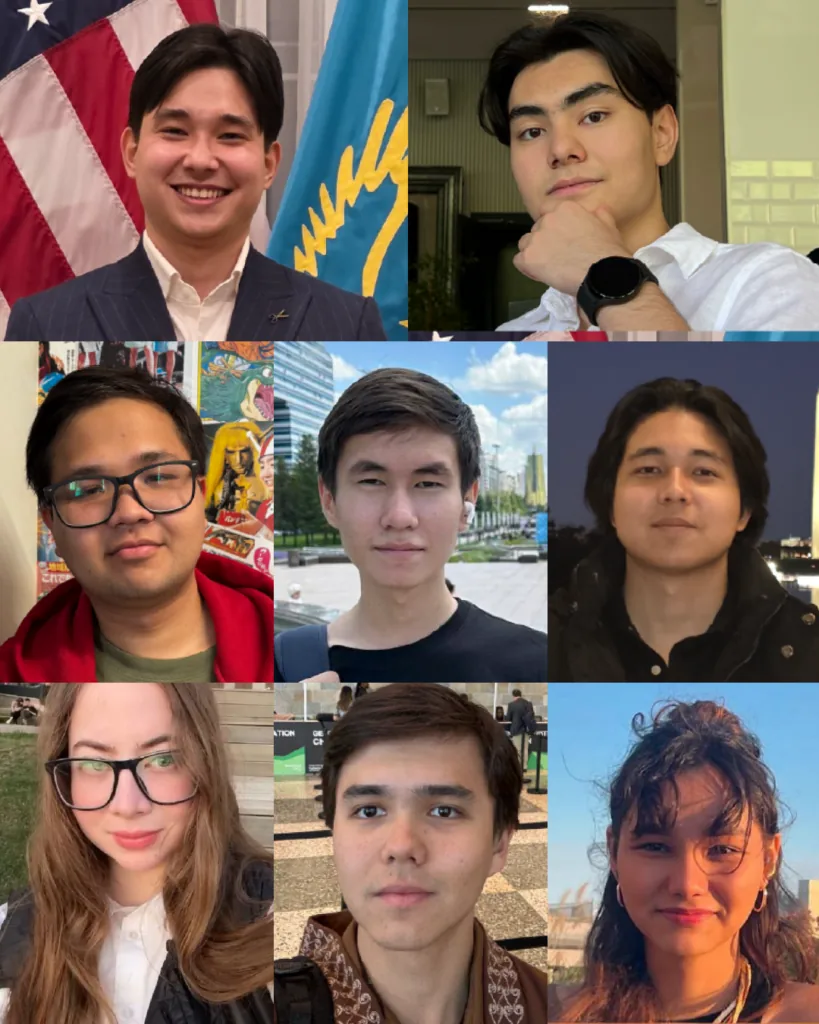
The Team
Today, our team consists of eight people. Each of us combines work on the project with studies or other activities, but we are all united by one thing — belief in the product and the desire to develop it further.
Aldar Kuchukov, CEO of Aleem. I am a serial entrepreneur; I have been involved in startups since I was 17. My first project — a platform for transparent charity on blockchain and NFT — attracted $150,000 in angel investments. After the startup experience, there were many other online and offline businesses. Currently, my focus is entirely on Aleem.
Asylzhan Altai, CMO of the project, studies in Boston on a grant at Hult International Business School. A graduate of NIS, he has gathered more than 700,000 followers on educational content and is a co-founder of GETENG — the largest online school for self-study of English.
Berdibek Saparbekov, COO of the project, studies at Johns Hopkins University. He founded one of the largest SAT and IELTS preparation schools in Kazakhstan with MRR of $47,000 and ARR of more than $600,000.
Temirlan Amanzhanov, CTO of the project, is a student at New York University. Founder of the Ace.it platform and many other educational projects.
Temirlan Temirbayev, founding engineer. Winner of the country's largest Web3 hackathon — Decentraton. Participated in many other projects.
Creativity and design:
— Alen Altai, CCO, co-founder of GETENG. Has three to four years of experience in marketing and design, and his content has gathered more than 400 million views on social
— Amal Sadekova, UX/UI designer, intern at UPROCK — the leading studio in the CIS. Has three years of professional experience in design
— Aiya Zhumagaliyeva, artist and designer, studies at one of the best universities in the world — Parsons School of Design.
Target Audience
Currently, we are targeting advanced users studying English at the A2 level and above, helping them reach the Advanced level. So far, the app is available only to Russian-speaking users, but we plan to localize it into other languages in the near future, primarily Kazakh.
In the first two days, we attracted 100,000 users, and their number is growing every hour.
Incubation Programs
In August, we were selected for acceleration at Alchemist X and Silicon Valley Residency at Silkroad Innovation Hub, Silicon Valley. The program lasts four months — from September to the end of December 2025.
The program does not provide funding but offers housing in Silicon Valley based on Draper University, access to an extensive network of contacts, workshops, and mentors. The participation cost for four months is $5,000 per person — we paid $15,000 for three participants.
Alchemist X is primarily a B2B accelerator. This autumn, we tested a B2B model and realized that it is currently more effective to focus on B2C. In the future, we plan to return to B2B, as there are interesting opportunities there.
At the moment, the startup is funded exclusively through personal savings, and all users come organically. To serve customers, we received grants from Google and Microsoft to use Gemini and OpenAI, which allows us to provide the service completely free of charge.
Difficulties
We faced a number of difficulties and mistakes that slowed down the launch. If they hadn't occurred, we could have launched faster and achieved more. For example, testing the B2B model turned out to be unnecessary, and we immediately switched to B2C. Also, the MVP in the Telegram mini-app did not work in terms of conversion to payment — people are not used to this format. However, retention was at industry-average levels, which confirmed that the concept was interesting to users and the hypothesis was worth testing.
Currently, the most difficult aspect is bootstrapping the project with our own funds as a small team. Additionally, we encountered difficulties in trying to attract investment: we spent a lot of time on fundraising, but due to market changes related to AI, it has become much harder to raise funds based solely on an idea — now specific numbers and metrics are required.
Achievements
Aleem has achieved impressive results in a short time. In the first two days after launch, the app attracted 150,000 users, and in the App Store, it surpassed Duolingo, becoming one of the fastest-growing language apps.
This event became a huge motivation for the team: we are fully immersed in the project, working without sleep, and the results drive us to develop further. At the same time, we continue our successes in streaming and other areas, strengthening the app's position in the market.
Plans
Our plans for the rest of the year — maintaining current growth rates — are to reach one million users.
The main tasks are localizing the app into Kazakh and launching on Android.
We also plan to add new features and improve existing ones, with the main priority being app stability, especially under large user loads. The next step is to expand learning outside the app, so users can develop skills in everyday life, turning every experience into part of the learning process.
In the business direction, priorities are fundraising and expanding the team in Silicon Valley for efficient and coordinated work.
The Tech on Telegram Follow The Tech on Telegram
Keep up with the latest technology and startup news.
Related reading






More from this author

Article Useful
How to protect your accounts from hacking: 8 settings you should check today
The Tech

Article Useful
500 Global: How the Accelerator Works and Who Can Receive Investments
The Tech

Article Interviews
Game Development in Central Asia: Arkady Moldavski on Developing Reverb and the Growth of the Industry
The Tech

Article Useful
Google, Tesla, BlackRock, and the IMF: Where to Apply for an Internship in Fall 2026
The Tech

News IT
Tesla unveiled the flying electric car Roadster
The Tech

News IT
Intero Biosystems startup won the Startup Battlefield at TechCrunch Disrupt 2026
The Tech