The Tech AI
Get the key points in seconds - a short summary from The Tech AI.
OpenAI introduced Dots — autonomous AI agents based on GPT-6 Astra, capable of performing multi-step tasks around the clock and adapting to the user. Each agent operates in an isolated cloud environment with access to more than 4,000 applications via ChatGPT, Slack, Teams, or voice calls. Versions are available for Pro and Business Premium users, as well as a beta version for Enterprise businesses with a limited set of permissions and security controls.
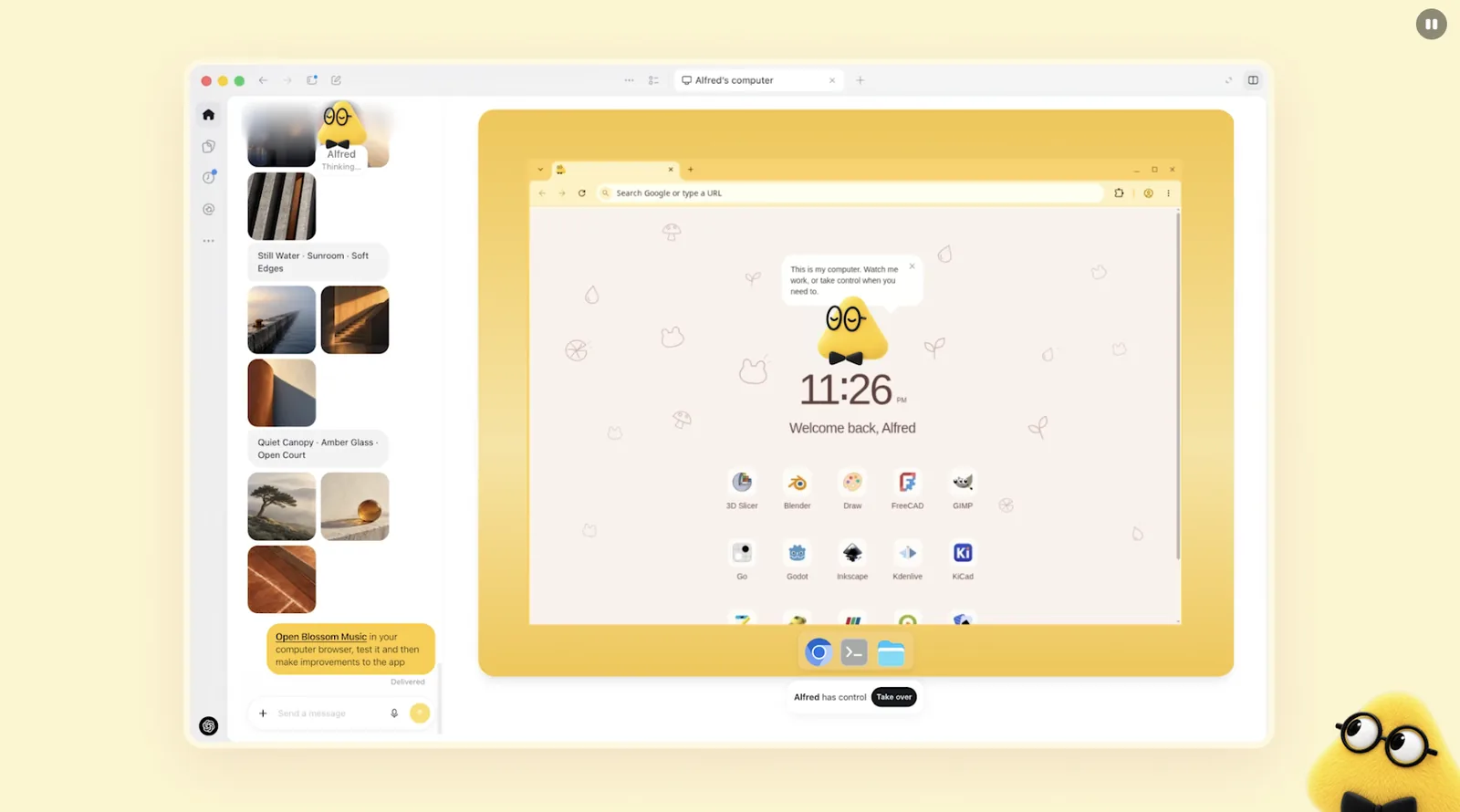
OpenAI introduced Dots — a new type of always-on AI agents capable of independently executing multi-step tasks, managing projects, using applications, writing and testing code, and continuing work without human intervention. Dots can operate around the clock and gradually adapt to user preferences over time.
The key difference between Dots and standard ChatGPT is that the agent receives its own computing environment. Each Dot runs on a separate cloud computer with its own browser and account to manage access and permissions. Meanwhile, users can open the virtual computer to see exactly what the Dot is doing.
By default, the cloud environment is isolated from the user's computer. If needed, a Dot can be connected to the user's own computer, allowing the agent to work directly on the user's device.
Dots are based on the GPT-6 Astra model. OpenAI has also integrated the agents with its own plugin ecosystem, enabling them to work with over 4,000 applications. Interaction with a Dot is possible through ChatGPT, text messages, Slack, Microsoft Teams, and voice calls. Context is preserved across communication channels.
The main feature of Dots is their ability to independently continue started work. Users do not need to keep a chat window open or control every step: the agent can take on a project, execute individual stages, monitor changes, and contact the user only when a decision is required.
For example, an agent can monitor user feedback about an application, identify recurring issues, make code fixes, and prepare them for developer review. However, final decisions regarding changes remain with the user.
In another scenario, the agent monitors product launch preparation. If product specifications or requirements change, the Dot can revise the launch plan, update documents and marketing materials, and prepare changes for human review. For research tasks, the agent can repeat analysis as new data arrives, study unexpected results, and update illustrations and conclusions.
Dots are designed not only for executing specific tasks but also for proactive work. OpenAI refers to this as "proactive research": the agent can access connected applications in the background and look for ways to continue current work. At this stage, such background tools have limited capabilities — for example, they cannot send messages independently, modify application content, or control the user's browser and computer.
The autonomy of Dots is limited by a permission system. The user determines which applications the agent can access and can set rules for individual actions: allowing them automatically, requiring confirmation, or completely prohibiting them. Dots will also ask for confirmation for actions that affect user accounts or may result in information transfer. Some operations, such as password changes, are reserved exclusively for humans by OpenAI.
Dots also have a separate mechanism to protect against potentially dangerous behavior. If the agent detects a security threat, it can pause or completely stop task execution. OpenAI specifically emphasizes that Dots can still make mistakes, so results on which important decisions or actions depend must be verified.
For businesses, OpenAI is preparing specialized versions of Dots. In this case, the agent will receive a separate account, its own credentials, and only the set of access rights to corporate systems necessary for performing a specific role. The company is already testing scenarios for procurement, invoice processing, email marketing, customer support, and commercial contract negotiations.
At launch, Dots are available to ChatGPT Pro and Business Premium users, while an Enterprise beta version is offered for corporate clients. The first Dot is included in plans at no additional cost, and in the future, OpenAI plans to charge a separate monthly fee for adding new agents, increasing their speed, or expanding the volume of work performed.
Source: OpenAI
The Tech on Telegram Follow The Tech on Telegram
Keep up with the latest technology and startup news.
Related reading




More from this author

Article Useful
How to protect your accounts from hacking: 8 settings you should check today
The Tech

Article Useful
500 Global: How the Accelerator Works and Who Can Receive Investments
The Tech

Article Interviews
Game Development in Central Asia: Arkady Moldavski on Developing Reverb and the Growth of the Industry
The Tech

Article Useful
Google, Tesla, BlackRock, and the IMF: Where to Apply for an Internship in Fall 2026
The Tech

News IT
Tesla unveiled the flying electric car Roadster
The Tech

News IT
Intero Biosystems startup won the Startup Battlefield at TechCrunch Disrupt 2026
The Tech