Nvidia has introduced a tool for collaborative work of video cards from multiple computers.
The Tech AI
Get the key points in seconds - a short summary from The Tech AI.
Nvidia has introduced the Personal AI Router (PAIR) to combine graphics cards in a local network. The tool distributes AI tasks among GeForce RTX 20-series GPUs, DGX Spark, and Mac M4+, supporting LM Studio and Ollama. The system works with Windows, macOS, and Linux, automatically disabling devices when they are loaded by the user.
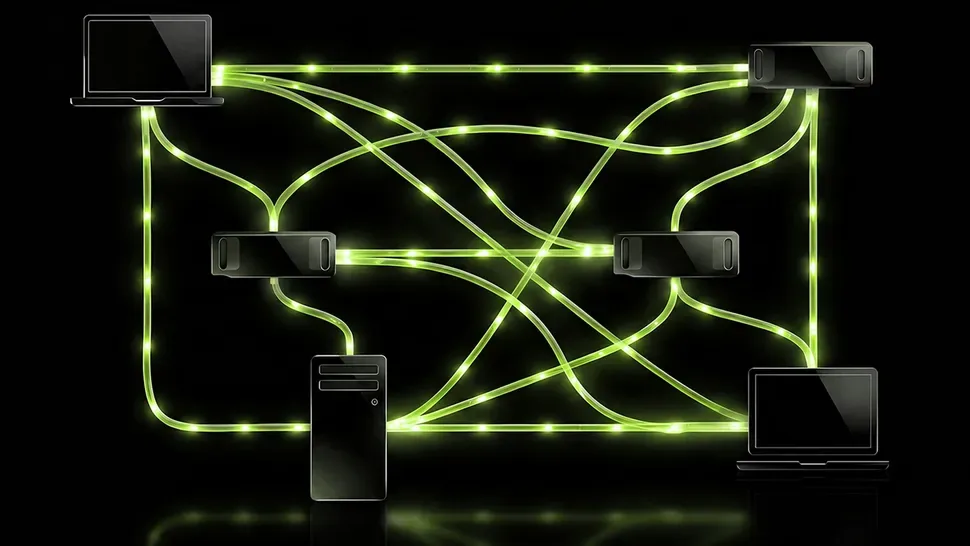
Nvidia introduced Personal AI Router, PAIR — a tool that allows combining GPUs from multiple computers in a single local network to perform artificial intelligence tasks. The solution distributes subtasks among available GPUs and utilizes the idle computing resources of the devices.
PAIR is designed to work with local AI agents. When a user assigns a complex task to an agent, it can divide it into several subtasks. PAIR distributes them among computers in the network if their GPUs have free resources, and then returns the results to the main computer. This reduces the load on a single GPU and potentially speeds up task execution.
The system operates on the principle of elastic resource distribution. If the owner of one of the computers starts using the GPU for gaming, work, or their own AI tasks, PAIR stops relying on the available power of that device. There is no guaranteed task execution time, so the technology is more suitable for long-running processes that do not require strict deadlines.
To connect, PAIR creates proxies for popular local AI platforms LM Studio and Ollama. Devices on the network are discovered via mDNS or IP address, and models can be downloaded to connected computers if necessary. It is not required to have identical models installed on different nodes — having the same model on multiple computers simply increases the number of available nodes for corresponding requests.
PAIR supports computers with Nvidia GeForce RTX 20-series GPUs and newer, as well as systems based on DGX Spark and other devices with the GB10 chip. For local inference, Macs with M4-series processors and newer are also supported. The client will be available for Windows, macOS, and Linux.
Source: tomshardware.com
The Tech on Telegram Follow The Tech on Telegram
Keep up with the latest technology and startup news.
Related reading




More from this author

Article Useful
How to protect your accounts from hacking: 8 settings you should check today
The Tech

Article Useful
500 Global: How the Accelerator Works and Who Can Receive Investments
The Tech

Article Interviews
Game Development in Central Asia: Arkady Moldavski on Developing Reverb and the Growth of the Industry
The Tech

Article Useful
Google, Tesla, BlackRock, and the IMF: Where to Apply for an Internship in Fall 2026
The Tech

News IT
Tesla unveiled the flying electric car Roadster
The Tech

News IT
Intero Biosystems startup won the Startup Battlefield at TechCrunch Disrupt 2026
The Tech