Is a person even needed in IT if there is AI?
Is a human still needed in IT if AI already handles coding, data analysis, and routine tasks? At the beetech conf conference, experts discussed how the roles of specialists are changing in the era of artificial intelligence — and why humans remain indispensable.
Author - Mansur Ismagulov
The Tech AI
Get the key points in seconds - a short summary from The Tech AI.
Experts Mikhail Pasechny, Anuar Makashev, Asem Bolatjan, and Rustem Uspenov note that AI accelerates code development and data processing, but does not replace human creativity and responsibility. IT specialists work more efficiently: one engineer performs the workload of a team of 5–10 people, and the path from junior to middle is shortened. Knowledge of AI becomes a competitive advantage, increasing salaries by 25–50%, and companies are actively hiring interns to implement more than 10 new products per year.
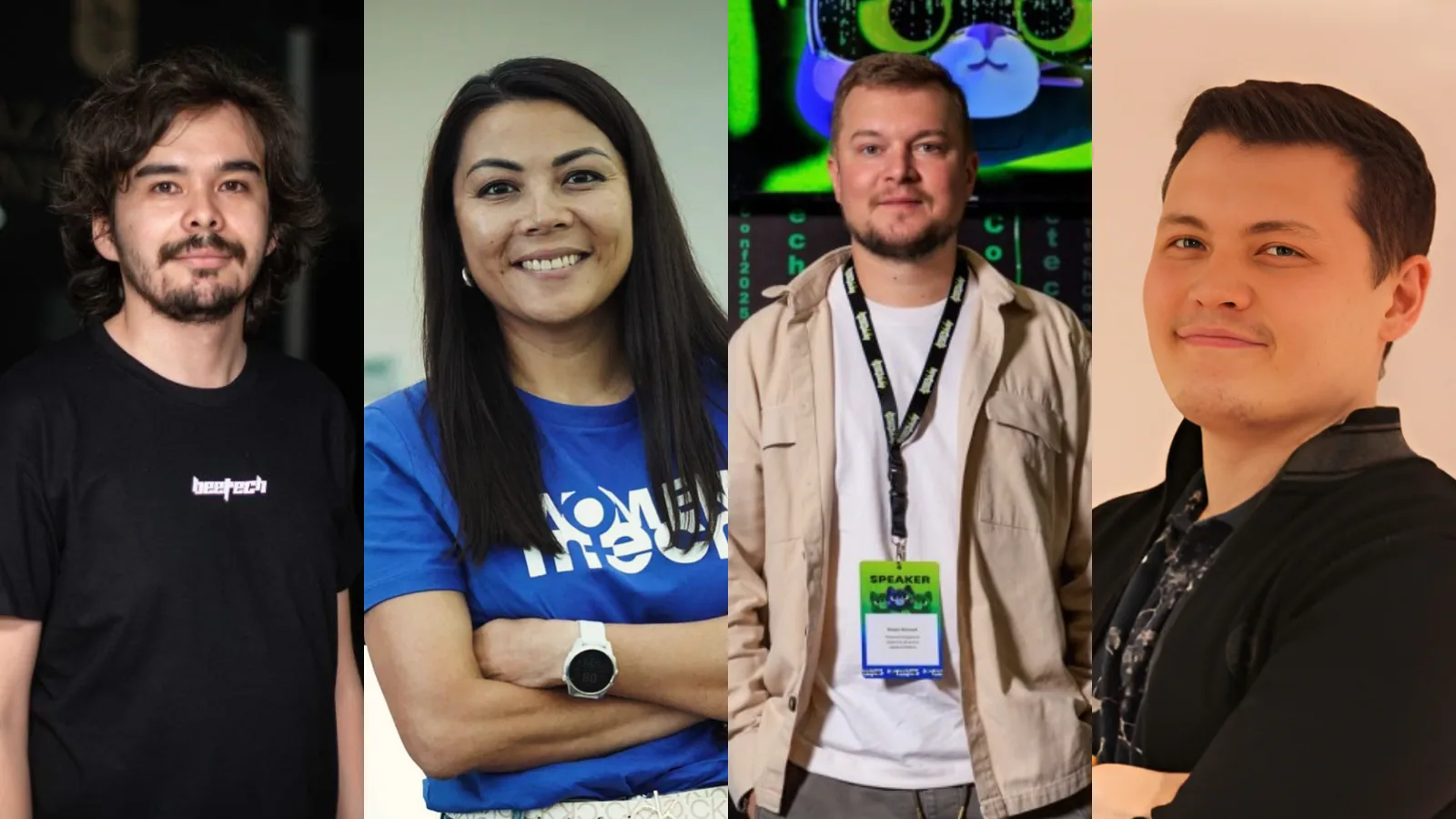
Mikhail Pasechny, Head of Cloud Solutions Development Department at Beeline Kazakhstan
Anuar Makashev, Head of Big Data Projects Department at QazCode
Asem Bolatjan, CEO of Women in Tech Kazakhstan
Rustem Uspanov, CEO of CORE 24/7
What AI already does better than humans
Mikhail. AI is indeed faster than humans at creating code, texts, and collecting data. However, the notion of complete human replacement by AI is controversial.
Some companies, having reduced their workforce in anticipation of full automation, later rehired them — at higher salaries. During that time, specialists mastered AI and learned to use it effectively in their work.
The volume of tasks and data has grown significantly: if an Excel document used to weigh a megabyte per hour, now it weighs 500-600. Manual processing has become more difficult, increasing the risk of errors.
In design and photography, AI helps, but the workload has increased, and the final result still requires human involvement — to add style and emotional coloring.
AI is particularly strong in processing large volumes of data. For example, we use models to identify vulnerabilities in applications and networks. When properly configured, they find everything needed — quickly and in large volumes.
But AI lacks creativity and imagination. Even when creating beautiful images, it does not convey what a human envisions. In voice interfaces, AI may seem like a living interlocutor, but once you step outside the script — it gets lost. It does not pick up on intonations or react to nuances.
This is its limitation: AI currently lacks flexibility and emotional depth.
Anuar. What AI still cannot do — is dream, build strategies, or manage context. Without humans, this is still impossible. IT without strategy and planning does not work.
Yes, you can try delegating this to a GPT chat, but the question is — what will come of it? And who will be responsible for the result? If the algorithm makes a mistake, you cannot sue it. Responsibility always lies with the human.
It is also important to remember about security and ethical aspects — these are serious issues.
Who will be needed in the future team
Rustem. Modern IT specialists are like "steroid-enhanced" professionals: they perform the same volume of tasks, but ten times more. Where a team of 5-10 people used to work, today two strong engineers, or perhaps a product manager and a business analyst with AI tools, can handle it.
This is not about layoffs, but about rising requirements. Specialists will need to constantly learn, keep up with the level, and cope with increased workloads.
Technologies, especially AI, allow for faster growth. If it used to take one and a half to two years to move from junior to middle, today this path can be significantly shorter — especially for those who know how to effectively use AI tools. This noticeably accelerates professional development.
It is important not only to be able to forecast but also to understand technologies, methodology, project structure, and areas of responsibility. Such skills, along with communication and soft skills, will be in high demand.
AI cannot fully take over management due to risks and accountability. It can offer solutions, but the choice always remains with the human. This is especially important in administration. In development, however, it is a different story.
How requirements for specialists are changing
Anuar. According to Stack Overflow statistics, from 2000 to 2017, the number of queries grew rapidly, but with the emergence of advanced language models, interest in the platform began to decline. People started finding information differently and writing code faster.
New professions have emerged, such as vibe coder, and major tech companies have begun removing algorithmic tasks from interviews. Changes are happening quickly, but adaptation has always been a strong suit of humans.
The junior, middle, and senior gradations will remain, but their profiles will change. A junior who uses AI and a senior who applies it effectively are already different specialists. The evaluation approach will change.
Many companies are moving toward practical interviews: candidates are given real business tasks. Someone writes perfect code but slowly. Someone uses AI and solves the task faster. It is important not only quality but also speed.
A logical question arises: how important is it for you, as a hiring specialist, that a candidate knows how to use AI in their work?
Mikhail. When hiring, especially at hackathons where we look for interns, we pay attention to the ability to work with AI. We really need junior specialists — we are ready to develop them within the team. Many of them have grown up with these tools and often know them better than we do. They are easier to adapt and train for our tasks, and in a year or two they become specialists capable of configuring solutions for business and clients.
The number of tasks is constantly growing. Our goal is to release more than 10 new products per year, preferably with AI support. Even teams previously responsible only for infrastructure are now actively being replenished with young specialists and interns. They know how to quickly implement projects: write, deploy, launch. Sometimes the system itself suggests suitable candidates — already trained and ready to work.
Asem. This can be compared to language skills. There are specialists, and there are those who know English — that is an additional 25% to salary. Know Chinese — add another 50%. With AI, the situation is similar: while it is not yet a mandatory requirement, knowledge of these technologies significantly increases the chances of a high income. This is logical, and the market will develop in this direction.
Talented specialists already understand this and are deliberately developing the necessary skills. Over time, this will become the standard.
The Tech on Telegram Follow The Tech on Telegram
Keep up with the latest technology and startup news.
Related reading







More from this author

News
zypl.ai begins operations in Japan and focuses on next-generation risk models
Mansur Ismagulov

News
Elon Musk's net worth has exceeded $700 billion for the first time
Mansur Ismagulov

Article Interviews
"Central Asian countries should build a joint ecosystem," — Bekhzod Ismoilov on the development of AI in the region
Mansur Ismagulov

Article Interviews
Bloom's Taxonomy and Engineering Levels: A Practical Growth Model
Mansur Ismagulov

Article Useful
How the IT industry in Azerbaijan developed in 2025: key events
Mansur Ismagulov

News
Tajikistan has become a new member of the regional innovation alliance Central Asian Innovation Hubs.
Mansur Ismagulov