The Tech AI
Get the key points in seconds - a short summary from The Tech AI.
NASA and IBM launched an open-source AI model, the NASA-IBM Lunar Foundation Model, for analyzing lunar data. The model was trained on 2 million images from the LRO spacecraft over 17 years, as well as data from the GRAIL, Lunar Prospector, and SELENE missions. It enables crater mapping, detection of volcanic formations, and assessment of polar ice stability. The model's results are comparable to or outperform other baseline solutions. The source code and datasets are available on GitHub and Hugging Face as part of the TerraTorch toolkit.
NASA, in collaboration with IBM Research and academic institutions, has launched the NASA-IBM Lunar Foundation Model — an open AI model designed to analyze scientific data about the Moon. The model is available for use on Hugging Face, and its source code is published on GitHub.
The model was trained primarily on data collected by NASA's Lunar Reconnaissance Orbiter over 17 years. Approximately 2 million images were used for training, including more than 1 million high-resolution images with a resolution of up to 1 meter and nearly 964,000 multispectral images with a resolution of 100 meters. Data from the GRAIL, Lunar Prospector missions, and the Japanese SELENE spacecraft were also used in training.
The NASA-IBM Lunar Foundation Model enables researchers to analyze the lunar surface more quickly and adapt the model to various scientific tasks. It can be used to map craters, identify young volcanic formations, and assess the location and stability of ice deposits in polar regions.
A separate area of focus is the permanently shadowed regions near the Moon's poles, where temperatures may remain low enough for ice to accumulate over billions of years. The model helps evaluate where such deposits may be stable on and beneath the surface.
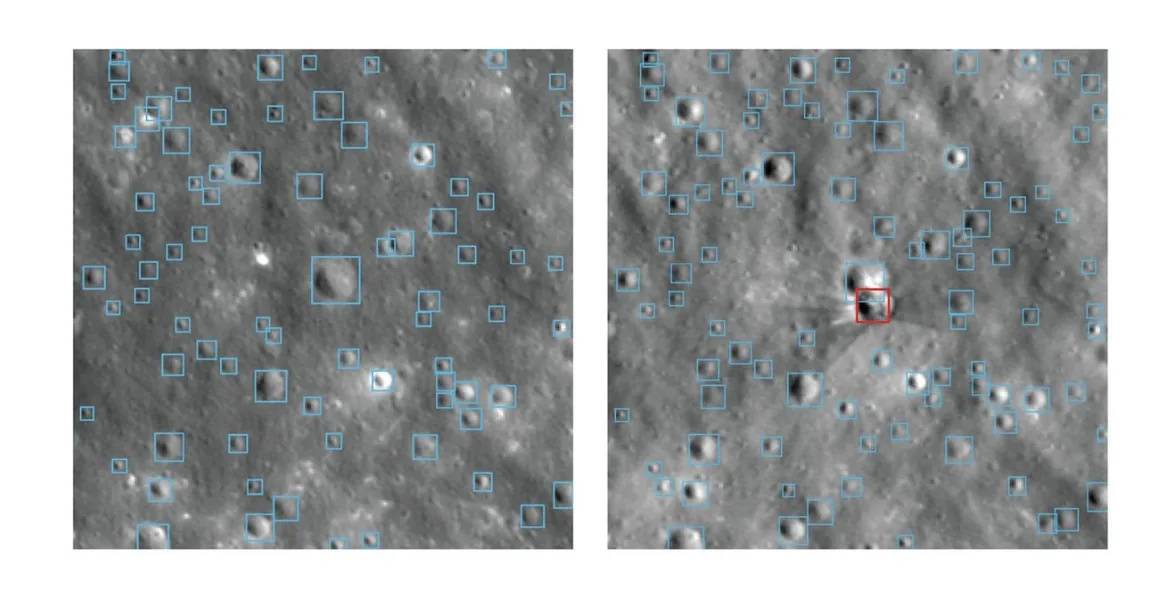
AI is also used to search for and measure craters. In one test, the model successfully detected existing craters and a new impact crater formed after the fall of a space object. Notably, data about the new crater was not used during the model's pre-training.
Testing results showed that the NASA-IBM Lunar Foundation Model performed comparably to or better than several other foundational models. A particularly notable advantage was the accurate determination of polar ice stability.
NASA notes that the model is part of a joint NASA-IBM program applying AI to scientific research. As part of the partnership, models are also being developed to analyze Earth data and predict space weather.
The NASA-IBM Lunar Foundation Model, training datasets, and test sets are publicly available. The model is integrated into the open-source TerraTorch toolkit, allowing researchers to use, compare, and refine it for further lunar research.
Source: science.nasa.gov
The Tech on Telegram Follow The Tech on Telegram
Keep up with the latest technology and startup news.
Related reading




More from this author

Article Useful
How to protect your accounts from hacking: 8 settings you should check today
The Tech

Article Useful
500 Global: How the Accelerator Works and Who Can Receive Investments
The Tech

Article Interviews
Game Development in Central Asia: Arkady Moldavski on Developing Reverb and the Growth of the Industry
The Tech

Article Useful
Google, Tesla, BlackRock, and the IMF: Where to Apply for an Internship in Fall 2026
The Tech

News IT
Tesla unveiled the flying electric car Roadster
The Tech

News IT
Intero Biosystems startup won the Startup Battlefield at TechCrunch Disrupt 2026
The Tech