Kazakhstan has launched a project for artificial precipitation enhancement
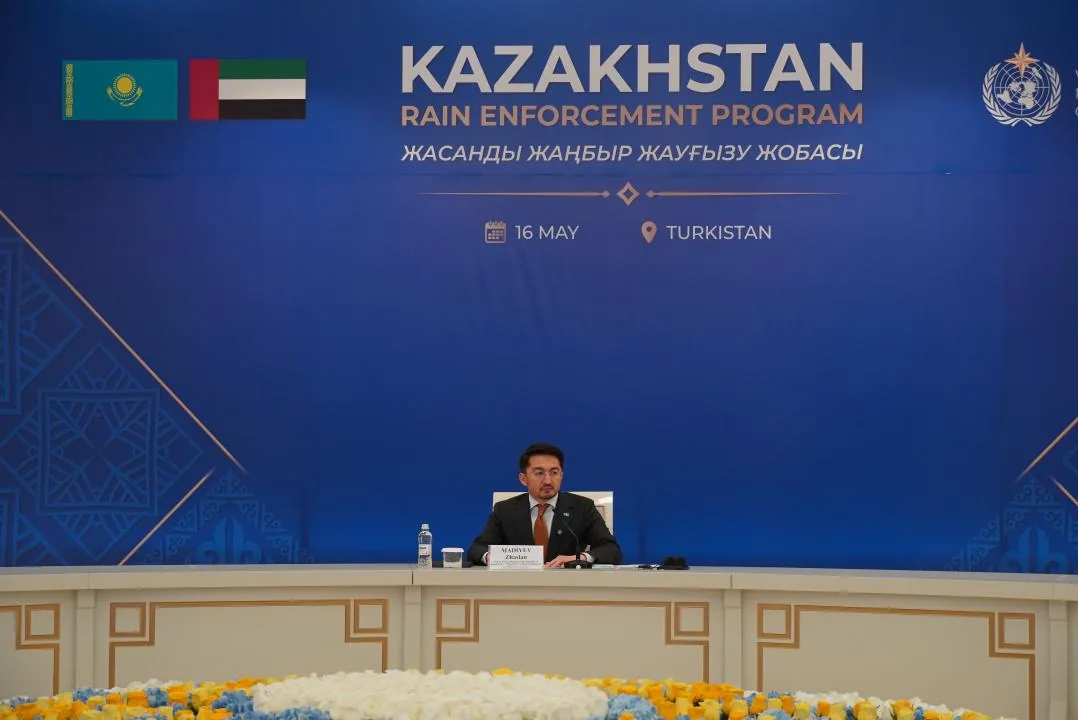
On May 16, 2026, an official ceremony was held in Turkestan to launch the project for artificial precipitation enhancement. Kazakhstan became the first in the region to begin the practical implementation of artificial rain-making technologies.
The main goal of the project is to increase reservoir levels and ensure water resources for agricultural lands in the southern regions of the country. Full-scale implementation of the program begins on May 17, 2026.
The technology aims to mitigate the consequences of drought and water shortages for agricultural areas in the Turkestan region, where the area of arable land exceeds 911,000 hectares. The project is being implemented in cooperation with the UAE National Center of Meteorology, which has decades of experience in weather modification and artificial precipitation enhancement technologies since the late 1980s.
The ceremony was attended by the Deputy Prime Minister – Minister of Artificial Intelligence and Digital Development of the Republic of Kazakhstan, Zhaslan Madiev; the President of the World Meteorological Organization of the UN and Director General of the UAE National Center of Meteorology, Abdullah Ahmed Al-Mandus; the UAE Ambassador to Kazakhstan, Muhammad Said Muhammad Al-Ariki; and the Akim of the Turkestan region, Nuralkhan Kusherov.
According to the Deputy Prime Minister – Minister of Artificial Intelligence and Digital Development of Kazakhstan, Zhaslan Madiev, the launch of the project will be an important step in building the country's climate resilience. Kazakhstan is implementing artificial precipitation enhancement technologies of this scale with international experts for the first time in the region.
According to international assessments, artificial rain-making technologies can increase precipitation volumes by 10–20% compared to natural levels. Similar solutions are already being used in China, the United States, the UAE, France, and Saudi Arabia.
The project will be implemented locally in areas with high water resource needs, primarily on agricultural lands. Work zones are determined in collaboration with specialists from meteorological services and relevant state authorities, taking into account weather conditions, the environmental situation, and water supply needs. The technology has a localized impact with a radius of no more than five kilometers and is not associated with the formation of large-scale weather phenomena. Salts-based reagents used in international artificial precipitation enhancement practices are employed in the work.
It is expected that the implementation of the project will improve the efficiency of water supply for agricultural areas, reduce drought damage, and support increased crop yields. The potential economic effect is estimated at up to 35 billion tenge annually.
As part of the cooperation, specialists from the UAE National Center of Meteorology are training specialists from the Turkestan region in weather modification technologies, including meteorologists, pilots, engineers, and other relevant professionals. The possibility of expanding the project to other regions of Kazakhstan and establishing a foundation for the development of domestic climate technologies is also being considered.
The project involves the Ministry of Artificial Intelligence and Digital Development, the Ministry of Water Resources and Irrigation, the Ministry of Foreign Affairs, the Ministry of Culture and Information, the Ministry of Defense, the Ministry of Agriculture, the Ministry of Transport, the Ministry of Finance, the Ministry of Ecology and Natural Resources, the Ministry of Energy, the Ministry of Emergency Situations, the Akimat of the Turkestan region, the Committee of Civil Aviation, "Kazaeronavigatsiya," and "Kazhydromet."
Source: gov.kz
The Tech on Telegram Follow The Tech on Telegram
Keep up with the latest technology and startup news.
Related reading




More from this author

Article Useful
How to protect your accounts from hacking: 8 settings you should check today
The Tech

Article Useful
500 Global: How the Accelerator Works and Who Can Receive Investments
The Tech

Article Interviews
Game Development in Central Asia: Arkady Moldavski on Developing Reverb and the Growth of the Industry
The Tech

Article Useful
Google, Tesla, BlackRock, and the IMF: Where to Apply for an Internship in Fall 2026
The Tech

News IT
Tesla unveiled the flying electric car Roadster
The Tech

News IT
Intero Biosystems startup won the Startup Battlefield at TechCrunch Disrupt 2026
The Tech