What was the first POCO tablet like?
POCO smartphones have long become synonymous with the combination of good gaming performance and a very affordable price. Now, tablets have also appeared in the brand's lineup. We got acquainted with the first of them — the POCO Pad — and can confidently say that the manufacturer remains true to itself in this segment as well.
Author - Mansur Ismagulov

The Tech AI
Get the key points in seconds - a short summary from The Tech AI.
The POCO Pad is equipped with a 12.1-inch IPS LCD display (1600×2560, 120 Hz), a Snapdragon 7s Gen 2 processor, 8/256 GB of memory, and a 10,000 mAh battery with 33 W charging. The device runs on Android 14/HyperOS, features 8 MP cameras, weighs 571 g, and costs around 150,000 tenge in Kazakhstan. The tablet supports microSD, has a 3.5 mm jack, and supports Dolby Vision/Atmos. It is based on the Redmi Pad Pro platform.
POCO Pad Technical Specifications
Display: 12.1 inches, 1600×2560 pixels, IPS LCD, 120 Hz.
Processor: Qualcomm Snapdragon 7s Gen 2 (4 nm), 4× 2.40 GHz (Cortex-A78) + 4× 1.95 GHz (Cortex-A55).
Memory: 8/256 GB.
Rear camera: 8 MP (f/2.0, 1/4.0", 1.12 µm).
Front camera: 8 MP (f/2.3, 1/4.0", 1.12 µm).
Battery: 10,000 mAh, 33W wired charging.
Operating system: Android 14, HyperOS.
Dimensions: 280×181.9×7.5 mm.
Weight: 571 g.
So, as you can see, the specifications of this tablet are quite impressive, especially considering that it will cost around 150,000 tenge in the Kazakh market. Of course, it was not created from scratch: the Redmi Pad Pro served as the basis for the POCO Pad. But it was precisely the basis. It is impossible to call these devices identical, of course. Even visually.
In general, the design of the POCO Pad is close to ideal: concise, strict, and business-like. Nothing superfluous. All that is on the back cover are two camera lenses and a small POCO logo. The body color is deep gray. By the way, the body itself is made of aluminum, and the front glass is Gorilla Glass 3. The front of the device looks modern thanks to thin bezels on all sides.
The tablet does not have a fingerprint sensor, so the owner will have to enter a code, draw a pattern, or use face recognition. However, there is an option to expand internal memory using a microSD card. This feature is not available on all tablets. Plus, for some, this may be important: the POCO Pad has a 3.5-millimeter jack for wired headphones — it is located at the bottom, next to the USB-C port.
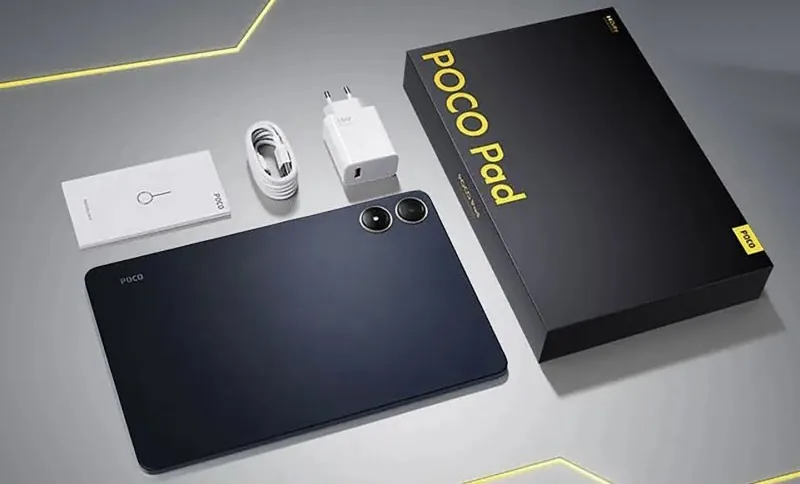
Another convenient feature is that upon first startup, the POCO Pad completely copies all applications from your smartphone, which is very convenient and saves extra time on additional settings.
Despite the rather substantial display, remember, it is 12.1 inches or, if it is easier to understand, 280 x 181.9 mm, the device does not feel bulky. Thanks to the even distribution of mass, it is very comfortable to hold in your hands. The front camera is located on the long right side, so video calls become more convenient when using the gadget in landscape orientation.
As for photos and videos — the cameras are clearly not the strongest side of the POCO Pad. The tablet is equipped with an 8-megapixel rear camera with rather modest specifications: sensor size 1/4 inch, aperture f/2.0, pixel size 1.12 µm. The front camera has exactly the same specifications, but the aperture is slightly simpler — f/2.28. This is quite enough for video calls — everything is at a good level here. You can take a selfie or capture a moment if this is the only available tool. At the same time, the Camera app includes features such as Night Mode, HDR, AI Camera, and Watermark. Video recording can be switched to resolutions from 720p to 1080p.
But here it is necessary to understand that the cameras are not supposed to be the strong side of the tablet. Agreed, a tablet is not the most convenient option for shooting during a walk or some kind of excursion. A phone is preferable in this regard.
Any tablet is, first of all, a device focused on the display. And here everything is in perfect order with this. The POCO Pad screen is a high-class IPS LCD panel with a diagonal of 12.1 inches and a resolution of 2560 x 1600 pixels. The maximum refresh rate reaches 120 Hz, and when adaptive mode is activated in the settings, it will change depending on the content on the screen between 30, 48, 50, 60, 90, and 120 Hz, which helps save energy. The 16:10 aspect ratio makes the tablet convenient in both portrait and landscape orientations.
And of course, it is excellent for multimedia and web content. At least because the display itself supports Dolby Vision for HDR content, and the four POCO Pad speakers support Dolby Atmos, providing good sound quality. So watching videos or movies on it is a pure pleasure.
You can also play games. The tablet is equipped with the Snapdragon 7s Gen 2 processor. Of course, you should not expect outstanding gaming capabilities. But you can run Wreckfest on medium settings.
By the way, if you consider more utilitarian use cases, the POCO Pad can quite well replace a laptop for a while. For example, if for you a vacation is not a reason to completely detach from solving work tasks, then it is the ideal option.
In general, it can already be said with confidence that the POCO Pad has everything to take its rightful place in this segment. The company has once again managed to create a good, high-quality device at a rather democratic price. The starting point has been set, milestones have been marked. We await the continuation.
The Tech on Telegram Follow The Tech on Telegram
Keep up with the latest technology and startup news.
Related reading







More from this author

News
zypl.ai begins operations in Japan and focuses on next-generation risk models
Mansur Ismagulov

News
Elon Musk's net worth has exceeded $700 billion for the first time
Mansur Ismagulov

Article Interviews
"Central Asian countries should build a joint ecosystem," — Bekhzod Ismoilov on the development of AI in the region
Mansur Ismagulov

Article Interviews
Bloom's Taxonomy and Engineering Levels: A Practical Growth Model
Mansur Ismagulov

Article Useful
How the IT industry in Azerbaijan developed in 2025: key events
Mansur Ismagulov

News
Tajikistan has become a new member of the regional innovation alliance Central Asian Innovation Hubs
Mansur Ismagulov