How to get a job at Booking.com: Ayana Almagambetova's experience
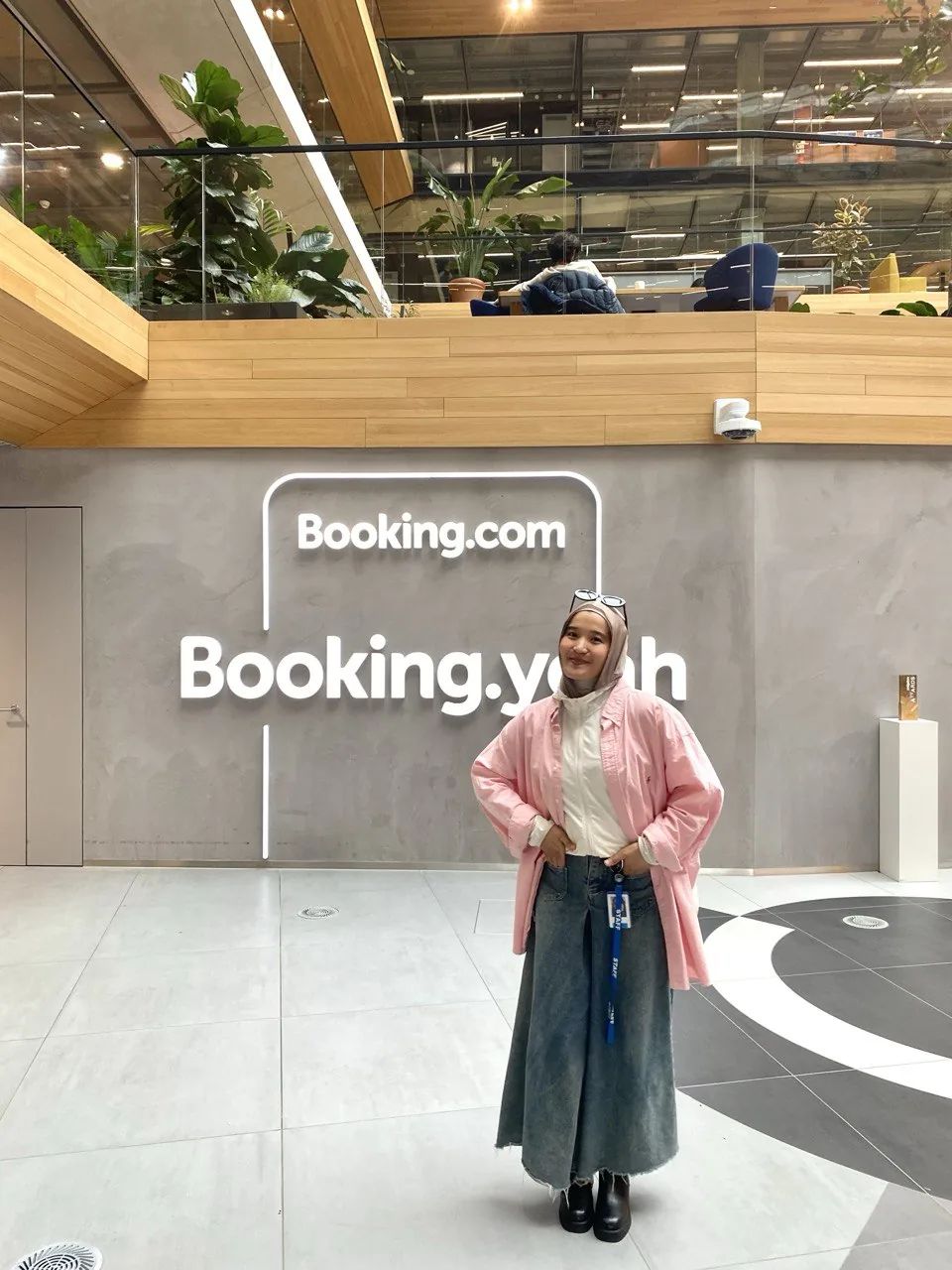
A Senior Data Analyst at Booking.com explained how the company’s selection process works, what skills are necessary for working in an international Big Tech team, and what professional challenges analysts face when creating products for millions of users around the world.
Ayana Almagambetova, city — Amsterdam, Senior Data Analyst at Booking.com, LinkedIn
About me
I have been working as a Senior Analyst at Booking.com for over six years.
Outside of work, I am the founder of the IT Qaimaq movement, a community of Digital Nomads in Kazakhstan. We organize meetings with specialists from Big Tech companies, run competitions for students across Kazakhstan, and develop educational initiatives. Currently, we are also working on a new project to implement programs in universities.
Additionally, I am a member of the industrial committee at KazNU (KBTU), where we help the university determine which subjects and directions are important to add to the curriculum.
How to get into Booking.com
You can get into Booking.com by actively applying for open positions. Do not expect recruiters to reach out to you first; it is important to independently monitor open roles on careers.booking.com and on the company’s LinkedIn page. New vacancies, graduate programs, and various initiatives and projects, including special programs for specific candidate groups, appear there regularly.
The hiring process usually consists of several stages. First, there is resume screening. At this stage, the CV plays a key role: it must be clear, structured, and aligned with the key requirements of the vacancy. However, it is not necessary to meet all requirements completely. If about 60% of the skills match, it is worth applying. It is important to correctly highlight relevant experience, the tech stack, and key competencies; otherwise, even a suitable candidate may not pass the initial screening.
Next comes the HR interview, followed by an interview with the hiring manager, i.e., the future supervisor. Then come technical and business interviews. In the technical interview, professional skills, data handling, analytical thinking, and problem-solving approaches are assessed. In the business interview, understanding of business logic, product thinking, and the ability to work with case studies are checked. The final stage is the cultural fit interview, where the candidate’s alignment with the corporate culture and team work style is evaluated.
From experience, candidates from the region often face difficulties specifically during the cultural fit interview, as the work culture in international companies may differ from what is customary in Kazakhstan.
My personal job search process began with active applications. Resumes were sent daily to various positions, sometimes from multiple devices simultaneously. At some point, I received the first call from a Booking.com HR representative, which became the first stage of screening. The conversation was short and included a discussion of experience and salary expectations.
After that, there was an interview with the future manager. A good professional connection was established immediately between the candidate and the manager, which became an important stage of the process. Then, several interviews were scheduled in one day, which required intensive preparation.
Special attention was paid to studying the company’s business model, key metrics, and potential case studies. Specifically, the click-through rate metric and approaches to its analysis and forecasting were considered.
The technical and analytical interview went quite confidently due to preparation and similarity to previously solved tasks. The business interview was more difficult but generally manageable. The final cultural fit interview included questions about teamwork, conflict management, task prioritization, and interaction with stakeholders.
A few days after the process was completed, I received an official offer.

Tips for those who want to work in an international company
If we narrow it down to Big Tech, first of all, it is important to conduct a SWOT analysis and evaluate your strengths and weaknesses to understand what you want and in what environment you want to develop.
In the international sphere, there is not only Big Tech — there are also large corporations with different work cultures, as well as developing startups, each with its own specifics.
If you want stable growth, development, and training with a relatively stable salary, it is better to consider large companies. If the goal is rapid learning and professional growth, startups are more suitable. In this regard, companies with similar cultures can also be found in Kazakhstan.
If a person wants to get into Big Tech, I would recommend studying the companies’ requirements: what key skills they expect and what competencies need to be developed. I also always advise the “fail fast” approach — starting as early as possible.
Many talented specialists do not apply to large companies for a long time because they consider themselves insufficiently prepared. In practice, this is not so critical. It is much more important to start the application process as early as possible. Even if you do not have time to perfectly refine your CV, it is worth just trying to apply. Any result already provides feedback: if there is a response, you understand what needs to be improved; if there is no response, this is also a signal to improve the resume.
The main idea is to start earlier and learn through experience and mistakes, rather than spending too much time on preparation detached from practice. Many skills in Big Tech become obsolete quickly, so it is important not to delay applying and to develop iteratively, already in the process.
I acted exactly this way: I did not wait for the moment when I would be “fully ready,” but started applying in advance and gradually improved my CV and skills as I gained experience and feedback.

Work specifics
The current project, unfortunately, is under NDA, as it is related to artificial intelligence. Currently, almost all technology companies are focusing on AI implementation, and Booking.com is no exception. My role involves data collection: we develop AI products and use feedback options to improve them based on user reviews. Various technologies are also used, including LLMs, which I worked with less before, so this is a new area for me.
Historically, data in the company was stored in Hadoop, and we worked with it as part of processing large data sets. There was also experience working with Google Cloud — this was an effective tool in terms of speed and stability. The main stack includes Python and PySpark, which are widely used in data science. Also, some specialists use R for statistical analysis, and this language was also used in work.
The main challenge in work is related to interacting with stakeholders. In the process of work, it is necessary to simultaneously take into account the requests of different product teams, engineers, and department heads. Often, tasks come in parallel from several sides with different priorities and deadlines. Under such conditions, it is important to correctly balance the workload, manage expectations, and at the same time avoid burnout.
One of the key skills for overcoming such challenges is resilience — stability and flexibility. This quality is not about rigidity, but about adaptability to changes and pressure. Its development is associated with the formation of basic life habits: quality sleep, balanced nutrition, regular physical activity, and movement. Relationships with loved ones also play an important role. With these “supports,” it is easier for a person to cope with workload and changes. At the same time, difficulties are viewed as a natural part of development that contributes to growth.
The company also has wide opportunities for professional development. Educational platforms are available, including internal training portals and course libraries, such as Udemy, as well as internal learning hub resources. Trainings and knowledge sharing sessions are regularly conducted, led by both internal experts and invited specialists. At the same time, a significant part of learning occurs directly in the process of work, as the technological environment is constantly changing, and continuous skill development is required.
Before working at Booking.com, my main experience was related to research in an academic environment. The key difference lies in data access: in research, it is often necessary to independently search for and request data, go through approval processes. In a large technology company, on the contrary, a huge amount of ready-made data is available, which significantly expands analysis opportunities.
Among the features of working in a large company, one can note a high level of requirements for the result and constant evaluation of efficiency. This is an environment where it is important to maintain productivity and develop, otherwise career growth slows down. At the same time, individual contribution is often a small element within a large system, but it still affects the overall result.
It is also worth considering that large technology companies are sensitive to market changes and investor decisions, including possible layoffs. Therefore, it is important to be ready for instability that may arise at the industry level.
One memorable experience was working in the first team, where the team dealt with a marketing-meta direction. It included about 40 people and accounted for a significant portion of the company’s revenue. The task was to manage bids on advertising platforms and optimize them to ensure maximum visibility and conversion. The work required daily analysis of large amounts of data and quick reaction to external events, such as market changes, seasonal factors, or major events like sports competitions or holidays.

About life abroad
We moved with my husband. Initially, my husband found a job in a startup here. I moved and already looked for a job here. When you are geographically located in the country, it is easier.
Booking.com has always had a good relocation package. It includes visa processing, flights, as well as organization of moving belongings.
To be honest, Kazakhstani technological culture and international culture are becoming increasingly close to international practice. Everywhere, approximately the same approaches are used — Agile and other methodologies. Everyone works in sprints, evaluates tasks for the next one or two weeks, and forms a plan based on this. In general, I observe that Kazakhstani technology companies are gradually approaching the culture of international companies. Therefore, there are fewer and fewer significant differences. The only thing noticeable in a company like Booking.com is the influence of Dutch culture.
Work after five or six o’clock is considered undesirable. I remember staying in the office after 6:00 PM once, and a colleague was surprised and asked me to leave. In the Netherlands, this is perceived as the norm — to finish the workday on time. In Kazakhstan, on the contrary, overtime and later completion of work are more common. This is due to the specifics of the local culture. If the headquarters were located in another country, for example, in the USA, the approach might differ.
It is important to understand why you are moving, because after moving, illusions disappear quite quickly, and real difficulties arise. It is also important to consider that feelings of loneliness, sadness, and homesickness for home and loved ones can persist for a long time. It is necessary to clearly define your goal and intention for moving. If this is considered the main goal and guide, the adaptation process is easier. It is also important to study the laws, safety level, and cost of living in the destination country in advance. We, for example, analyzed these factors in detail before moving to the Netherlands, including financial planning.
It is important to understand that when moving, a person starts practically from scratch — without a familiar environment, social circle, and often with significant changes in lifestyle.
A short-term move, for example, for a year, usually does not provide an opportunity to fully adapt and show oneself in a professional environment. Therefore, such a step is more often considered for at least two to three years. In practice, most people who leave either stay for a longer period or return later without having fully integrated.
The Tech on Telegram Follow The Tech on Telegram
Keep up with the latest technology and startup news.
Related reading






More from this author

Article Useful
How to protect your accounts from hacking: 8 settings you should check today
The Tech

Article Useful
500 Global: How the Accelerator Works and Who Can Receive Investments
The Tech

Article Interviews
Game Development in Central Asia: Arkady Moldavski on Developing Reverb and the Growth of the Industry
The Tech

Article Useful
Google, Tesla, BlackRock, and the IMF: Where to Apply for an Internship in Fall 2026
The Tech

News IT
Tesla unveiled the flying electric car Roadster
The Tech

News IT
Intero Biosystems startup won the Startup Battlefield at TechCrunch Disrupt 2026
The Tech