How a startup from Uzbekistan turned from a simple bot into an AI platform for business in a year
The Uzbek startup Kotib AI began with a simple bot for transcribing Uzbek speech, and within a year transformed into a platform for analyzing calls, chats, and other business communications. Co-founder and CEO Samandar Tursunaliyev shared how the company, without external funding, reached break-even in eight months, attracted around 100 clients, and is preparing to enter its first international market in Azerbaijan.

The Tech AI
Get the key points in seconds - a short summary from The Tech AI.
Samandar Tursunaliyev, CEO of Kotib AI from Tashkent, created a platform for analyzing Uzbek and Russian speech. After a successful pilot with Zoodmall in August 2025, Kotib Analytics was launched, processing over two million dialogues. The product is used by approximately 100 companies, including Oqtepa Lavash and Bellissimo. Over the course of a year, the team grew to 12 people, achieving self-sufficiency without external investments, and is now raising a Seed round to expand into Azerbaijan.
Samandar Tursunaliyev, city — Tashkent, co-founder and CEO, Instagram, LinkedIn
How it all started
I am the co-founder and CEO of Kotib AI. Before that, I spent many years leading XCDM, a studio that developed software for other companies. Kotib was not initially conceived as a startup. It all began with a bot that transcribed Uzbek speech into text. At that time, there were virtually no high-quality solutions for this, so we faced the task of teaching AI to truly understand the Uzbek language.
At some point, Zoodmall reached out to us. Previously, they had tried working with several major players in the speech technology market, but the results did not meet their expectations—primarily regarding the quality of processing Uzbek speech. They were then recommended to pay attention to what we were doing.
Zoodmall had a large call center in Uzbekistan and a task familiar to almost any large business: thousands of conversations every day, but it was impossible to manually understand what was happening in all these calls. They asked us: “You work with voice and AI—can you analyze our conversations and show us what’s going on there?”
We processed their calls through our system and presented the results. It then became clear that the problem was much broader than just recognizing Uzbek speech. Almost any company with a large volume of calls lacks a complete understanding of what is happening in most customer conversations.
We didn’t have a product yet. But we had already identified a problem that regularly arose in business.
Launching the startup
After the first project with Zoodmall, we began to notice that the problem was not unique. We spoke with other companies and heard roughly the same thing: there were too many calls, and managers physically could not listen to all of them, while spot checks did not provide a complete picture.
At that point, we realized that this task could be turned into a separate product. Thus, in August 2025, Kotib Analytics was born.
The first version was very simple. We had no website, no dashboard, and no personal account. The system transcribed and analyzed calls, and we collected the results and sent them to the client in Excel. Essentially, at first, we offered not an interface, but the actual answer to the question of what was really happening in the company’s conversations with clients.
Further, the product evolved together with our clients. They asked us to identify reasons for lost sales, evaluate operator performance according to their own criteria, detect script violations, track objections, and receive reports not on a few selected calls, but on the entire flow. Thus, around the initial analysis of conversations, a full-fledged product gradually took shape.
The Team
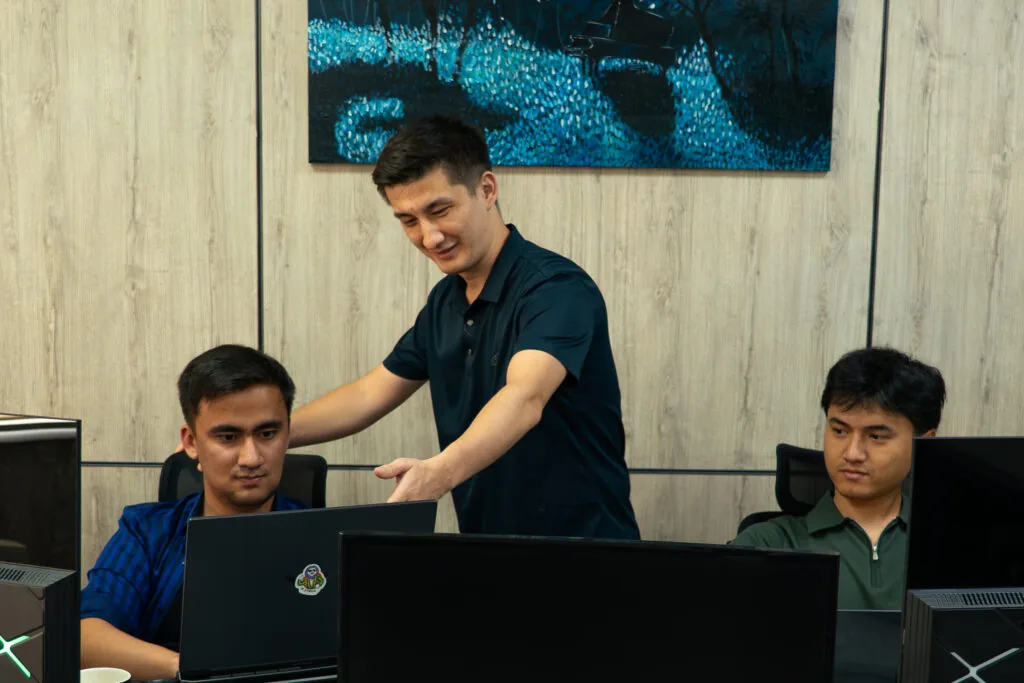
The core of the technical team consisted of people we had worked with before. Sardor Saydamatov, our current CTO, joined me from XCDM. We met Igor Muzykin when he was working at Skillbox, and later he joined Kotib as COO. Asror Hasanov came from TBC Bank, and Tatiana Solodovnikova, our CPO, reached out to us and offered to join the team. Currently, the team has more than twelve people.
In the first year, Kotib Analytics went from an Excel file for one client to a product used by about a hundred companies.
Target Audience
Kotib Analytics is primarily needed by companies where a significant part of sales and service occurs through direct interaction with the client: call centers, sales departments, clinics, developers, retail, and service companies.
This is especially noticeable in Uzbekistan. Many processes still take place in voice format: people call, send voice messages, come to the office, and often prefer to talk to a person rather than engage in lengthy correspondence. Therefore, a significant part of business interaction with clients remains outside CRM systems and reports—directly in conversations.
The problem is that there are too many such conversations for a manager to get a complete picture. You can manually listen to a few calls a day, but that will still be only a small part of the total volume. For example, in one of the branches of the Shoxmed International network, the flow reaches approximately 500 calls per day—processing such a volume manually is practically impossible.
Kotib Analytics makes this segment of business work visible: it analyzes conversations, helps identify recurring errors and objections, determines the causes of lost inquiries, evaluates compliance with standards, and understands which employees need additional training.
At the same time, the product itself has been evolving together with clients from the very beginning. We did not define all its features in advance. Companies came to us with their own scripts, evaluation criteria, and real tasks, and we added tools that were truly necessary in their work. Gradually, analytics began to be used not only for evaluating calls but also for employee training, error correction, and making management decisions.
This process continues to this day. The more companies work with Kotib Analytics, the more real scenarios we see, and the broader the product’s capabilities become.
Today, about a hundred companies work with Kotib Analytics. Among them are Oqtepa Lavash, Bellissimo, Turon Telecom, Shoxmed, Murad Buildings, Apex, Xonsaroy, Max Way, Texnomart, and others.

Challenges
Technologies were difficult. People were even more so.
AI differs from any other software in that it affects the people who work with it. Operators saw that the system was listening to their calls, and the first question was understandable and fair: what does this mean for me personally? The reaction was normal, and initially, we underestimated it—we thought it was enough to agree with the manager.
What we understood: the director signs the contract, but the product lives together with the team. Therefore, now we come not over the employees’ heads, but together with them: we show a tool that helps not miss a deal, rather than a report that looks for errors. When a person sees that the system works for them, the questions disappear on their own.
Advice for those who are starting: do not build a product in a vacuum. Find a company with a real problem and solve it with what you have today—even if manually. We started by giving the client the analysis result in a regular table. The interface, dashboards, and everything else appeared later, when we already knew exactly what people needed.
Achievements
In 12 months, we went from one table for one client to a platform with more than 9 AI agents and about 100 client companies. More than two million analyzed dialogues. We reached zero external funding in eight months. And what we are most proud of: Kotib natively understands Uzbek and Russian, and all data remains in Uzbekistan. We have not encountered solutions of this level for Uzbek on the market.
Plans
We want to take over the entire conversation between business and client—from the first “hello” to the closed deal.
Today, Kotib Analytics listens to calls, chats, and even offline sales points. Kotib Support responds to comments on Instagram and Telegram and to inquiries on the website—without a human in the chain. Kotib Calls answers the phone itself and makes calls itself. Together, this means that every touchpoint goes through Kotib—and works at the level of the company’s best seller on their best day.
Currently, we are raising a Seed round for scaling. The first foreign market is Azerbaijan.
The Tech on Telegram Follow The Tech on Telegram
Keep up with the latest technology and startup news.
Related reading






More from this author

Article Useful
How to protect your accounts from hacking: 8 settings you should check today
The Tech

Article Useful
500 Global: How the Accelerator Works and Who Can Receive Investments
The Tech

Article Interviews
Game Development in Central Asia: Arkady Moldavski on Developing Reverb and the Growth of the Industry
The Tech

Article Useful
Google, Tesla, BlackRock, and the IMF: Where to Apply for an Internship in Fall 2026
The Tech

News IT
Tesla unveiled the flying electric car Roadster
The Tech

News IT
Intero Biosystems startup won the Startup Battlefield at TechCrunch Disrupt 2026
The Tech