How to turn an idea into a startup: all Antler Academy courses on one page
Every startup begins with an idea—but to turn it into a successful business, you must go through many stages: from identifying a problem and its solution to securing funding and building a team. Antler Academy has compiled a library of tools and advice from experienced entrepreneurs to help you at every step. Here’s what each course offers and how it helps a startup founder.
Author - Mansur Ismagulov
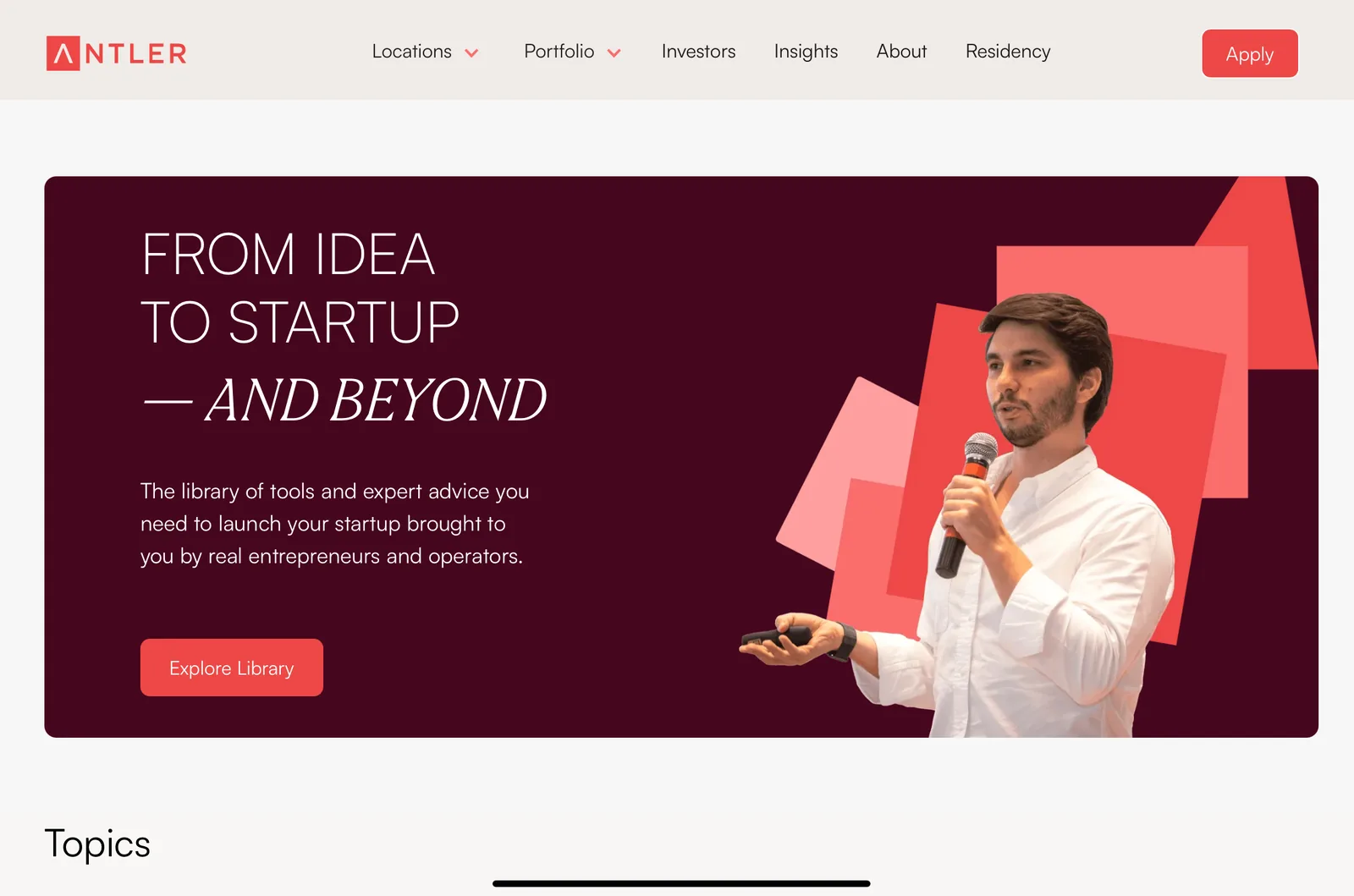
Antler Academy — a project of the global venture fund Antler, operating in dozens of countries. The fund is known for investing in early-stage companies while simultaneously building infrastructure around them—mentorship, networking, and expertise.
The page covers 11 topics. Each topic is a concentration of practical materials, checklists, and concise guides. Below is a condensed breakdown of each and a route that can be put into practice.
Ideating
Most founders start with ideas that interest only them. Antler proposes a different approach—starting with a problem. The course teaches you to find real pain points rather than inventing "unique solutions" without demand. After completing it, you will have one clearly formulated market assumption and a hypothesis that can be tested, rather than just discussed over coffee.
Validating
Here, you learn how not to fall in love with your idea but to test it maturely. From initial interviews to mini-experiments with an MVP. The course teaches you which signals count as evidence and which are noise. The result is an understanding of whether it’s worth building further or if it’s time to throw it out and start over.
Marketing
Antler’s marketing is not about "branding" and "strategies," but about initial conversions. The course shows how to articulate the product’s value, test channels, and avoid wasting a single cent. Afterward, you will have a concrete channel map and initial metrics that actually matter.
Strategy
If the idea is validated, the most tedious part begins—strategy. Yet, this is where startups most often fail. Antler breaks down how to build a business model, manage finances, and understand where the project has a chance for growth. Without this, there is simply no point in moving forward.
Finance
Instead of boring finance lectures, this is a step-by-step course: how to calculate runway, equity, and funding needs. Here, you learn to understand when money will run out and how much is needed to survive until the next round.
Product
One of the most useful blocks. Here, you learn how not to get bogged down in features and not to build a product for the sake of building. ICE and RICE frameworks, initial product metrics, and an approach to feedback—all to ensure the MVP is minimally viable, not just "something we’ve been testing for a year."
Legal
Legal issues may not sound romantic, but they break startups more often than poor marketing. Antler covers the basics: how to formalize relationships between co-founders, what to include in an option scheme, and how to protect intellectual property.
Fundraising
Here, you learn what a pitch deck looks like, what you should definitely not say to VCs, and how to formulate your ask. Instead of advice like "be confident," you get examples of deals, communication structure, and pitch practice.
Team
Team is one of the most practical parts. The team is what makes or breaks a startup. Antler explains how to find co-founders, define roles, and keep the team sane when there’s no money and deadlines are looming.
Pitching
A short but powerful course: how to structure a pitch, convey the essence of the project, and answer uncomfortable questions. It all comes down to one thing—if the investor doesn’t understand what you’re doing within a minute, the problem is not theirs.
Competition
The course breaks down how to analyze competitors based on substance rather than website descriptions. Not just "who has which features," but who is truly solving the same problem for the same audience. It shows how to build competitive maps, identify weak spots in the market, and turn competition into a growth benchmark rather than a reason for panic.
The Tech on Telegram Follow The Tech on Telegram
Keep up with the latest technology and startup news.
Related reading







More from this author

News
zypl.ai begins operations in Japan and focuses on next-generation risk models
Mansur Ismagulov

News
Elon Musk's net worth has exceeded $700 billion for the first time
Mansur Ismagulov

Article Interviews
"Central Asian countries should build a joint ecosystem," — Bekhzod Ismoilov on the development of AI in the region
Mansur Ismagulov

Article Interviews
Bloom's Taxonomy and Engineering Levels: A Practical Growth Model
Mansur Ismagulov

Article Useful
How the IT industry in Azerbaijan developed in 2025: key events
Mansur Ismagulov

News
Tajikistan has become a new member of the regional innovation alliance Central Asian Innovation Hubs.
Mansur Ismagulov