How to Find an Investor. Managing Partner of UzVC, Abdulazal Toshkhuzhaev, on New Priorities of the Venture Market

Managing Partner of UzVC, Abdulazal Toshkhujayev, shared how he selects startups, the problems founders most often face when raising investment, and which projects have the best chances of success.
Abdulazal Toshkhujayev, Managing Partner of UzVC, LinkedIn
About Me
I am the Managing Partner and simultaneously Deputy General Director of the UzVC venture fund, which currently operates as a “fund of funds.” In my role, along with my colleagues, I handle a wide range of tasks, including investments in venture funds, direct investments in startups, as well as organizing and developing incubation and acceleration programs, conducting educational events, masterclasses, and other initiatives. In fact, we cover all key areas related to the development of the venture ecosystem.
Additionally, I was a serial entrepreneur, and I have my own DeepTech startup. Throughout my career, I have engaged in various activities: I worked in the EdTech sector, managed a restaurant business, collaborated with private companies, and worked in large corporations, including state-owned corporations and export-oriented organizations.
After that, I received several offers related to participating in projects of the Ministry of Innovations. I worked for some time at the Ministry of Innovations, where our team laid the foundation for the project to create the first venture fund in Uzbekistan — UzVC. Later, I moved to the venture fund and was involved in its development from the very beginning.
About Investments
When investing in startups in the region, many different problems arise. One of the most notable is the dilution of startup founders’ shares by previous investors who were not venture or angel investors, but rather classic investors. Such investors took at least 30% of the company’s shares, and in some cases, we had to explain that this was a technology company where the share should depend on the contribution to business development.
Furthermore, one of the main problems is the insufficient understanding by founders of their market. They are capable of developing products, and there are many talented specialists among them; however, issues with product-market fit and a focus on custom development arise regularly.
One of the most successful projects in our portfolio is the startup TASS Vision — it was UzVC’s first investment in 2022.
Today, TASS Vision remains one of the strongest assets in the portfolio, along with startups such as zypl.ai and several other projects. Currently, there are about 14 startups in the portfolio, of which 3-4 are showing good performance. There is an expectation that at least one of them will fully cover the invested capital.

Startup Selection Strategy
Initially, given the high level of risk and the fact that we were among the first players in the market, we consciously took a balanced position. An additional factor was that we manage state funds, which required a particularly conservative approach to investment decisions.
Our priority was startups at the MVP+ stage — projects with a ready minimum viable product and confirmed, albeit small, traction, including initial revenue. We focused on boosting their growth through networking, promotion, educational programs, and facilitating additional funding. This is where we saw and continue to see our key expertise and competitive advantage. Investments in projects at the idea stage were extremely rare.
With our transformation into a fund of funds, our strategy has evolved toward building a full-fledged venture ecosystem, in which a sequential chain of startup development at different stages is formed.
Starting next year, we are launching incubation and pre-acceleration programs in partnership with TechStars. At the same time, we plan to enter other venture funds as investors, provided they have their own acceleration programs that ensure further development of startups.
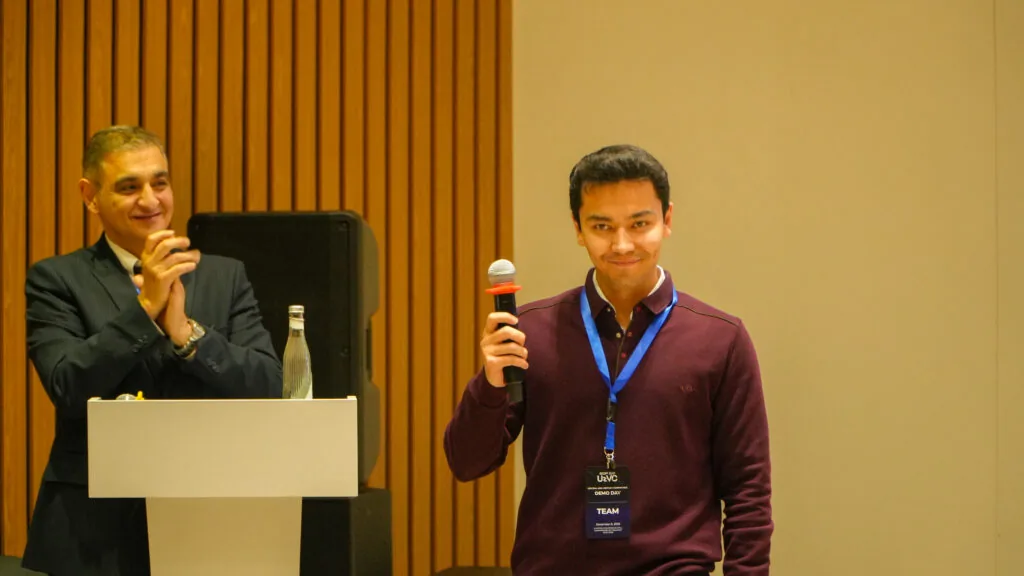
Additionally, on December 5, the demo day of our flagship acceleration program, UzVC SGP 2.0, took place. We plan to conduct this program annually, involving mentors from the USA, Silicon Valley, and MENA. During the demo day, an agreement was also signed with Big Sky Capital. This became the second foreign venture fund we invested in. The first was the Dutch fund DOMiNO Ventures, in which we acted as the anchor investor. The second fund we are entering jointly with Alem Ventures Fund is Big Sky Capital. The total planned investment volume is up to $12 million. Our individual commitment to this fund is $2 million; the decision to participate was made considering the fund’s progress and the high level of trust.
Investment Size
Currently, we cannot invest in foreign startups due to legislative restrictions on capital outflow and requirements for special permits. We take into account that starting next year, there will be an opportunity to invest in American startups, which is beneficial for our projects — in such conditions, it is worth considering relocating the headquarters to Delaware. In these conditions, our activities are built around three priority areas.
The first area is Uzbek startups that begin operational activities in Uzbekistan, then scale to international markets, and at a later stage relocate their headquarters to jurisdictions such as Delaware, Dubai, or Singapore.
The second area is working with the technological diaspora. This refers to entrepreneurs of Uzbek origin who develop startups in the USA and other countries, while opening subsidiary companies or branches in Uzbekistan and conducting operational activities in the local market.
The third area is foreign startups entering the Uzbek market. We also invest in such projects, as evidenced by examples like zypl.ai, Cargon, and several other companies.
Our average investment check ranges from $50,000 to $150,000. In addition to financial support, we offer a comprehensive system of educational programs. If a startup has a strong idea and a team capable of implementing it, we support the project from the early stage through the incubation program, and then through acceleration.
We have access to a developed mentor pool, a wide network of investors, as well as partnerships with venture and corporate funds. This allows startups not only to raise funding but also to commercialize solutions and integrate products into corporate and industry systems.
Additionally, we work in the B2G segment, interact with government structures, and provide support to startups in this direction. Our strategic goal is to support projects through at least two investment rounds.
Already today, there are startups in the portfolio for which an exit is planned in the third investment round. Next year, we expect our first exit.
Advice for Investors
First of all, it is important that the startup can clearly and structuredly present its project through basic investment logic. The team must clearly understand and be able to explain the entry point, exit point, and monetization model. These are fundamental elements that the startup must know deeper and more accurately than potential investors, since it understands its product, market, and implementation opportunities better than anyone else.
All other competencies — from packaging the project to preparing for scaling — are sequentially formed within our incubation program, where teams acquire the necessary knowledge and practical skills.
Plans
In the next two years, we expect a slight shift in the venture market’s focus toward DeepTech, unlike the current hype around B2B SaaS and standard API AI. At the same time, DeepTech projects will organically include AI elements.
We believe that the market is entering a phase where priority should be given to truly technological startups, rather than numerous identical and repetitive solutions.
For 2026-2027, we have formed a strategic plan: a series of incubation programs jointly with TechStars and other partners, with up to 20 startups participating in acceleration annually.
We will reduce direct investments to a maximum of five to six projects per year, focusing on investments through venture funds to which we provide management capital. This will allow us to increase the share of private capital and reduce dependence on state funds.
We live in a remarkable time of technological development that opens up new opportunities in previously non-existent fields — creating new so-called blue ocean markets. For those who possess vision, understanding, and intuition in choosing the right moment, this is an excellent opportunity to realize ideas that have long remained only on paper.
The Tech on Telegram Follow The Tech on Telegram
Keep up with the latest technology and startup news.
Related reading






More from this author

Article Useful
How to protect your accounts from hacking: 8 settings you should check today
The Tech

Article Useful
500 Global: How the Accelerator Works and Who Can Receive Investments
The Tech

Article Interviews
Game Development in Central Asia: Arkady Moldavski on Developing Reverb and the Growth of the Industry
The Tech

Article Useful
Google, Tesla, BlackRock, and the IMF: Where to Apply for an Internship in Fall 2026
The Tech

News IT
Tesla unveiled the flying electric car Roadster
The Tech

News IT
Intero Biosystems startup won the Startup Battlefield at TechCrunch Disrupt 2026
The Tech