How LEGO helps children learn programming and robotics
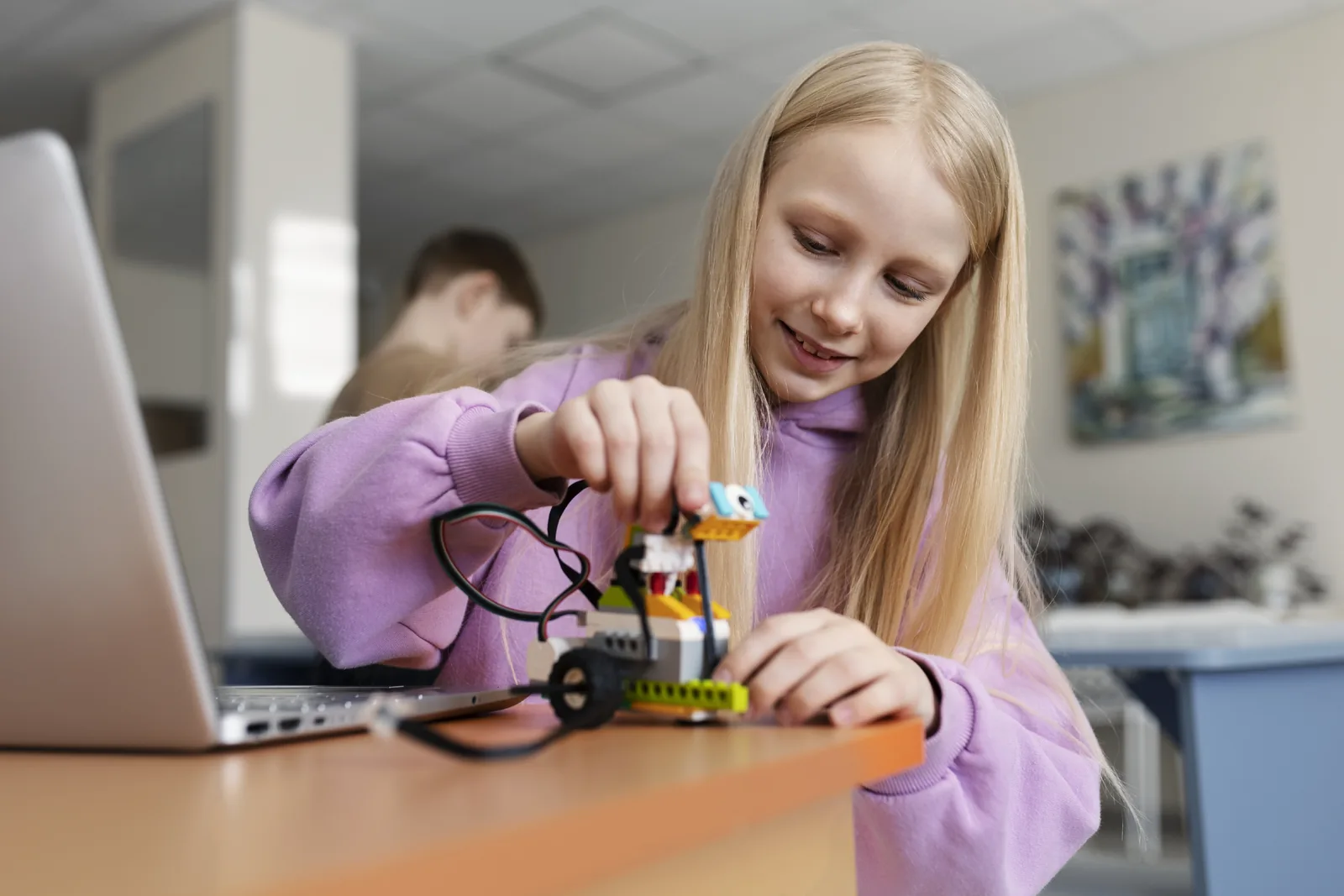
LEGO kits have long since moved beyond simple entertainment, evolving into a powerful educational tool. In the context of teaching programming and robotics, LEGO offers a unique synergy between physical construction and digital coding, making complex concepts accessible and engaging.
Author - Mansur Ismagulov
1. Logical Thinking and Problem Solving
Building a model from LEGO requires a sequence of actions and an understanding of how one piece connects to another. When transitioning to programming a robot built from LEGO, students encounter tasks that require decomposition, algorithmization, and debugging. For example, to make a robot move along a specific trajectory, one must not only write code but also understand what steps are necessary, in what order to perform them, and how they interact.
2. Creativity and Innovation
LEGO does not provide ready-made "correct" solutions. LEGO offers a set of tools that can be used to create anything, from a simple car to a complex sorting system. This encourages children to seek non-standard approaches, experiment, and create their own unique projects. Programming in this context becomes not just memorizing syntax, but a tool for implementing envisioned ideas.
3. Collaboration and Teamwork
Many educational projects with LEGO involve teamwork. This teaches children to distribute responsibilities, exchange ideas, negotiate, and resolve conflicts that arise. In programming, especially in modern projects, the ability to work in a team is considered an indispensable quality.
4. Understanding Abstract Concepts Through Concrete Experience
Abstract programming concepts such as loops, conditions, variables, and functions become more understandable when they can be applied to a physical object. For example, creating repetitive movement in a robot clearly demonstrates the principle of a for or while loop. If a robot must turn only upon detecting an obstacle, this perfectly illustrates the if-else conditional statement.
LEGO Education and Its Impact
The LEGO Education website is dedicated to educational solutions that help children from preschool through middle school learn science, technology, engineering, arts, and mathematics through play with LEGO building sets. Educators can find ready-made lessons, teaching materials, articles, webinars, and professional development programs, as well as purchase kits in the online store. The main goal of the project is to make learning engaging and practical, developing students' critical thinking, creativity, and problem-solving skills.
Product lines such as LEGO Education SPIKE Prime and LEGO MINDSTORMS Education EV3 are specifically designed for educational purposes. They include:
— programmable bricks: electronic blocks that act as the robot's "brain," to which motors and sensors are connected
— sensors: light, color, ultrasonic, gyroscopic, and others, allowing the robot to interact with the surrounding world
— motors: enable the robot to move and perform various actions
— intuitive programming environments, mostly based on block-based programming similar to Scratch, which makes the entry barrier for beginners low. As skills develop, it is possible to switch to text-based languages such as Python.
These kits allow students not only to build robots but also to program them to perform complex tasks: line following, object sorting, color tracking, maze solving, and much more.
The Tech on Telegram Follow The Tech on Telegram
Keep up with the latest technology and startup news.
Related reading







More from this author

News
zypl.ai begins operations in Japan and focuses on next-generation risk models
Mansur Ismagulov

News
Elon Musk's net worth has exceeded $700 billion for the first time
Mansur Ismagulov

Article Interviews
"Central Asian countries should build a joint ecosystem," — Bekhzod Ismoilov on the development of AI in the region
Mansur Ismagulov

Article Interviews
Bloom's Taxonomy and Engineering Levels: A Practical Growth Model
Mansur Ismagulov

Article Useful
How the IT industry in Azerbaijan developed in 2025: key events
Mansur Ismagulov

News
Tajikistan has become a new member of the regional innovation alliance Central Asian Innovation Hubs.
Mansur Ismagulov