IT families: Mikhail and Tatiana Plotnikov
Mikhail and Tatiana met almost 25 years ago at a desk, and today they both work in IT and admit that their shared professional language helps them not only at work but also in their family life. Read their story on our website.
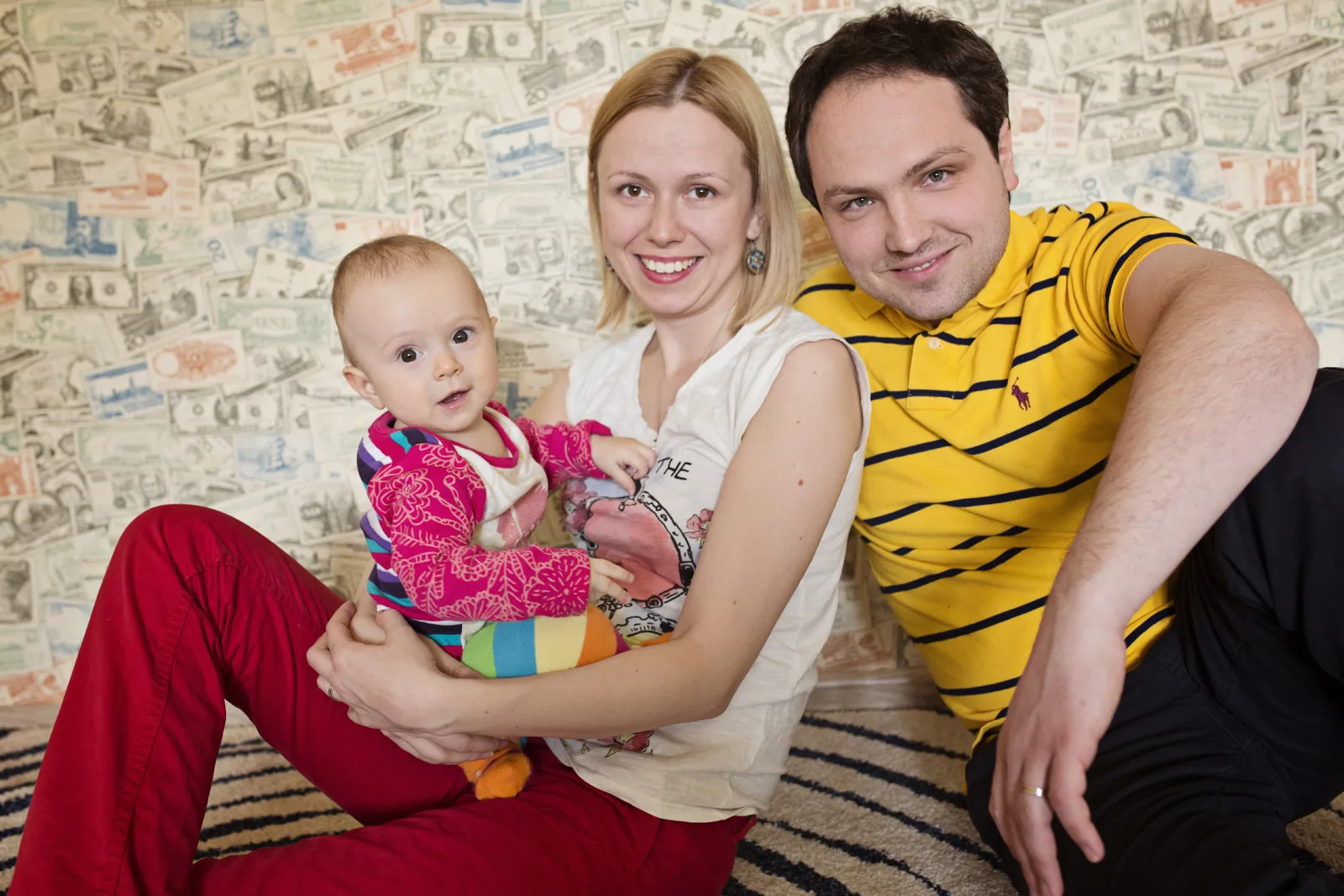
Mikhail Plotnikov, city — Almaty, IT Director of the Client Block, LinkedIn
Tatiana Plotnikova, city — Almaty, CEO, Instagram, LinkedIn
About Us
Tatiana. We met almost 25 years ago—literally at a desk. It was our first day of studies at AUES University.
Before that, I graduated from a humanities class at a gymnasium, where there were 13 history lessons a week. I dreamed of becoming a journalist and wrote articles “in a drawer.” But when choosing a university, I unexpectedly settled on an engineering specialty. I had always been interested in technology, and mathematics, as the foundation of all exact sciences, came easily to me. Moreover, there was no money in the family, and my parents suggested choosing a specialty based on the availability of grants and low competition. I prepared all summer—filling in gaps in physics knowledge and reviewing the history of Kazakhstan—and scored high.
Interestingly, upon entering an IT specialty, I didn’t even have a computer at home. I had only heard of programming and didn’t use the internet.
Mikhail. I was more consistent in my choice: I chose a technical specialty well in advance, as both my father and stepfather were programmers, and I was “on good terms” with technology since childhood. I wrote my first program already in the second grade. So, for me, the path was quite transparent.
How We Entered the IT Field
Tatiana. Our paths were different—I took my diploma with honors, inscribed “Engineer of Electronic Systems and Technologies,” and went to work in a telecommunications company, but not as an engineer, but as a marketer. At the same time, I wrote articles for newspapers and magazines—my childhood dream turned into a hobby, but I didn’t pursue journalism seriously.
Almost 20 years of my professional life passed like this: different telecom companies, different cities, and even countries, but always managing marketing and the development of technological products. At the beginning of this path, I realized that for a career in business, even technological, it is important to understand how it works, so I obtained an EMBA degree, which significantly accelerated my growth. At my peak, I had up to 200 employees and responsibility for revenue exceeding $100 million. I was responsible for the development of the B2B direction—product portfolio, promotion, and sales.
Then I changed countries, left the corporate world, and came to creating my own IT product. A startup gives so much energy that it feels like an atomic reactor is working inside. In employment, I was also always passionate about ideas, proposing new things, but while the project went through all approvals, it sometimes changed beyond recognition. In a startup, your main boss is the client, and this is the most honest boss to whom it is important to listen.
Mikhail. And I have never worked outside of IT. In my fifth year of university, an acquaintance of my father took me as an intern at an IT company that wrote and implemented core banking systems in banks in Central Asia—the main program for banks. I worked at this company for almost 10 years and went from intern to acting general director.
From there, I left for the then still “Sberbank” of Kazakhstan in the IT department as Deputy Director. There, I became passionate about the Agile idea and became one of the leaders of the bank’s agile transformation. A year and a half later, I was invited to the parent bank in Moscow, to the transformation department, as an agile coach.
We returned to Kazakhstan; now I hold the position of IT Director of the Client Block at BI Group, but the experience in Agile has changed me significantly as a leader—I now build IT in close interaction with business units and look for ways to deliver value to the company 5-10 times faster, especially since AI has generously provided us with the necessary tools.
Distribution of Responsibilities
Tatiana. In our case, combining work in IT with managing household affairs and family is difficult. We even have a funny tradition: from time to time, one of us goes to another city or country for work. And I’m not talking about short business trips—these are trips lasting several months or even a full relocation. Honestly? I don’t advise anyone. This kind of life is constant flights, huge costs, and difficulties in organizing daily life. Every time we say, “That’s it, no more life in two cities!”, but then opportunities arise that cannot be refused.
One can argue a lot on this topic, saying that there is always an alternative and priorities are important. But for us, self-realization is a significant priority. This is primarily about happiness, not just financial well-being. It is the opportunity for children to see parents passionate about their work.
Family Traditions
Tatiana. Before having children, we actively participated in the animal protection movement: we helped shelters and volunteered at a foundation. Unfortunately, combining volunteering with children and work turned out to be an insurmountable task, but the values remained the same—and these are exactly what we transmit to our children. We are not alone on this planet; humans are just one of the species. It is important to treat nature and other inhabitants of Earth carefully, and it is helping others that distinguishes the strong. As far as possible, we support animal protection and environmental initiatives and talk about this a lot with our children.
But values are best transmitted through actions and real-life situations. One event significantly changed our family’s life: I found a runaway husky and initially planned to return her to her owners. We already had an old mixed-breed dog—we called her a “noblewoman”—from a shelter, and there were no plans for new dogs. But the husky’s owners were not found, and the dog soon gave birth to eight puppies.
The children were delighted, and we, the parents, were horrified. Finding homes for furry babies was always a difficult task, and for eight of them at once—almost impossible. In the end, we kept the mother husky and three of her daughters. Our previous dog passed away at the age of 18. Such an expansion of the family significantly limited our mobility. Now, simply packing up and moving to another country is possible only in dreams.
We thought a lot about buying our own house—we currently rent housing—and about building a house at the dacha and inviting a reliable person to live there who would look after the dogs. But in the end, we realized that relocating with the full composition is the only correct decision, because now we have 24 legs in our family, and all are dear to us. Currently, a dog trainer is working with the dogs to adapt them to the change in conditions.

Combining Household and Work
Tatiana. Since the arrangement of household affairs often changes, our rules are flexible. The main thing is to simplify and automate tasks as much as possible. The best household purchase of 2024 was a large freezer—we now have the opportunity to store vegetables already peeled and cut, and in winter, prepare full meals in 15 minutes. Last year, we updated our robot vacuum and were shocked by how well the new models cope with their tasks. A washing machine with a dryer is a new level of comfort without a dryer taking up half the room.
We distribute responsibilities flexibly, taking into account each other’s preferences. For example, when we washed dishes by hand, it wasn’t me who did it—I hate this activity. And Misha doesn’t like cooking, so that’s my responsibility. We almost never order food because we doubt the quality of the ingredients.
Now, when Misha is often in Astana, and I am with the children in Almaty, the help of a nanny is extremely valuable, although she works for us only in the evenings.
Frankly, we have almost no free time at this stage. We work a lot—it has always been this way. When we are not working, we do sports or take the children to classes. Our eldest daughter is 13 years old—she already attends some sections and music classes on her own. The younger one, she is 6 years old, still needs to be taken everywhere.
We can fully visit museums and parks during vacations or while working in other countries. I lived in the Netherlands for three months, managed to travel half the country, and my daughter even attended a local school for a while. Then we lived in Moscow for two years—there, for some reason, there was also much more time: theaters, concerts, walks around the city.

Recommendations for a Happy Family Life
Mikhail. The most important thing is to take off the rose-colored glasses. In real life, there are many situations where support is more important than romance. Adult life does not exist without losses, clashes of views, physical and psychological overload. In my opinion, the key ingredients of a family as a stable system are the alignment of basic values, responsibility, and the ability to talk. Nothing is perfect—it is impossible to agree on everything, but you can highlight the key points and make agreements. It’s great if you can achieve a win-win, but in some situations, compromise is also a victory.
How much becomes clear when two people discuss a critical situation: one saw it this way, and the other completely differently. If you don’t talk, both will leave, horrified by their own perception. Like in sad movies, when a couple broke up, and 20 years later it turned out that someone misunderstood something, but nothing can be returned.
How IT Families Differ from Others
Tatiana. Professional interests are another unifying factor. You can always exchange news in the kitchen or listen to a podcast together. IT is about logic, so there is a common habit of not relying solely on feelings, but checking and calculating—for example, family expenses or even “digitizing” emotions. I often evaluate my mood and well-being in percentages. This may seem funny to someone, but it is clearer than just “good” or “normal.”
The Tech on Telegram Follow The Tech on Telegram
Keep up with the latest technology and startup news.
Related reading



More from this author

Article Useful
How to protect your accounts from hacking: 8 settings you should check today
The Tech

Article Useful
500 Global: How the Accelerator Works and Who Can Receive Investments
The Tech

Article Interviews
Game Development in Central Asia: Arkady Moldavski on Developing Reverb and the Growth of the Industry
The Tech

Article Useful
Google, Tesla, BlackRock, and the IMF: Where to Apply for an Internship in Fall 2026
The Tech

News IT
Tesla unveiled the flying electric car Roadster
The Tech

News IT
Intero Biosystems startup won the Startup Battlefield at TechCrunch Disrupt 2026
The Tech