Global Trends in AI and Startups: Insights from CEVF in Almaty
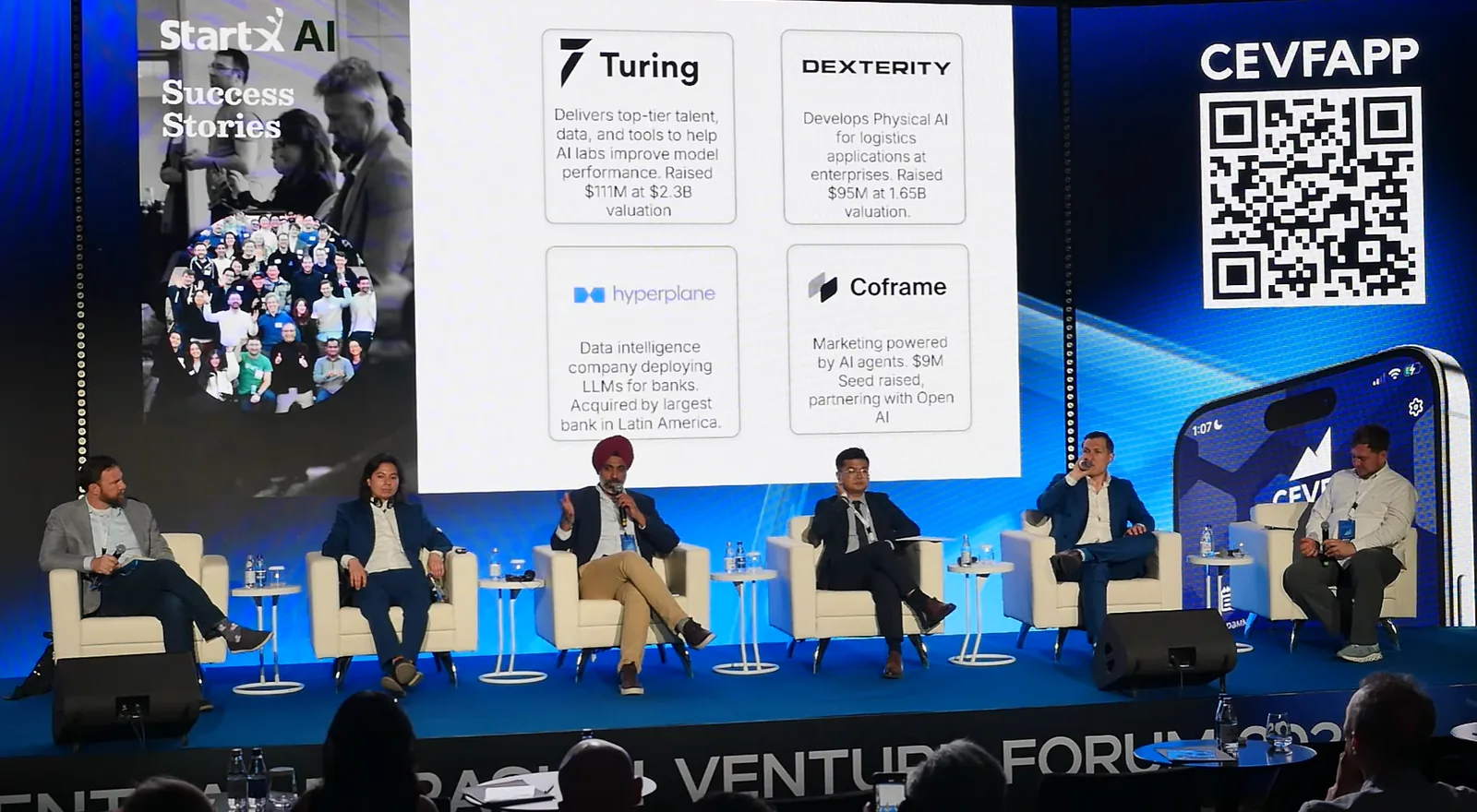
At the CEVF panel discussion in Almaty, experts from the US, China, and Kazakhstan discussed how artificial intelligence is changing the global order. Among the participants were Pavel Koktyshev, Dr. Ramzes Alkaide, Alexander Makobin, Darsh Singh Mann, John Cole, and Frances Chang.
Author - Mansur Ismagulov
The Tech AI
Get the key points in seconds - a short summary from The Tech AI.
Alexander Makobin, Francis Chang, Darsh Singh Mann, John Cole, and Pavel Koktyshev discussed the role of AI in startups. Investors are using AI to evaluate projects, and more than half of investments in China are directed toward industry-specific solutions. Nearly half of late-stage funding goes to AI companies. Pavel Koktyshev highlighted the success of founders with personal brands (Fifi Le, Mira Murati) and those without formal education (Cursor, Merkur). Almaty has been named a promising location for launching global projects.
A must-have for startups — AI
Aleksandr Makobin, founder of the venture network Liberty Ventures
Every startup today must use AI — not necessarily by creating its own models, but at least to improve efficiency. Investors now use AI themselves to evaluate teams and product prospects. This approach saves resources, accelerates time-to-market, and helps make data-driven decisions.
Frances Chang, representative of the Chinese company TwoSpark
China is building a technological ecosystem based on the triple helix model, which unites the efforts of the state, universities, and business. In the new conditions, it is impossible to develop AI as a standalone product — it is important to integrate it into specific industries, creating AI+ solutions. More than half of all investments in China go precisely into such projects. Kazakhstan is a region with enormous potential, and it is the energy and drive of local founders that make them truly promising.
Fundraising and new types of founders
Darsh Singh Mann, representative of the StartX accelerator at Stanford
Today, nearly half of all late-round investments go to AI companies. Startups using AI receive higher valuations — especially at early stages.
John Cole, engineer and DeepTech investor
Experience in the fields of artificial intelligence, semiconductors, and energy has formed a deep understanding of key technological trends. Almaty is considered a good place to launch large-scale projects. It is here that the potential is seen for creating solutions based on advanced scientific developments capable of entering global markets.
The future of infrastructure is not only about technology, but also about new models of interaction between states, universities, and business. AI is not just changing tools — it is rethinking the rules of the game.
Pavel Koktyshev, managing partner of MOST Holding
Types of founders who receive investments:
— The first type is founders with a strong personal brand. An example is Feifei Li, who is called the "godmother of AI." She announced plans to launch a startup and received nearly $300 million in investments — without a team or product, just on an idea. A similar story happened with former OpenAI CTO Mira Murati: after leaving the company, she also received hundreds of millions to launch a new project.
— The second type is young founders without higher education. Among them are Michael and Brandon, founders of the startups Cursor and Merkur. Both dropped out of college but have already raised large rounds. Cursor is a no-code tool that is changing the rules of development, allowing products to be launched without large teams. These cases are especially important for Kazakhstan with its young demographics — everyone has a chance to scale if they choose their own niche.
Recommendations
It is important to communicate personally with investors working in the venture sector. This will help understand what opportunities might be missed, especially in the context of the rapid development of innovative products and solutions.
There is an old Chinese wisdom: those who keep pace with change will survive and thrive. Those who follow these changes survive and prosper. Therefore, the advice for players is: it is important to embrace all new things, learn to live in conditions of uncertainty, and maintain patience.
It is necessary to look deeper — to think not only about algorithms and neural networks, but also about infrastructure, without which AI is impossible.
The full panel discussion can be watched here.
The Tech on Telegram Follow The Tech on Telegram
Keep up with the latest technology and startup news.
Related reading







More from this author

News
zypl.ai begins operations in Japan and focuses on next-generation risk models
Mansur Ismagulov

News
Elon Musk's net worth has exceeded $700 billion for the first time
Mansur Ismagulov

Article Interviews
"Central Asian countries should build a joint ecosystem," — Bekhzod Ismoilov on the development of AI in the region
Mansur Ismagulov

Article Interviews
Bloom's Taxonomy and Engineering Levels: A Practical Growth Model
Mansur Ismagulov

Article Useful
How the IT industry in Azerbaijan developed in 2025: key events
Mansur Ismagulov

News
Tajikistan has become a new member of the regional innovation alliance Central Asian Innovation Hubs.
Mansur Ismagulov