Effective Procurement Management: From Tenders to Signing Acceptance Certificates
Daniil Matyushenko, expert in procurement management and industrial development
Author - Mansur Ismagulov
The Tech AI
Get the key points in seconds - a short summary from The Tech AI.
Daniil Matyushenko, an expert with 12 years of experience and an MBA graduate from Moscow State University, managed procurement at ERG and CIS companies with revenues exceeding $120 million. He advocates for balancing the system: 70–80% planned procurements versus 20–30% urgent ones, with special attention to complex projects. Efficiency is achieved through fair tenders with savings of up to 30%, expert teams, and process optimization for sustainable business development.
Daniil Matyushenko is an expert in procurement management and industrial development with over 12 years of experience in large manufacturing companies. He progressed from heading the procurement department at the Association of Trade and Industrial Enterprises, managing supply chains for ERG Group (the largest mining and metallurgical company in Kazakhstan), to the position of General Director of an international company. He has successfully built effective procurement systems in Russia, Kazakhstan, and CIS countries with an annual turnover exceeding $120 million. He has implemented numerous projects to optimize procurement processes, including the introduction of supply management systems, organization of international tenders, and development of relationships with key industrial equipment manufacturers. He is a graduate of the MBA program at Lomonosov Moscow State University in the field of “Strategic Management and Entrepreneurship.”
In recent years, I have frequently heard the same questions from my colleagues in the industry: “How do you build a procurement system that actually works? How do you find a balance between planned purchases and urgent production needs?” Interestingly, these questions come from both small manufacturing companies and industrial giants with billion-dollar turnovers.
Over 12 years in industrial procurement, I have progressed from organizing the supply of individual components to managing procurement with an annual turnover of more than $120 million. The main conclusion I have drawn is that successful industrial procurement must be systematic and predictable. Yes, predictable, although many still consider this impossible.
In this article, I want to share my vision of how to build a functioning procurement management system—from planning to the final signing of acceptance acts. A system that does not just “meet needs” but genuinely helps the business grow and save money.
Predictability in industrial procurement is a reality I encounter every day. Any production equipment operates according to specific rules. It has passport data, maintenance regulations, and clearly defined service life periods. This is not fortune-telling with coffee grounds, but precise engineering science.
Take a simple example: a large metallurgical plant uses a rolling mill. According to technical documentation, certain components require replacement every six months, major repairs are needed once a year, and full modernization is necessary every five to seven years. Isn’t this an ideal basis for procurement planning?
However, in recent years, I have observed an interesting trend: more and more companies are abandoning annual procurement planning. The argument usually boils down to “why allocate money in advance; we will buy when needed.” While working with large industrial enterprises in Russia and Kazakhstan, I have repeatedly encountered situations where the refusal to perform planned equipment maintenance led to premature wear and tear. As a result, instead of a planned component replacement for a hypothetical $100,000, the company was forced to urgently replace the entire line for a million dollars.
Of course, one should not fall into the other extreme by including absolutely everything in the plan. A reasonable balance is needed here. Based on my experience, I can say that the optimal ratio is 70-80% planned purchases and 20-30% for urgent and unforeseen needs. This proportion allows for maintaining equipment in good condition while retaining flexibility to respond to non-standard situations.
Applying the Pareto principle to procurement management, I arrived at an interesting observation: about 80% of our daily purchases are standard, well-practiced processes that rarely cause serious problems. These are the aforementioned planned replacements, regular supplies of consumables, and updates of standard equipment. The team knows what to do, suppliers are verified, and processes are streamlined.
The remaining 20%, however, are precisely those purchases that consume 80% of our time and nerves. What is the issue? In my practice, I identify three types of the most complex purchases that require special attention. These are the acquisition of fundamentally new equipment, where the cost of error can reach tens of millions of dollars; non-standard purchases to replace unavailable imported equipment; and purchases in new business areas for the company, where requirements and standards may differ drastically from the familiar ones.
What to do with these problematic 20%? My experience shows that a special approach is needed here. For such purchases, I always create a separate project team, attract external experts, and allocate additional time for market research and technical details. Yes, this requires more resources, but it minimizes the risk of costly errors.
And one more important point: these complex 20% of purchases are not a problem, but an opportunity for development. They force us to learn new things, seek non-standard solutions, and expand the team’s competencies. Ultimately, this makes the entire procurement system more effective and resilient.
When managing risks in non-standard purchases, it is critically important not to rely solely on internal expertise. In my practice at ERG, there was a telling case: when purchasing complex gear equipment, attracting an external consultant helped avoid an error and save the company approximately one million dollars on future repairs.
It is important here to find the right balance between preserving commercial secrets and exchanging experience between enterprises. My approach is to clearly separate confidential information from general knowledge that can be shared. At the same time, external experts should not just provide recommendations but participate in employee training, transferring their experience and methodology.
Now let’s talk about tenders without embellishment. Over 15 years in procurement, I have seen how this tool can be both a powerful driver of efficiency and a real brake on business.
I will start with the unpleasant: often, tenders turn into a formal procedure where the winner is known in advance, and the other participants are just a crowd to comply with regulations. I have encountered situations where the preparation and conduct of a tender took more time than the actual delivery of the equipment. This is an absurdity that costs the business dearly.
But there is another side to the coin. While working with large metallurgical companies, I have seen examples of truly effective tender procedures. What is the secret? In a competent balance of key elements.
First of all, this is a thorough development of the technical specification: there is nothing worse than vague formulations that later lead to disputes with suppliers. In my practice, there was a case where an unclear technical specification led to a three-month delay in the delivery of critically important equipment.
Real competition is no less important. It is pointless to hold a tender with two or three “favored” suppliers. When we at ERG expanded the pool of potential suppliers and moved to an international level, average procurement savings increased by 15-20%.
An important aspect is also the competent evaluation of proposals. One cannot rely solely on price. I remember a project where the cheapest offer ultimately resulted in additional costs for equipment adaptation, which offset all the savings.
A separate issue is the timeline for conducting tenders. Yes, the procedure must be thorough, but when approval drags on for months, it becomes a problem. In my practice, I implemented a system of parallel document approval between departments, which allowed us to reduce tender timelines by an average of 40%.
And last but not least is market research. You cannot simply post a tender and wait for crowds of suppliers to arrive with attractive offers. Active work is needed to search for and attract potential participants, preliminary negotiations, and study of technical capabilities.
Successful organization of procurement activities is built on several proven practices. A multi-platform approach to tenders, posting them on platforms in different countries, allows for a significant expansion of the supplier pool—in my practice, this led to savings of up to 30% while maintaining quality.
It is no less important to form strong expert teams where a technical specialist, purchaser, financier, and lawyer work as a single mechanism through regular meetings and discussions.
This system is complemented by a comprehensive evaluation of suppliers, taking into account not only price and quality but also technical capabilities, financial stability, supply experience, and service capabilities.

This approach minimizes risks even with attractive price offers and significantly reduces the number of problematic deliveries.
From my experience managing large procurements in the metallurgical sector, I have identified several areas for process optimization. The first is the competent prioritization through a three-level system: critical purchases for production continuity, planned purchases for maintenance and development, and purchases for efficiency optimization.
The second is the development of team competencies through a practical approach: a mentoring system and rotation of specialists between different procurement areas. This method gives employees a broader perspective on processes and real experience.
The third is the implementation of simple but effective management tools instead of complex automation systems: a unified supplier database, a shipment and payment tracking system, and automated document approval. At the same time, it is important to constantly analyze efficiency based on key performance indicators: delivery timeliness, savings from tenders, application processing speed, and the number of complaints.
Effective procurement management in industry is a living, constantly evolving system, not just a set of procedures and regulations. Experience shows that even in conditions of apparent unpredictability of needs, most purchases can and should be planned, while maintaining the necessary flexibility in working with suppliers.
Speaking about the prospects for the development of this field, it is worth noting the trend toward the development of production cooperation, especially in the context of import substitution, and the growing role of digitalization of processes. At the same time, it is important to remember that any changes should be aimed at real efficiency improvement, not at following fashionable trends.
In conclusion, I would like to note: effective procurement is not about saving money at any cost. It is about creating a sustainable system that ensures uninterrupted production operations and contributes to business development. And if you can build such a system—the results will not keep you waiting.
Author: Daniil Matyushenko
The Tech on Telegram Follow The Tech on Telegram
Keep up with the latest technology and startup news.
Related reading






More from this author
News
zypl.ai begins operations in Japan and focuses on next-generation risk models
Mansur Ismagulov

News
Elon Musk's net worth has exceeded $700 billion for the first time
Mansur Ismagulov

Article Interviews
"Central Asian countries should build a joint ecosystem," — Bekhzod Ismoilov on the development of AI in the region
Mansur Ismagulov

Article Interviews
Bloom's Taxonomy and Engineering Levels: A Practical Growth Model
Mansur Ismagulov

Article Useful
How the IT industry in Azerbaijan developed in 2025: key events
Mansur Ismagulov
News
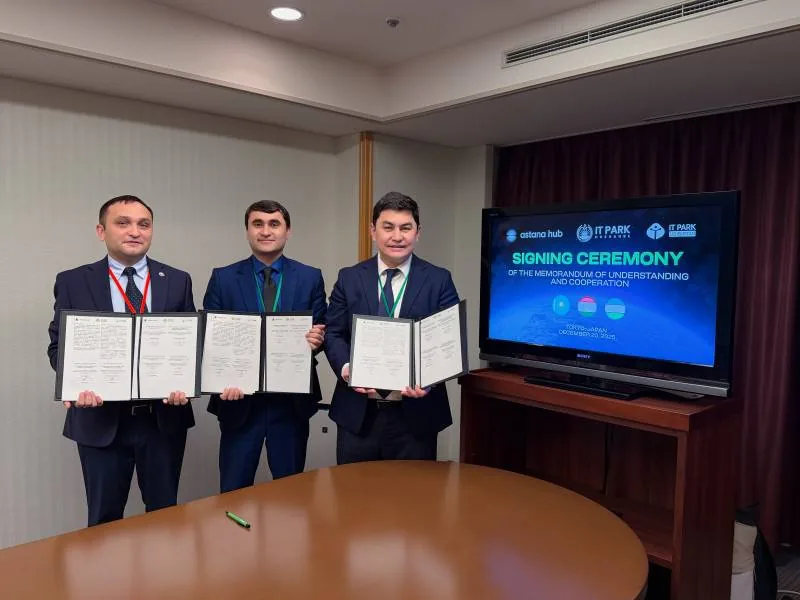
Tajikistan has become a new member of the regional innovation alliance Central Asian Innovation Hubs
Mansur Ismagulov