AI Digest: Claude Opus 5, OpenAI Keyboard, and Floating Data Centers by Samsung
We’ve gathered the main AI news from the past few weeks.
Anthropic released Claude Opus 5
Anthropic introduced Opus 5, a new flagship model that approaches the intelligence level of Claude Fable 5 but costs half as much, while maintaining pricing at the level of the previous Opus 4.8 version. The model has shown significant improvements in programming and natural science tasks, became better at verifying its own results, and, according to the company's internal audit, exhibits the lowest propensity for deceptive behavior among Anthropic's models. Opus 5 has become the default model in Claude Max and the most powerful option for Claude Pro subscribers.
Moonshot AI introduced Kimi K3
China's Kimi K3 is built on a Mixture-of-Experts architecture with 2.8 trillion parameters, but utilizes only 16 out of 896 experts for each request, making the model significantly more efficient than dense analogs of the same size. The model supports a context of up to one million tokens, processes text and images directly without OCR, and stands out in coding tasks and work with large repositories. Due to a surge in demand, Moonshot temporarily suspended registration for new paid subscriptions in the app.
Roblox launched a mobile AI tool for game creation
The new Build tab in the mobile Roblox app allows users to create a game prototype from a text description—without programming or modeling skills. The tool operates within the same ecosystem as the desktop Roblox Studio, and developers using the full version of the editor will be promised AI agents for level testing, analytics collection, and idea generation for player retention. Closed alpha testing for Build begins on July 28 in New Zealand.
OpenAI sold out the first batch of the Codex Micro keyboard
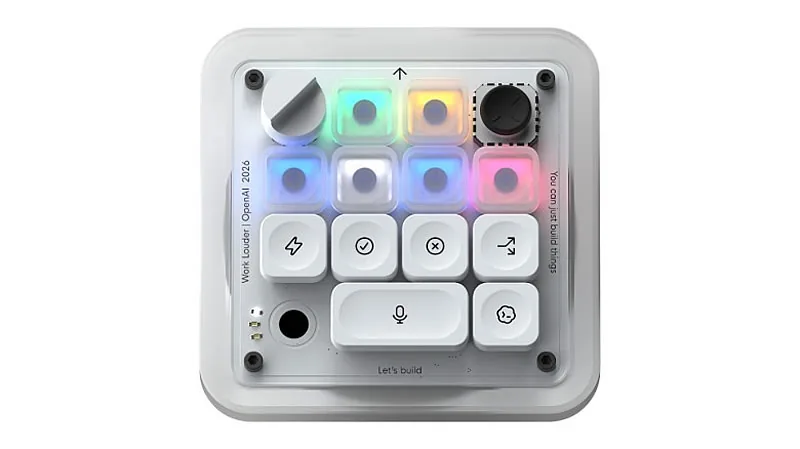
OpenAI's first hardware device—the Codex Micro keyboard, created in collaboration with Work Louder—sold out in less than a day after pre-orders opened at a price of $230. The compact keyboard features 13 mechanical keys, a joystick, and a touchpad, designed for controlling AI agents in Codex: six keys with RGB backlighting display task execution status in real time. The project is unrelated to another OpenAI hardware device being developed in partnership with Jony Ive.
OpenAI is preparing a screen-less companion speaker
According to Bloomberg, OpenAI is developing its first consumer device—a portable, screen-less smart speaker powered by ChatGPT, which the company refers to not as a speaker, but as a new type of computer for the AI era. The device will feature a camera and sensors for context awareness, run on a new voice model called GPT-Live, and learn to adapt to the owner's habits. The development is led by a former Apple team headed by Jony Ive, with a commercial launch expected no earlier than 2027.
Spotify launched an AI assistant for music search
Spotify's new voice and text assistant helps users discover music, podcasts, and audiobooks in a conversational format—users can refine genres, moods, or release periods directly within the conversation. In addition to recommendations, the assistant shares song histories and displays personal listening statistics. The feature is available in beta mode in English for users over 18 with a Premium subscription.
Samsung presented a project for floating data centers for AI
Samsung Heavy Industries signed an agreement with Capital Clean Energy Carriers and Lloyd's Register to create floating data centers with a capacity of 50 MW for AI computing, and also partnered with Supermicro to test server resilience to marine conditions. The data centers will be cooled by seawater and powered either by the shore grid at port or by fuel cells running on liquefied gas in autonomous mode. Similar projects are already underway in Japan, China, and the US.
ByteDance introduced Seedream 5.0 Pro
ByteDance's new multimodal model for image generation and editing is targeted at designers and content creators. Seedream 5.0 Pro follows prompts more accurately, allows editing of specific image areas without regenerating the entire frame, separates images into layers, and handles text in over 10 languages, including Russian. The model is already available for testing via the BytePlus platform API.
From July 17 to 20, the World Artificial Intelligence Conference 2026 took place in Shanghai—one of the world's largest conferences dedicated to artificial intelligence. This year, the event gathered over 1,100 companies, which presented more than 3,000 developments, as well as over 300 world premieres of new AI products.
Key announcements from the conference:
— China announced the creation of the World AI Cooperation Organization—an international body for cooperation in the field of artificial intelligence.
— Huawei unveiled for the first time the Atlas 950 SuperPoD computing cluster based on its own Ascend AI chips—one of the company's most ambitious projects in AI infrastructure.
— Moonshot AI announced Kimi K3, which the company calls the world's largest open-source AI model by parameter count.
— The exhibition showcased more than 400 humanoid robots demonstrating operations in industry, logistics, medicine, and service sectors.
— Open-source AI models became the key trend of WAIC 2026. Chinese companies have bet on accessible technologies and the mass adoption of artificial intelligence in business and industry.
— Following the conference, organizers reported the signing of agreements and letters of intent totaling approximately $3 billion, marking one of the largest results in the history of WAIC.
The Tech on Telegram Follow The Tech on Telegram
Keep up with the latest technology and startup news.
Related reading




More from this author

Article Useful
How to protect your accounts from hacking: 8 settings you should check today
The Tech

Article Useful
500 Global: How the Accelerator Works and Who Can Receive Investments
The Tech

Article Interviews
Game Development in Central Asia: Arkady Moldavski on Developing Reverb and the Growth of the Industry
The Tech

Article Useful
Google, Tesla, BlackRock, and the IMF: Where to Apply for an Internship in Fall 2026
The Tech

News IT
Tesla unveiled the flying electric car Roadster
The Tech

News IT
Intero Biosystems startup won the Startup Battlefield at TechCrunch Disrupt 2026
The Tech