AI agents, investments, and Kazakhstan: what Nik Davydov discussed at Digital Bridge 2025
At Digital Bridge 2025, one of the main topics was AI. In his speech, investor and digital technology expert Nik Davydov discussed global trends in AI development, its limitations and opportunities, as well as the challenges and prospects it opens up for Kazakhstan.
Author - Mansur Ismagulov
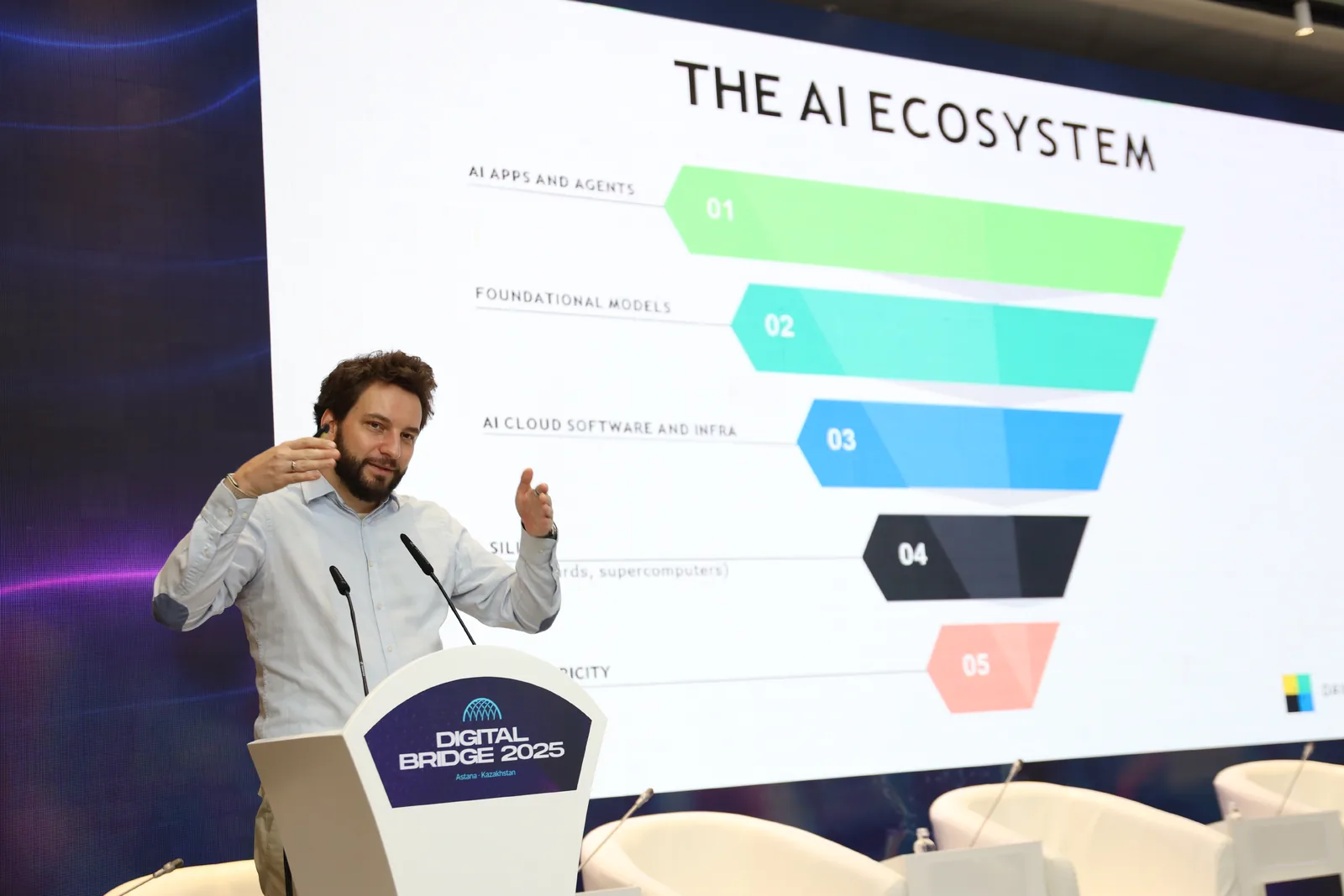
Nik Davydov, co-founder of Davidovs VC, Instagram
Global Trends and Investments
Artificial intelligence is today a key topic in the global economy. Its development is accelerating thanks to open technologies: large models and tools are quickly becoming open source, losing their exclusivity, and forming the basis for dozens of new products. This drives rapid progress but simultaneously complicates life for companies trying to maintain uniqueness and monetize their developments.
The investment landscape has also changed. Capital is concentrated in the hands of major players, making it increasingly difficult for startups to attract resources. To break through, they must immediately demonstrate scale and growth speed. As a result, companies with valuations in the tens of billions of dollars are emerging, even though their current revenue is not commensurate with these figures. This is less about economics and more about expectations of a technological leap. However, if the global conjuncture changes, many businesses may be forced to sharply cut costs and more actively replace humans with AI for optimization.
AI Opportunities and Limitations
AI is already showing impressive results in areas with structured data: programming, law, and the financial sector. In these fields, algorithms help speed up work, reduce costs, and augment specialists. However, in creative fields such as marketing, results still fall short of expectations. This is due both to the lack of context and data in models and to high user expectations: AI is not treated leniently, and a chatbot's mistake is perceived much more painfully than a human's error.
Limitations are also evident in the development of so-called agentic systems—AI assistants that are supposed to independently perform complex tasks. In practice, they lack memory, context, and flexibility. Nevertheless, popularity is growing: hundreds of millions of users have already integrated AI into their daily lives. But the main challenge remains the same—monetization. The main revenues in the digital economy are still generated in traditional segments such as search, advertising, or travel services. New AI applications are still looking for sustainable business models.
Kazakhstan and Local Context
For Kazakhstan, this situation brings both risks and opportunities. The country has strong internet infrastructure, access to modern technologies, and talented specialists capable of working at a global level. However, the venture ecosystem is still underdeveloped. Local investors are cautious, and state initiatives often face bureaucratic barriers.
To take advantage of these benefits, systemic steps are needed. These include stimulating investment, creating conditions for scaling startups, and supporting applied projects where AI actually solves local problems. AI is becoming cheaper and more accessible, and a new economy is forming right now. Those who manage to integrate technologies into real processes and build trust in products will gain a significant advantage. But this requires not only algorithms and computing power, but also mature markets, capital, and a flexible institutional environment.
The Tech on Telegram Follow The Tech on Telegram
Keep up with the latest technology and startup news.
Related reading







More from this author

News
zypl.ai begins operations in Japan and focuses on next-generation risk models
Mansur Ismagulov

News
Elon Musk's net worth has exceeded $700 billion for the first time
Mansur Ismagulov

Article Interviews
"Central Asian countries should build a joint ecosystem," — Bekhzod Ismoilov on the development of AI in the region
Mansur Ismagulov

Article Interviews
Bloom's Taxonomy and Engineering Levels: A Practical Growth Model
Mansur Ismagulov

Article Useful
How the IT industry in Azerbaijan developed in 2025: key events
Mansur Ismagulov

News
Tajikistan has become a new member of the regional innovation alliance Central Asian Innovation Hubs.
Mansur Ismagulov