Women as Architects of the Digital Economy in Central Asia and the South Caucasus. An Analytical Outlook
A region with a consumer market of 80 million people stands on the brink of a technological explosion. Data from global analysts confirm what market leaders are observing from within: women here are not observers of transformation, but its architects.
The region that stopped playing catch-up
Central Asia and the Caucasus were long perceived as the periphery of the global tech economy. Today, this perception is outdated.
In November 2025, Kazakhstan adopted the Law “On Artificial Intelligence” and established a separate Ministry of Artificial Intelligence and Digital Development—one of the first such precedents in the region. Azerbaijan is building a technology hub by integrating human capital into its post-oil strategy. Uzbekistan is scaling IT infrastructure across 19 regions of the country with direct support from the IFC, which allocated $42 million in 2024 to finance small and medium-sized businesses, with a 25% quota for women entrepreneurs. Kyrgyzstan is launching a state-supported creative industries park. Tajikistan is creating the country’s first digital logistics platform, integrated with customs systems.
And these are not isolated initiatives—they represent a consolidated regional shift backed by measurable market data.
What is being built: five countries, five focuses
Before turning to macro data, it is important to understand the internal logic of this transformation.
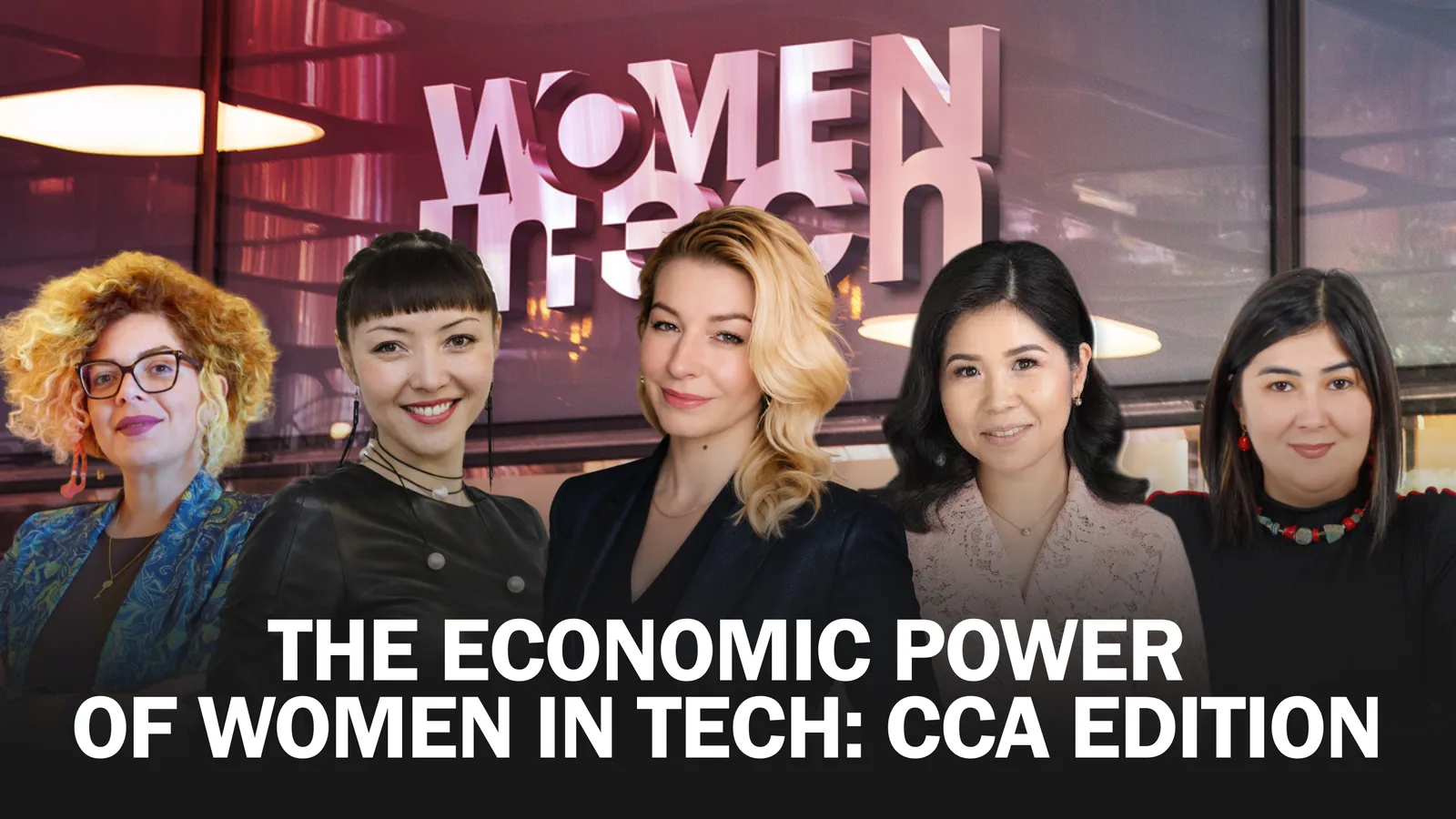
In April, representatives of the Women in Tech Global chapters from five countries—Kazakhstan, Kyrgyzstan, Uzbekistan, Tajikistan, and Azerbaijan—met in a joint broadcast of The Tech and Women in Tech. Each represents their unique entry point into the broader transformation.
Leila Saidzade, Women in Tech Azerbaijan, is building a 360-degree approach to AI education—from schoolgirls to women investors. Her task is not only to prepare specialists but also to create an environment where they are invested in:
“Azerbaijan is transforming into a technological hub that will import not only natural resources but also human capital and technology. Our focus is supporting women in this transformation. We work across every segment: schoolgirls, women in small business, young professionals, and women investors—this is a 360-degree approach,” Leila notes.
Nurgul Ketebaeva, Women in Tech Kazakhstan, with 15 years of experience in entrepreneurship, focuses on helping sellers enter marketplaces and turning chaotic businesses into manageable ones. She views e-commerce as the region’s new oil:
Nurgul Ketebaeva
In Kazakhstan, 48% of small and medium-sized businesses are managed by women. Many financial institutions note that women are more disciplined and timely in fulfilling obligations and replenishing deposits. Women are leaders in e-commerce in Kazakhstan and generally look strategically ahead.
Kynekey Kazakbaeva, Women in Tech Kyrgyzstan, works on the startup ecosystem and builds a pipeline from schoolgirls to founders ready to enter international markets. Her bet is on the region as a single investment entity:
Kynekey Kazakbaeva
We do not want to highlight Kyrgyzstan, Kazakhstan, or Uzbekistan separately. We want to be attractive as the Central Asian region for investors. Therefore, we are building a startup ecosystem—one of our main directions.
Nasima Bahramova, Women in Tech Tajikistan
Roads shape trade, trade shapes cities, and cities shape the economy. Every time a woman starts an online business, she takes a small step for her business but a huge step for the regional economy.
Natalia Sorokina, Women in Tech Uzbekistan, notes the rapid growth of the community: in two years, the chapter has united over 7,000 participants. The main focus is digital literacy and personal branding as an entry point:
Natalia Sorokina
Whoever is thinking about how to start a profession can begin with basic skills: Canva, presentations, Google Calendar, time management. Girls who prepare at 14–15 years old can already aim for good positions in five years.
Three pillars of growth: what the data says
- E-commerce: the explosion that has not yet happened
The Central Asian e-commerce market reached $14.7 billion in 2024 and is projected to grow to $182.2 billion by 2033, at a CAGR of 30.6%, according to IMARC Group. This is one of the highest growth rates among emerging markets.
Today, the market remains predominantly B2B-oriented, while the B2C segment is structurally underdeveloped. This means that the main growth is still ahead and will be unlocked as consumer infrastructure forms.
This is where the effect arises, which experts call a “five-to-seven-fold explosion”: not organic growth, but the removal of structural constraints for a market of 80 million people.
Nurgul Ketebaeva notes that Kazakhstan’s e-commerce market shows steady growth: in 2025 it increased by 15%, in 2026 growth is expected at 15.5%, in 2027 around 17%, and by 2030, online trade could reach approximately 20% of total retail. According to her, e-commerce is becoming Kazakhstan’s “new oil.”
- Cybersecurity: scarcity as an opportunity
According to ISC2, women make up only 22% of the global cybersecurity workforce, while holding 36% of tech roles overall. In Central Asia, this figure is even lower. ISC2 forecasts that by 2031, the share of women in the industry will rise to 35%.
Entering this niche today means being at a point of minimal competition and maximum future demand.
Leila Saidzade notes that in cybersecurity, the share of women remains one of the lowest—in some areas, it does not exceed 10%. According to her, it is important to actively develop women’s participation in this field now to avoid a situation where changes happen too late.
- Women in SMEs: an economic multiplier
The share of women’s entrepreneurship in the region ranges from 29.2% in Uzbekistan to 49.4% in Kyrgyzstan. In Kazakhstan, women manage 48% of SMEs and demonstrate higher financial discipline.
According to We-Fi, the global economic potential of leveling the playing field for women entrepreneurs is $5–6 trillion.
In the region, this manifests as a massive layer of micro- and small businesses that scale when infrastructure barriers are removed.
Nasima Bahramova explains this through practice: “A woman turns her kitchen into a brand but faces delivery problems. Without infrastructure, she cannot scale. But once infrastructure appears, it becomes a path from the kitchen to a full-fledged brand.”
In October 2024, the IFC signed an agreement with Ipak Yuli Bank in Uzbekistan for a loan of up to $42 million, allocating 25% to women-owned SMEs. This is direct confirmation of the segment’s priority for global investors.
Competency map: what to invest in yourself now
Natalia Sorokina provides a pragmatic skills map. The basic starting point is digital literacy, which is often underestimated: “The most important thing for young professionals is digital literacy. The ability to use technologies and basic tools already gives a serious advantage,” she notes.
Next come growth levels:
AI literacy. According to McKinsey, specialists with AI skills earn on average 25% more.
“AI is a must-have skill, like the internet or Google Docs,” Natalia says.
Data Analytics and Machine Learning—one of the fastest-growing IT segments until 2030.
Product and Project Management—a direction with steady demand: team coordination, analytics, product management.
Personal brand and networking—already a measurable factor in the labor market:
What is changing structurally
All participants note a common trend: men are increasingly engaging in initiatives previously considered “women’s.”
Leila Saidzade
We are talking not about promoting women separately, but about equal opportunities in tech. It is important not to create closed communities.
EBRD, together with We-Fi, is implementing programs to support women’s entrepreneurship in four countries in the region. New communities are emerging in cybersecurity, Web3, and AI.
Three conclusions for those making decisions now
1. Infrastructure is a condition for explosion, not its consequence.
The region’s e-commerce is growing at a CAGR of 30.6%, but the B2C potential remains untapped.
2. Women in SMEs are an economic multiplier.
The potential is up to $5–6 trillion globally. This is not a social program, but an economic strategy.
3. The window of opportunity is limited.
Kazakhstan plans to train 1 million specialists in AI skills by 2030. In three to five years, the market will cement new leaders in AI, cybersecurity, and e-commerce.
The Tech on Telegram Follow The Tech on Telegram
Keep up with the latest technology and startup news.
Related reading




More from this author

Article Useful
How to protect your accounts from hacking: 8 settings you should check today
The Tech

Article Useful
500 Global: How the Accelerator Works and Who Can Receive Investments
The Tech

Article Interviews
Game Development in Central Asia: Arkady Moldavski on Developing Reverb and the Growth of the Industry
The Tech

Article Useful
Google, Tesla, BlackRock, and the IMF: Where to Apply for an Internship in Fall 2026
The Tech

News IT
Tesla unveiled the flying electric car Roadster
The Tech

News IT
Intero Biosystems startup won the Startup Battlefield at TechCrunch Disrupt 2026
The Tech