Z.ai has released GLM-5.2 — a free model that competes with GPT-5.5 and Claude
Z.ai has released GLM-5.2 — a new flagship model for complex programming tasks. It supports a context window of up to one million tokens, is freely available under the MIT license, and outperforms GPT-5.5 on several key benchmarks. Let’s explore what the model can do and how it differs from its competitors.
What is GLM-5.2
GLM-5.2 is the new flagship model from the Chinese startup Z.ai, formerly known as Zhipu AI. The model is not designed for casual conversation but for long-term technical tasks: large-scale code development, automated research, performance optimization, and complex debugging.
The main problem GLM-5.2 addresses is reliability over long durations. Most models lose track of the task when work stretches over hours and dozens of steps. GLM-5.2 was built specifically to prevent this.
Why a million tokens matters
The context window is the amount of information the model holds in memory simultaneously. GLM-5.2 has a context window of one million tokens—five times larger than that of its predecessor, GLM-5.1.
In practice, this means the model can hold an entire large project in memory at once: source code, tests, change history, and correspondence—without needing to break the work into parts.
Z.ai expanded the model's training on long-context scenarios: large-scale development, automated research, performance optimization, and complex debugging.
How the architecture works
GLM-5.2 is built on a Mixture-of-Experts architecture with 753 billion parameters. To support a context window of one million tokens, Z.ai developed its own mechanism called IndexShare.
Here’s how it works: typically, each layer of the model spends computational resources searching for relevant fragments within a long context. In GLM-5.2, every four layers share a single indexer instead of using four separate ones. This reduces the computational load by nearly three times when working with a one-million-token context.
Additionally, the model supports two operating modes:
— High — a balance of speed and quality for standard tasks
— Max — maximum performance for particularly complex cases.
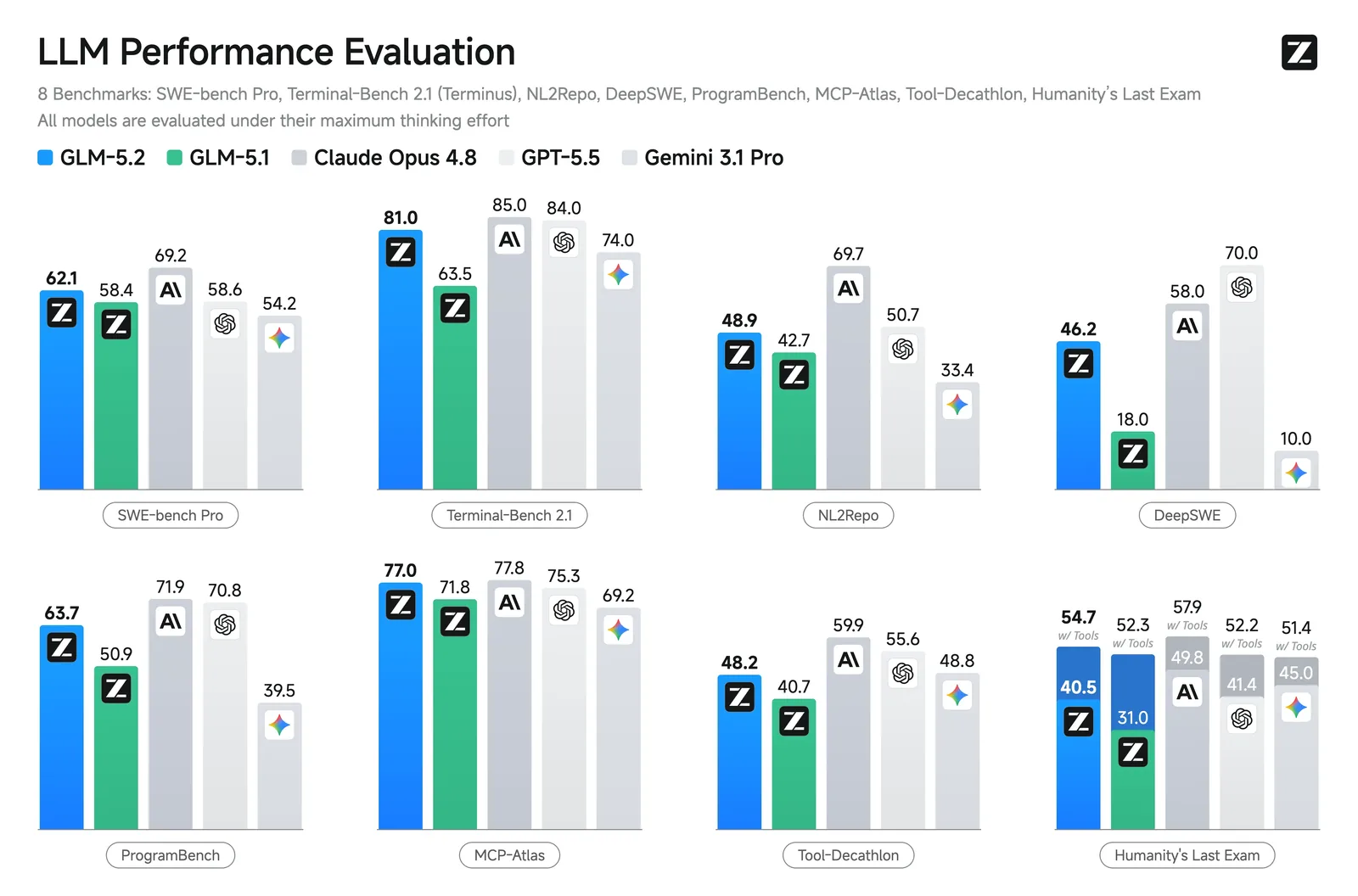
Test results
There are several standard tests for comparing AI models in development.
SWE-bench Pro — solving real bugs from GitHub. GLM-5.2 scored 62.1, GPT-5.5 scored 58.6, and Claude Opus 4.8 scored 69.2.
Terminal-Bench 2.1 — working in the terminal with real tools. GLM-5.2 scored 81.0, GPT-5.5 scored 84.0, and Claude Opus 4.8 scored 85.0.
FrontierSWE — independently managing a technical project over several hours. GLM-5.2 scored 74.4, GPT-5.5 scored 72.6, and Claude Opus 4.8 scored 75.1.
PostTrainBench — the model is given a GPU and must independently improve another model through fine-tuning. GLM-5.2 scored 34.3, GPT-5.5 scored 28.4, and Claude Opus 4.8 scored 37.2.
Among open-source models, GLM-5.2 achieved the best results across all long-term tests.
MIT License — what it offers
The model is distributed under the MIT license. This means: no regional restrictions, no royalties, and you can use, modify, and integrate it into commercial products without seeking approval from Z.ai.
This is important for companies: the model can be deployed on their own servers, independent of external providers.
The weights are published on Hugging Face, and the model is available via the Z.ai API and more than 20 development platforms, including Claude Code, OpenCode, and ZCode.
How to start using it
For subscribers of the GLM Coding Plan, the model is already available. It can be launched in familiar tools such as ZCode, Claude Code, OpenCode, and others. In Claude Code, the model is connected under the name GLM-5.2 with support for a one-million-token context.
Regarding pricing: until the end of September 2026, usage during off-peak hours consumes quota at the standard rate. During peak hours—from 14:00 to 18:00 Beijing time—quota consumption increases threefold.
Subscriptions can be purchased at z.ai/subscribe.
The Tech on Telegram Follow The Tech on Telegram
Keep up with the latest technology and startup news.
Related reading




More from this author

Article Useful
How to protect your accounts from hacking: 8 settings you should check today
The Tech

Article Useful
500 Global: How the Accelerator Works and Who Can Receive Investments
The Tech

Article Interviews
Game Development in Central Asia: Arkady Moldavski on Developing Reverb and the Growth of the Industry
The Tech

Article Useful
Google, Tesla, BlackRock, and the IMF: Where to Apply for an Internship in Fall 2026
The Tech

News IT
Tesla unveiled the flying electric car Roadster
The Tech

News IT
Intero Biosystems startup won the Startup Battlefield at TechCrunch Disrupt 2026
The Tech