How to get into the Kazakh-British Technical University for IT in 2026

The Tech AI
Get the key points in seconds - a short summary from The Tech AI.
The Kazakh-British Technical University (KBTU), founded in 2002, trains IT and engineering specialists. The School of Information Technology and Engineering brings together more than 4,500 students and holds accreditations from ABET, ACBSP, IQAA, CIMA, ACCA, and CFA. In 2026, new programs in Game Development and Data Science will be launched. Tuition costs 50,000 tenge per credit for bachelor's students and 35,000 tenge for master's students. Over 98% of graduates find employment or continue their studies.
The Kazakh-British Technical University (KBTU) is one of the leading technical universities in the region. The university operates in partnership with the global academic community, corporate and state sectors, adhering to fundamental values of quality, academic integrity, and openness.
The School was founded in 2002, when the Kazakh IT industry was just taking its first steps. The task was simultaneously simple and ambitious: to train world-class specialists for a market that barely existed.
Today, 25 years later, the School is an internationally accredited educational hub with its own research laboratories and programs that have no analogues in Central Asia.
The university’s main mission is the development of new competencies in engineering and technical fields through innovation, scientific research, and the implementation of international education standards. This mission is embodied by the School of Information Technology and Engineering, the largest subdivision of KBTU, which unites more than 4,500 students and remains a benchmark for technical education in Central Asia.
Accreditation
The university is included in the international QS World University Rankings every year. In the Central Asian region, KBTU is among the top 30% of universities. The university’s programs have received international recognition through accreditations from ABET, ACBSP, IQAA, CIMA, ACCA, and CFA.
Three out of four undergraduate programs of the School of IT and Engineering have passed ABET accreditation, Accreditation Board for Engineering and Technology — an American organization recognized as the global standard in engineering education.
Undergraduate Programs
KBTU has several schools that prepare graduates in the field of IT:
Undergraduate:
— Automation and Control
— Information Systems
— Computer Engineering and Software
— Robotics and Mechatronics.
Tuition fees are fixed per credit and depend on the level of the program. For undergraduate students, the cost is 50,000 tenge per credit, and for master’s students, it is 35,000 tenge per credit.
The total tuition amount is calculated based on the number of credits selected per semester or for the entire academic period.
List of required documents:
- Application: filled out during document submission to the admissions office
- Applicant questionnaire: online
- Identity document, copy
- High school diploma and transcript — original
- Unified National Testing (UNT) certificate: printed version from the NCT personal account
- English language certificate: IELTS 5.5 / TOEFL iBT 46 / STEP KBTU B1: one of the listed — copy
- Photograph 3x4, 1 piece — original
- Medical certificate No. 075-U — original
- Fluorography scan — original
- Form 063/u, vaccination card — copy
- Conscription certificate/military commissariat certificate for young men — copy
- Documents confirming social category entitled to priority admission / KBTU discount
- Tuition agreement — electronic
- Registration in the Egov system
- Receipt for Student Fee payment of 40,000 tenge. Printed receipt from Halyk Bank.
- Receipt for first-semester tuition payment — for applicants to the paid department. Printed receipt from Halyk Bank.
In 2026, the School of IT and Engineering is launching two fundamentally new fields — the first of their kind in Central Asia.
— Game Development
The gaming industry has long ceased to be just entertainment: it is a multi-billion-dollar global market and a technological testbed for AI, graphics, and UX. The program prepares full-cycle developers — from game mechanics and visualization to product publishing and monetization.
— Data Science and Artificial Intelligence
Data analysts and AI specialists are needed everywhere today: in banks, retail, logistics, medicine, and the public sector. The program provides a full stack of skills — from statistics and machine learning to building industrial AI systems.

Master’s and Doctoral Programs
KBTU offers eight master’s programs, each tailored to a specific segment of the technological agenda:
— Data Science
— IT Management
— Software Engineering
— Computer Science and Data Analytics
— Information Systems
— Industrial and Systems Engineering
— Electronics and Control Systems
— Smart Cities and Smart Systems.
Master’s students are not just students but researchers: real-world cases, international tools, and scientific publications are an integral part of the educational process, not just a bonus.
The doctoral program offers two paths:
— “Informatics, Computer Engineering, and Control”
— “Computer Science and Artificial Intelligence”.
For those who want not just to apply technologies but to create new methods and algorithms.
Faculty
The teaching staff includes local and foreign specialists from the United Kingdom, Australia, Turkey, the USA, and India. Leading mathematicians and physicists work at KBTU. In the QS EECA ranking, the university regularly enters the top 10 for the number of foreign faculty members — today they account for more than 30% of the total staff.
Doctors of Science, conducting fundamental research, work side by side with practicing specialists from leading IT and engineering companies. The former provide depth, the latter provide relevance.
The Industrial Committee operates twice a year — a platform where representatives of Kazakh technology companies do not just observe education but participate in it: reviewing curricula and proposing new directions. The School does not lag behind the industry — it moves with it.
Student Opportunities
KBTU is more than just lecture halls. Starting from the fifth semester, every student builds a personal trajectory from more than 150 elective disciplines:
— Cybersecurity
— Game development
— Machine learning
— Digital twins
— Mobile development
— Industrial systems.
The KBTU Startup Incubator is also available, where students go through the journey from idea to MVP.
The School has a network of applied research laboratories with world-class technologies:
- GameLab KBTU — a laboratory for video game development and research, operating since 2022. Scientific publications, mentoring of student projects, and internships in the gaming industry — it was from here that the first Game Development program in Central Asia emerged.
- Computational Neuroscience Laboratory — research on neural networks, brain-computer interfaces, and biologically inspired algorithms with applications in medicine and neurorehabilitation.
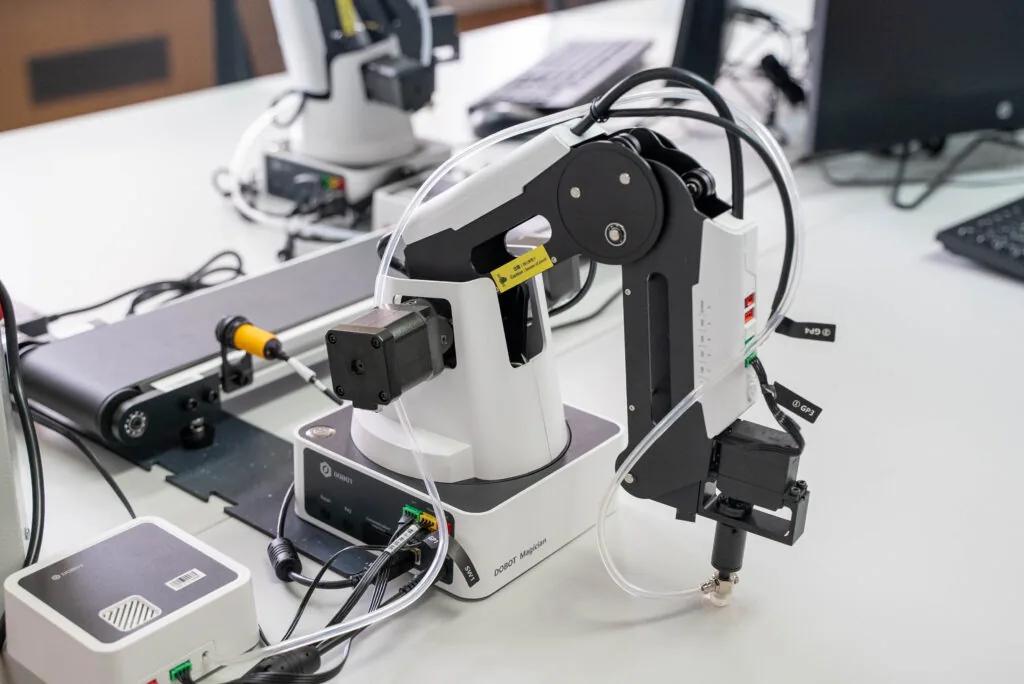
- Intelligent Robotics and Mechatronics Laboratory — mobile robots, manipulators, and sensors at the intersection of AI and physical systems.
- Cybersecurity Laboratory — ethical hacking, digital forensics, and network security. Tools: Kali Linux, Python, VirtualBox.
- Data Science Laboratory — full-cycle data processing: from collection to decision-making.
- Fuzzy Logic Laboratory — modeling decision-making under uncertainty, intelligent support systems.
Internships
Over 25 years, the School has graduated thousands of specialists — and their careers speak for themselves. KBTU graduates work at Google, Microsoft, Booking.com, Kaspi, Kolesa Group, Freedom Finance, and dozens of other companies in Kazakhstan and abroad. ICPC team members from KBTU received job offers directly after the championship — without standard selection stages. For major IT employers, an ICPC result is a stronger signal than any resume. Some graduates go on to found their own companies: fundamental training and close ties with the industry provide everything necessary for this.
Partner Universities
KBTU has established partnerships with leading universities worldwide. Students have access to academic mobility to universities in Europe, Asia, and the CIS:
Azerbaijan — ADA University, Azerbaijan State Oil and Industry University, Baku Higher Oil School
Belarus — Belarusian State University of Informatics and Radioelectronics
Bulgaria — Technical University of Varna, University of Economics Varna
United Kingdom — University of London, University of Leicester, Suffolk University, University of Manchester, University of Northampton, University of Southampton, University of Reading
Germany — Furtwangen University
Spain — Universidad San Jorge, EADA Business School
Italy — Polytechnic University of Turin
China — China University of Petroleum, Shanghai Polytechnic University, China University of Petroleum-Beijing, Northeast Petroleum University, Wuhan College
South Korea — Soongsil University, Sejong University
Malaysia — Asia Pacific University, Universiti Teknologi Malaysia, Universiti Teknologi Petronas, Universiti Sains Malaysia
Poland — Kozminski University.
Partnerships have also been established not only with universities but also with leading global technology companies. Joint laboratories have been created where students work with real industrial tools:
— Honeywell — industrial controllers, digital twins, Experion PKS and UniSim Design platforms. More than 500 students have undergone training
— Schneider Electric — PLC programming, industrial networks, HMI interfaces on the EcoStruxure platform
— Siemens Industrial Academy — SIMATIC controllers, SINAMICS drive systems, TIA Portal and SIMIT complex
— Huawei ICT Academy — HCNA and HCNP certification courses, routing, switching, network security
— Cisco — Cisco network devices, design and configuration of corporate-level infrastructure
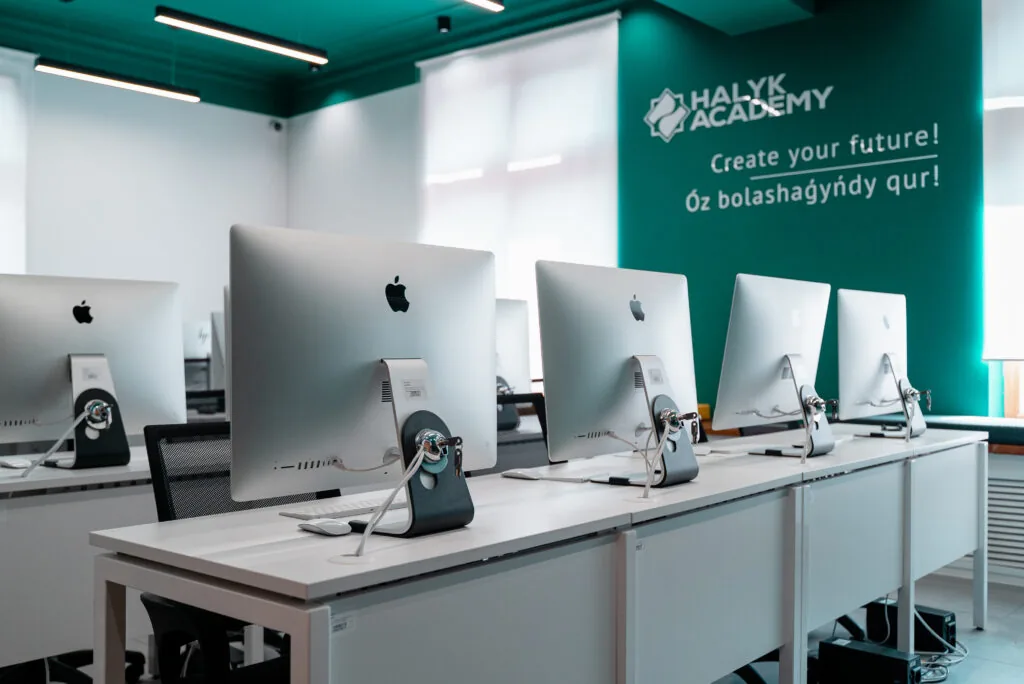
— Halyk Bank — cloud technologies and big data, Mac stations with professional software for web development, iOS programming, and network management.
Student Life
At KBTU, every student can find a student organization by interest or start their own. About 20 organizations operate constantly at the university across seven directions — from scientific clubs to creative associations. The Intellectual Debate Club has been operating since 2002 — a platform for developing public speaking skills and analytical thinking.
A separate aspect of student life is participation in ICPC, the international collegiate programming championship. The KBTU team qualified for the world final eight times — the best result among all universities in Kazakhstan. At the 2024 final in Astana, KBTU students were the first among more than 140 teams to solve one of the most difficult problems of the championship.
Two modern dormitory buildings operate for out-of-town students. Each building has recreation rooms, kitchens, an auditorium for 120 people, a cafeteria for 70 people, high-speed elevators, Wi-Fi, and video surveillance. The territory also features a three-story sports complex with a game hall for 198 people.
Academic Mobility
Academic mobility opens doors to partner universities: University of London, University of Manchester, Polytechnic University of Turin, Soongsil University, Universiti Teknologi Malaysia, and dozens of other universities around the world.
Employment
More than 98% of KBTU graduates find employment or continue their studies in master’s programs after graduation. Over 25 years, the School has graduated thousands of specialists working at Google, Microsoft, Booking.com, Meta, Bloomberg, Kaspi, Kolesa Group, Freedom Finance, Siemens, Huawei, and dozens of other companies — in Kazakhstan and abroad.
ICPC team members from KBTU received job offers directly after the championship — without standard selection stages. For major IT employers, an ICPC result is a stronger signal than any resume.
Some graduates go further and found their own companies: fundamental training and close ties with the industry provide everything necessary for this.
The Tech on Telegram Follow The Tech on Telegram
Keep up with the latest technology and startup news.
Related reading



More from this author

Article Useful
How to protect your accounts from hacking: 8 settings you should check today
The Tech

Article Useful
500 Global: How the Accelerator Works and Who Can Receive Investments
The Tech

Article Interviews
Game Development in Central Asia: Arkady Moldavski on Developing Reverb and the Growth of the Industry
The Tech

Article Useful
Google, Tesla, BlackRock, and the IMF: Where to Apply for an Internship in Fall 2026
The Tech

News IT
Tesla unveiled the flying electric car Roadster
The Tech

News IT
Intero Biosystems startup won the Startup Battlefield at TechCrunch Disrupt 2026
The Tech