Water from Air: Technology by a Nobel Laureate Hits the Market
A Nobel laureate has created a material that literally pulls water from the air—even in the driest place on Earth. His company is already preparing for industrial sales and targeting the agricultural sector. Let’s explore how it works and why it matters.
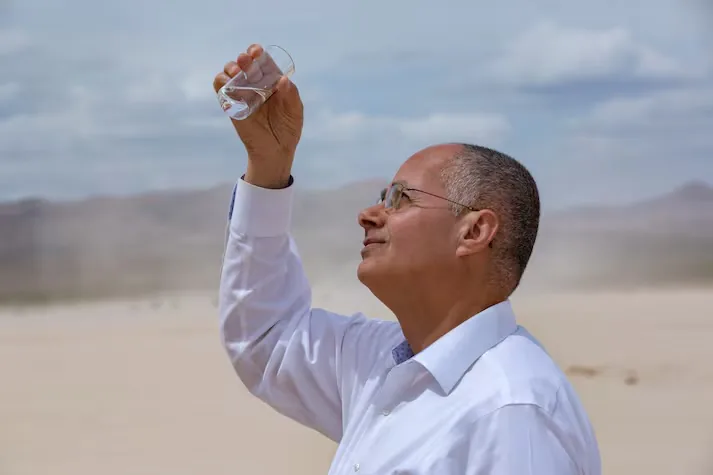
About the Atoco Startup
Climate startup Atoco is approaching the final stretch before its commercial launch. The company plans to begin selling its atmospheric water extraction technology within the next year.
The primary target is the agricultural sector, specifically greenhouses and controlled-environment farms that are increasingly feeling the strain of water shortages. This was stated by company representative Han Park during a panel discussion on controlled agriculture at the World Agri-Tech Innovation Summit in Dubai in December.
Atmospheric water harvesting involves extracting water directly from the air. No rivers, wells, pipelines, or desalination plants are needed. It sounds like science fiction, but the mechanism is quite concrete.
Atoco’s technology is based on a special porous material called a metal-organic framework, or MOF. This solid substance contains a vast number of micropores. The pores are so small and numerous that the material can literally “park” and capture water molecules directly from the air—even in environments with extremely low humidity.
To test this in practice, Atoco conducted trials in Death Valley, California—one of the driest and hottest places on Earth. The system operated solely on ambient energy, without grid connection, and successfully produced water. The quality of the resulting water was close to distilled.
The Team
The company was founded by chemist Omar Yaghi. In 2025, he was awarded the Nobel Prize in Chemistry alongside Susumu Kitagawa and Richard Robson. They received the prize specifically for the development of reticular materials, which include metal-organic frameworks.
In other words, the technology underlying Atoco is not just a startup experiment, but a development that has received the highest level of scientific recognition in the world.
What the Unit Looks Like and How Much Water It Produces
Atoco’s commercial product is a 20-foot container designed for industrial deployment. There are two versions.
The grid-connected version produces between 2,000 and 4,000 liters of water per day. The autonomous version, which operates without external power—relying solely on ambient energy—produces up to 1,000 liters per day. In both cases, the water is of high purity.
The unit is positioned not as a complete replacement for existing water sources, but as an additional decentralized source for arid and semi-arid regions. That is, it is not meant to replace rivers or municipal water supplies, but to operate alongside them—as a backup and enhancement.
Why This Matters for Farmers and Greenhouses
Atoco is primarily targeting the controlled agriculture sector—greenhouses and vertical farms. These facilities face two major challenges simultaneously: water scarcity and high energy consumption. The technology helps address both.
First, it provides an independent water source on-site. Second, the system can operate in reverse: extracting excess humidity from the air inside greenhouses, thereby regulating the climate and reducing costs for cooling and ventilation.
Han Park defines the ultimate goal as creating “water-positive” greenhouses—facilities that not only consume water but also produce it themselves. He stated that the future looks very promising for the company, particularly regarding partnerships with major market players.
How Industrial Waste Is Turned into Water
One of Atoco’s most interesting ideas is not just to extract water from the air, but to integrate this extraction into existing industrial processes.
Vertical farms and greenhouses are increasingly being built near cities and industrial zones—where energy access is available. However, these same zones generate large amounts of low-grade waste heat that is simply released into the atmosphere: from factories, data centers, and power plants.
Atoco proposes using this waste heat as fuel for its autonomous units. The resulting scheme would look like this: an industrial facility next to a greenhouse—waste heat is directed to the Atoco unit—the unit produces clean water—the water is supplied to the greenhouse. The greenhouse becomes a node in a closed energy and water cycle, where nothing is wasted.
Why This Is Globally Important
Today, humanity has two recognized alternative water sources besides natural ones: seawater desalination and wastewater recycling. Both are large-scale and require significant infrastructure.
Atoco aims to add a third option—air-derived water. The company explicitly states that recognizing air as a water source on par with the sea and sewage is critical for the sustainability of agriculture. This is especially true in regions where drought is not an exception, but the norm. If successful, greenhouses in deserts will no longer depend on transported water—they will “drink” the air.
The Tech on Telegram Follow The Tech on Telegram
Keep up with the latest technology and startup news.
Related reading




More from this author

Article Useful
How to protect your accounts from hacking: 8 settings you should check today
The Tech

Article Useful
500 Global: How the Accelerator Works and Who Can Receive Investments
The Tech

Article Interviews
Game Development in Central Asia: Arkady Moldavski on Developing Reverb and the Growth of the Industry
The Tech

Article Useful
Google, Tesla, BlackRock, and the IMF: Where to Apply for an Internship in Fall 2026
The Tech

News IT
Tesla unveiled the flying electric car Roadster
The Tech

News IT
Intero Biosystems startup won the Startup Battlefield at TechCrunch Disrupt 2026
The Tech