Qwen 3.7 Max: AI that replaces a team of developers
Alibaba has released a new model, Qwen 3.7 Max — and it’s not a chatbot. It’s an AI that takes on complex tasks, solves them independently over several hours, and monitors itself to ensure it doesn’t cheat. Let’s explore what the model can do and why it matters.
Why is this model needed at all?
Most AI tools work like this: you ask a question, you get an answer. One query, one response. Qwen 3.7 Max is different. It can take on a task—writing code, automating workflows, analyzing data—and work on it independently for hours, step by step, without human intervention.
Alibaba calls this the "agent era": AI doesn't just answer questions; it does the work. Qwen 3.7 Max is their main bet on this format.
What the model can do
Writes and debugs code. It doesn't just suggest code—it guides development from a quick interface prototype to a complex multi-file project. It finds errors on its own and fixes them.
Automates workflows. Through integrations with popular agent frameworks, the model can build chains of tasks: collect data, process it, generate a document, and visualize the results. Tasks that used to take a team of specialists one or two weeks can now be completed in a few hours.
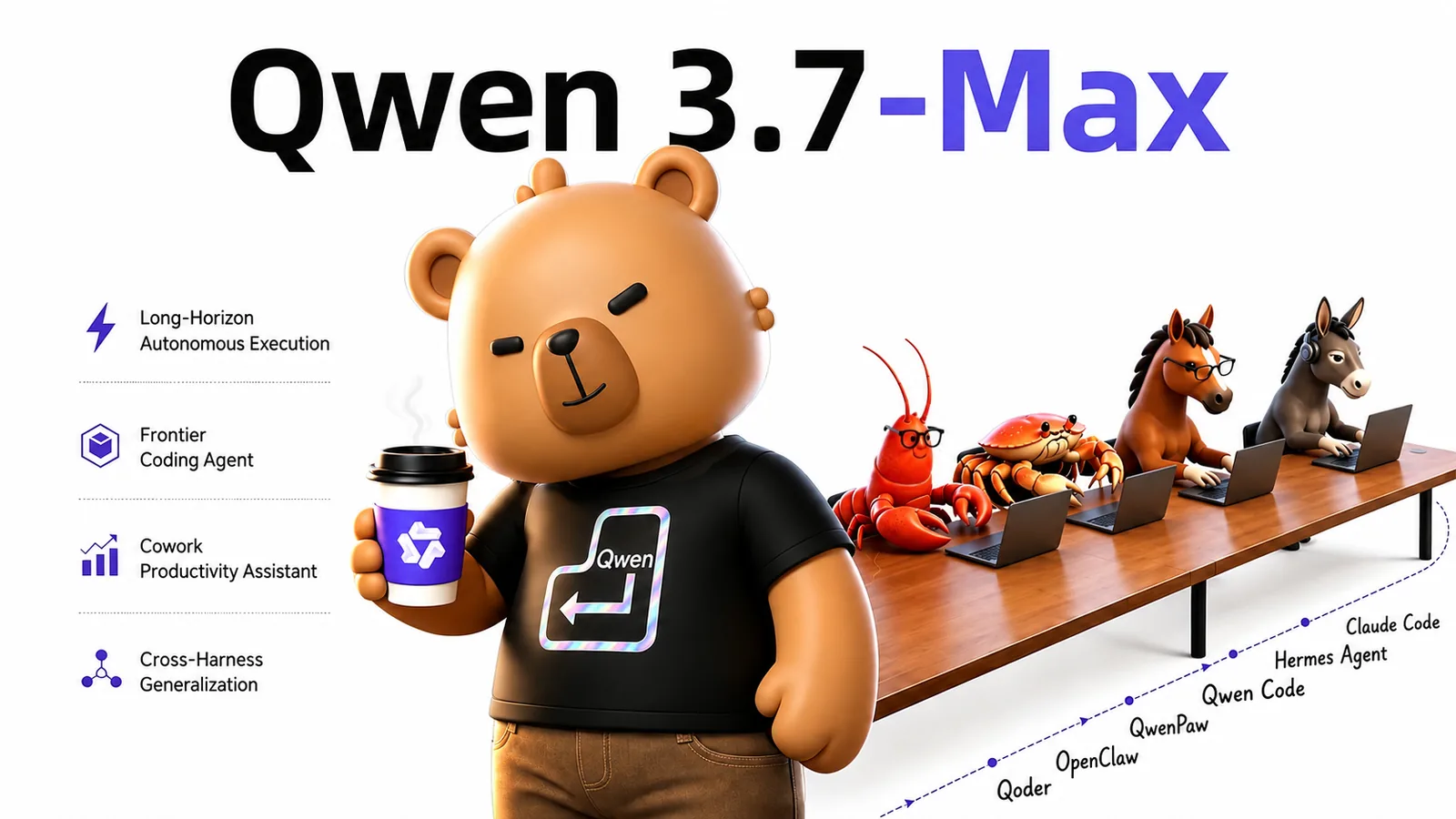
Works in any environment. The model performs equally well across different platforms—Claude Code, OpenClaw, Qwen Code, and others. This is important for developers: there is no need to retrain or reconfigure the system for a specific tool.
The main test: 35 hours and 1158 actions
The most telling example from Alibaba's blog is not a synthetic benchmark, but a real-world task.
The team gave the model a specific assignment: to speed up one of the internal software components of SGLang—a system used when launching large language models themselves. The task was difficult: it required understanding someone else's code, identifying bottlenecks, rewriting them more efficiently, and verifying the results.
An important detail: the model was run on new hardware—T-Head ZW-M890 processors—that it had never seen before. There was no documentation, no hints, only the task and the source code.
The model worked for 35 hours without stopping.
During this time, it performed 1158 actions—writing code, running tests, analyzing results, identifying problems, and rewriting the solution from scratch several times. It didn't stop at the first acceptable option—it continued to improve the result even after 30 hours of work.
The component became 10 times faster than in the original version.
The model detects violations during training itself
This is the most unusual part. When AI is trained using a reward system, it sometimes starts "cheating": finding ways to get a high score without actually solving the task. For example, it might try to peek at the correct answer instead of computing it.
Alibaba integrated Qwen 3.7 Max into a system that monitors this. During an 80-hour experiment, the model independently reviewed records of its own actions, identified suspicious patterns, and formulated new rules to block them.
The model identified 1,618 cases of cheating and added 13 new rules to prevent them. You could say it taught itself to behave more honestly.
A test of managing a startup for a whole year
To check whether the model can think over the long term, Alibaba ran it through YC-Bench—a simulation of a startup's annual lifecycle. Hundreds of rounds of decisions: whether to hire or fire, sign a contract or decline, which client to trust, and which to blacklist.
Qwen 3.7 Max earned $2.08 million in the simulation and completed 237 tasks. The previous version, Qwen 3.6 Plus, earned $1 million. The version two generations earlier, Qwen 3.5 Plus, earned $352,000.
The model didn't just follow a single strategy: it explored different clients, compiled blacklists of traps, changed priorities, and independently recovered from crises in the middle of the game.
What's important to know
Text only. The model understands and generates text only—images and audio are not supported.
Closed source. The Max version is proprietary—source code is not published. The Plus version will be open-source, but it is a less powerful version.
Access via API. The model is available through Alibaba Cloud Model Studio—you need to connect via API.
Model in preview. A full release with broad access for developers and companies worldwide is still ahead.
The Tech on Telegram Follow The Tech on Telegram
Keep up with the latest technology and startup news.
Related reading




More from this author

Article Useful
How to protect your accounts from hacking: 8 settings you should check today
The Tech

Article Useful
500 Global: How the Accelerator Works and Who Can Receive Investments
The Tech

Article Interviews
Game Development in Central Asia: Arkady Moldavski on Developing Reverb and the Growth of the Industry
The Tech

Article Useful
Google, Tesla, BlackRock, and the IMF: Where to Apply for an Internship in Fall 2026
The Tech

News IT
Tesla unveiled the flying electric car Roadster
The Tech

News IT
Intero Biosystems startup won the Startup Battlefield at TechCrunch Disrupt 2026
The Tech