How an Uzbek mathematician became an AI Safety researcher at Stanford
In our new material, we talk about how Abdumalik, an Uzbek, is currently creating safe artificial intelligence systems at Stanford University.
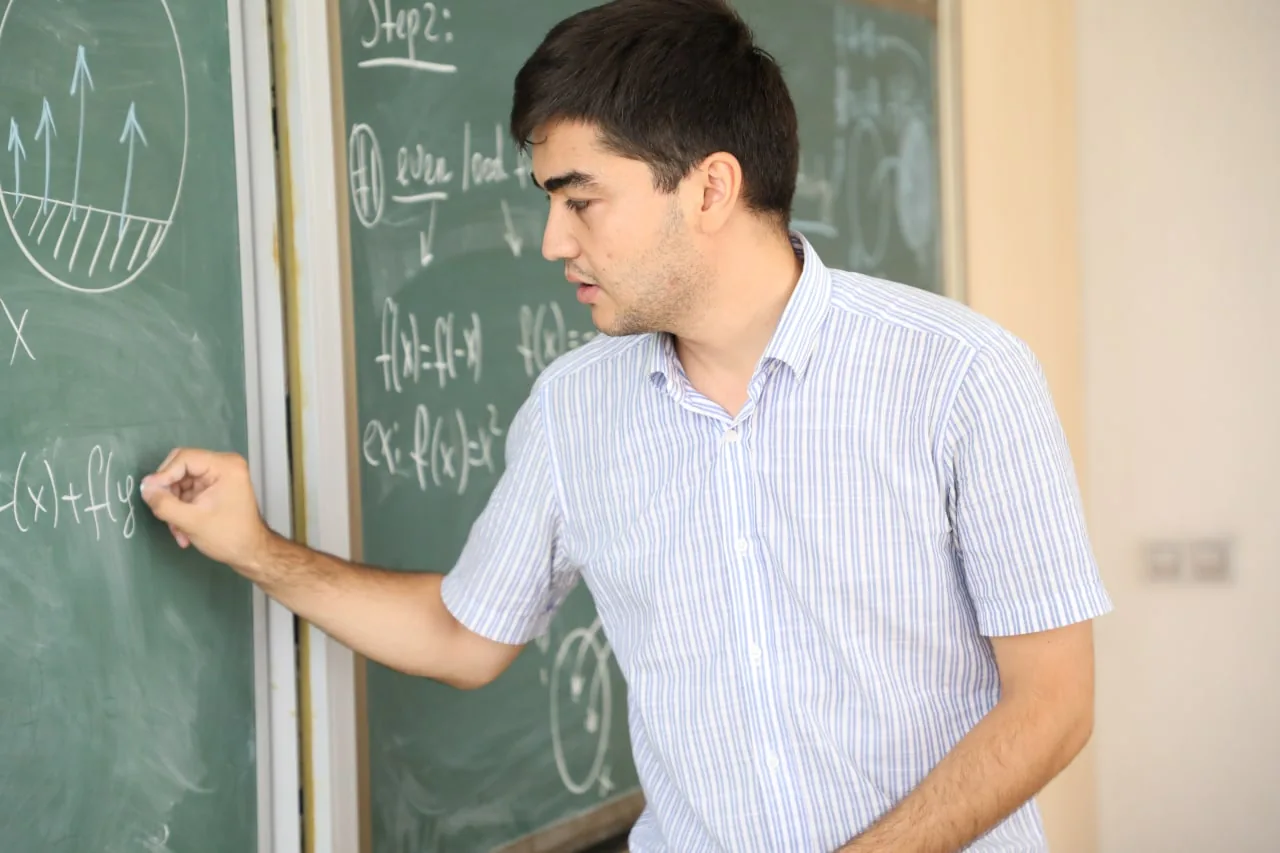
Abdumalik Abduqayumov, Palo Alto, PhD candidate at Stanford University, Instagram
About Me
I am from Uzbekistan and studied at the Karakol International Mathematics School. I then studied economics and finance at Tashkent State University of Economics. During my time in Tashkent, I dedicated most of my time to scientific research in the field of probability theory. Three years ago, I moved to the United States and earned a master’s degree in economics and IT at Duke University. I am currently a first-year PhD student at Stanford University. My research interests include optimization, machine learning, and the problems of AI Alignment and AI Safety.
How I Entered the Field of AI Research
At Duke University, I had the opportunity to conduct research in machine learning and statistics. At that time, I realized that I could apply my knowledge and experience to improve the efficiency of AI models and solve complex tasks. Since my scientific interests were focused on optimization, I naturally entered the field of AI Research, where algorithm efficiency plays a decisive role.
My career as a researcher began with a strong mathematical foundation. During the time I participated in international mathematics olympiads, our main sponsors were companies like Jane Street and other leading financial firms. They often hire olympiad winners. Unfortunately, living in Uzbekistan at that time, I did not have the opportunity to work there directly. Therefore, my friend and I founded our own hedge fund, where I held the position of lead quantitative researcher. Thanks to my previous research experience in probability theory, I successfully handled this task. We solved complex problems in algorithm production and optimization. Unfortunately, we closed the fund in 2022, and just before the start of my master’s program at Duke, I managed to complete an internship at the Financial Stability Department of the Central Bank of the Republic of Uzbekistan. It was precisely this practical and pure research experience that motivated me to dive deeper into science.
I chose Stanford GSB because it is a unique place where rigorous academic research harmoniously coexists with proximity to Silicon Valley. My program, the PhD track in Operations, Information and Technology, fully aligns with my goals. First, OIT allows for deep theoretical research in the fields of optimization and stochastic models, which form the basis of robust training and artificial intelligence safety. Second, Stanford supports an interdisciplinary approach, which gives me the opportunity to collaborate with experts from the Computer Science department and Stanford HAI. Furthermore, proximity to industry leaders not only allows for the development of theory but also for working on practical AI Alignment tasks in real-time. For me, it is very important that my research yields practical results and helps make artificial intelligence systems more reliable and safer.
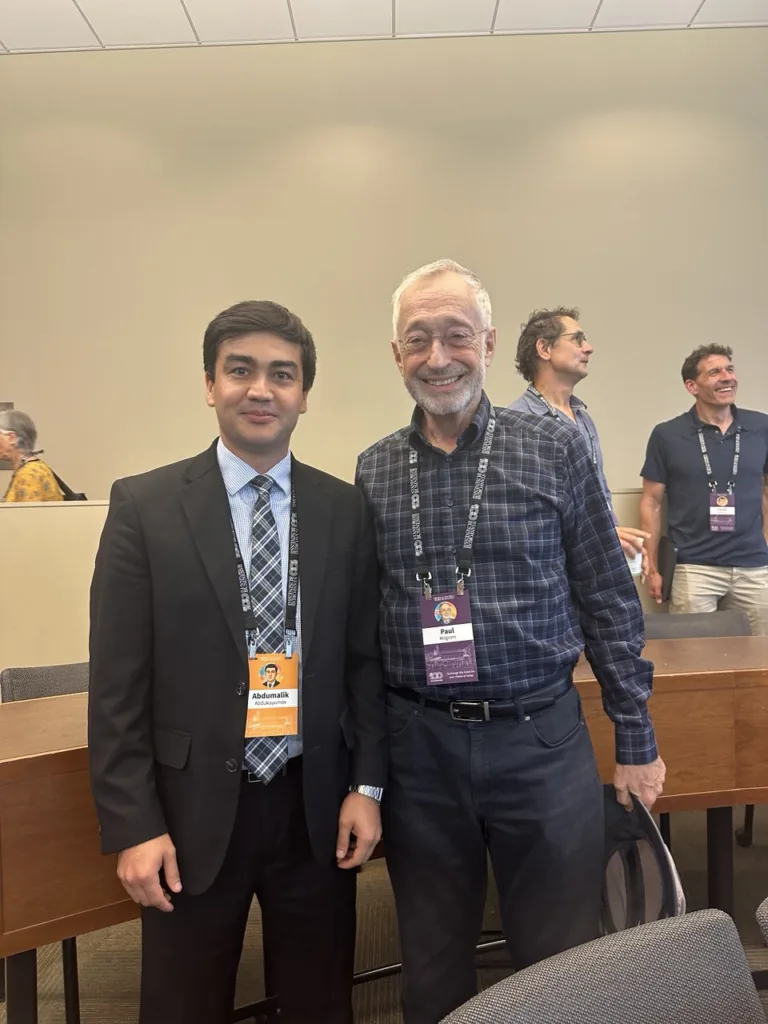
How the PhD Program Selection Process Went
The selection process for Stanford is highly competitive. This year, only three students were admitted to my PhD program in the OIT track. Having a strong mathematical foundation is crucial for admission to such a program. In my case, I believe the medals I won in international mathematics olympiads during school and university were a huge advantage. They served as clear evidence of my analytical thinking skills necessary for conducting complex research.
Furthermore, research experience is crucial for world-class PhD programs. Before admission, I collaborated closely with Professor Yehua Wei at the Fuqua School of Business. My work focused on optimization and training algorithms, specifically the extension of high-dimensional perfect foresight inequalities. This experience allowed the admissions committee to see that I was ready for independent scientific activity. Given that the admission rate to Stanford GSB is less than 5 percent, the synergy between my olympiad background and real academic papers became the key to my success.
My preparation in economics and algorithmic game theory is one of my main advantages in artificial intelligence research, especially in areas like AI Alignment and AI Safety. First, the problem of AI Alignment is essentially a task of mechanism design. We try to design such incentives and reward functions so that the behavior of the SI-agent aligns with human values. Game theory provides a precise mathematical apparatus for modeling such interactions. Second, modern AI methods, especially robust training, rely on the same fundamental principles as mathematical economics—optimization and stochastic processes. My experience working with perfect foresight inequalities and “regret bounds” is directly useful in analyzing the efficiency and reliability of training algorithms.
Finally, when we consider systems with many autonomous agents, game theory is the only way to predict and stabilize their behavior to prevent unexpected or dangerous consequences. My interdisciplinary knowledge and experience allow me to view artificial intelligence safety problems not just as engineering tasks, but as complex systems of incentives and strategic decisions.
Challenges
Transitioning from theoretical mathematics and economics to the technical field of AI was an interesting challenge for me. In this process, I would highlight two main difficulties. First, this is the transition from “proof-based” thinking to “experimental” thinking. In mathematics, we are used to working within the framework of strict proofs: if a theorem is proven, it is always true. In the fields of deep learning and RL, however, theory often follows practice. I had to learn to work in an environment where I conduct many experiments, tune hyperparameters, and analyze empirical results that cannot always be explained theoretically immediately. Second, this is the engineering aspect. Although I had basic programming knowledge, the modern AI field requires mastery of a specific technology stack—working with PyTorch, GPU computing, and effectively implementing complex optimization algorithms. However, my experience participating in mathematics olympiads helped me greatly. The olympiad base taught me to quickly understand new abstract structures and find non-standard solutions. Thanks to this, I was able to quickly master the necessary tools and focus on the main goal—how my knowledge of optimization can improve the safety and reliability of artificial intelligence systems.
Dead ends are inevitable in scientific work—they are part of the process of seeking new knowledge. When my research hits a dead end, I use several proven approaches:
1. My olympiad experience taught me that if a problem cannot be solved for a long time, perhaps I made the wrong assumption from the beginning. I try to simplify the model to its basic level and check if my ideas work in the simplest example.
2. One of the main advantages of studying at Stanford is having prominent specialists. I often discuss my difficulties with my colleagues or scientific supervisor. Sometimes an outside perspective helps see things that were overlooked due to getting too deep into details.
3. If I feel “stuck,” I temporarily switch to another task. For example, programming or reading literature on the relevant topic. Often, the solution comes precisely during such a mental break.
4. I write down why this or that approach did not work. In research, a negative result is also a result. This helps me organize the process and avoid repeating the same mistakes in the future.
Such an approach helps maintain motivation and turn every difficulty into a step toward the correct solution.
One of the most serious technical tasks I worked on was the research collaboration with Professor Yehua Wei at Duke University. We worked on extending perfect foresight inequalities for complex decision-making scenarios. The main technical difficulty was related to computational complexity in high-dimensional spaces. In multivariate settings, the number of constraints in optimization problems usually increases exponentially, making standard computational methods almost useless. My task was to find a way to increase computational efficiency without losing accuracy. To solve this problem, I developed a linear programming formulation with a polynomial number of constraints instead of an exponential one. This required a deep application of stochastic modeling and combinatorial optimization apparatus. As a result, we managed to prove new bounds on regret for training algorithms. This experience was very important for my current work in the field of AI Safety: it taught me that the safety and reliability of artificial intelligence systems, especially under conditions of high uncertainty, must start with mathematically proven guarantees of algorithm behavior.
Recommendations
Based on my personal experience of transitioning from pure mathematics to artificial intelligence safety research, I would give three main pieces of advice:
1. Strengthen your mathematical foundation. AI Safety is not just philosophy, but a strict technical discipline. A deep understanding of probability theory, optimization, and stochastic processes is not just a basis for using existing models, but for creating new methods to check their safety. My knowledge from my olympiad past has saved me several times when solving problems where standard methods did not work.
2. Study game theory and incentive economics.
The alignment problem, essentially, means redirecting the SI agent from striving for an artificially high score and aligning its behavior with our actual defined goals. Knowledge in the field of game theory helps you better understand how to design reward functions and analyze agent behavior in complex environments.
3. Do not be afraid of interdisciplinarity and early participation in research.
The AI Safety field requires ideas from the most diverse fields, from computer science to political economy. Look for opportunities to work on real projects with professors or in research laboratories. Working on a real scientific paper or algorithm teaches you much more than just reading literature.
Remember, this field is still very young, and you have the opportunity right now to contribute to how the future of humanity will look in the age of superintelligence.
The Tech on Telegram Follow The Tech on Telegram
Keep up with the latest technology and startup news.
Related reading



More from this author

Article Useful
How to protect your accounts from hacking: 8 settings you should check today
The Tech

Article Useful
500 Global: How the Accelerator Works and Who Can Receive Investments
The Tech

Article Interviews
Game Development in Central Asia: Arkady Moldavski on Developing Reverb and the Growth of the Industry
The Tech

Article Useful
Google, Tesla, BlackRock, and the IMF: Where to Apply for an Internship in Fall 2026
The Tech

News IT
Tesla unveiled the flying electric car Roadster
The Tech

News IT
Intero Biosystems startup won the Startup Battlefield at TechCrunch Disrupt 2026
The Tech