OpenAI has released GPT-Rosalind — a specialized model for accelerating drug development
OpenAI has introduced GPT-Rosalind, a reasoning model specifically designed for the life sciences. It is intended for use in biology, drug development, and translational medicine. The model is optimized for scientific workflows: genome analysis, protein modeling, chemical calculations, and synthesis of research literature.
The Tech AI
Get the key points in seconds - a short summary from The Tech AI.
OpenAI has introduced the GPT-Rosalind model, named after Rosalind Franklin. The model outperforms GPT-5.4 on the LABBench2 test and achieved results exceeding those of 95% of experts at partner Dyno Therapeutics. It is currently available only to Enterprise customers in the United States through a trusted access program.
The name is given in honor of Rosalind Franklin, whose work helped reveal the structure of DNA and laid the foundation for molecular biology.
Why a separate model is needed
In the US, the path from discovering a molecular target to regulatory approval of a new drug takes an average of 10 to 15 years. OpenAI believes that progress in the early stages creates a cumulative effect on all subsequent stages — if scientists more accurately select targets, formulate hypotheses faster, and conduct higher-quality experiments.
The key problem that GPT-Rosalind solves is not the complexity of science itself, but the complexity of research processes. Scientists work with vast amounts of literature, specialized databases, experimental data, and constantly changing hypotheses.
What the model can do
GPT-Rosalind shows the best results in tasks related to reasoning about molecules, proteins, genes, biological pathways, and disease biology. It works more effectively with scientific tools and databases in multi-step processes: literature review, interpreting "sequence-function" relationships, experimental planning, and data analysis.
In open tests, the model demonstrates high results. In the BixBench test, based on real bioinformatics tasks, GPT-Rosalind showed the best results among all models with published metrics.
In the LABBench2 test, it surpasses GPT-5.4 in 6 out of 11 categories — the most significant improvement was recorded in tasks for complete design of DNA sequences for molecular cloning protocols.
In partnership with Dyno Therapeutics, specializing in gene therapy, the model was tested on tasks of predicting and generating RNA sequences. The best of the 10 proposed variants exceeded 95% of experts in the prediction task and about 84% in the sequence generation task.
Plugin and tools
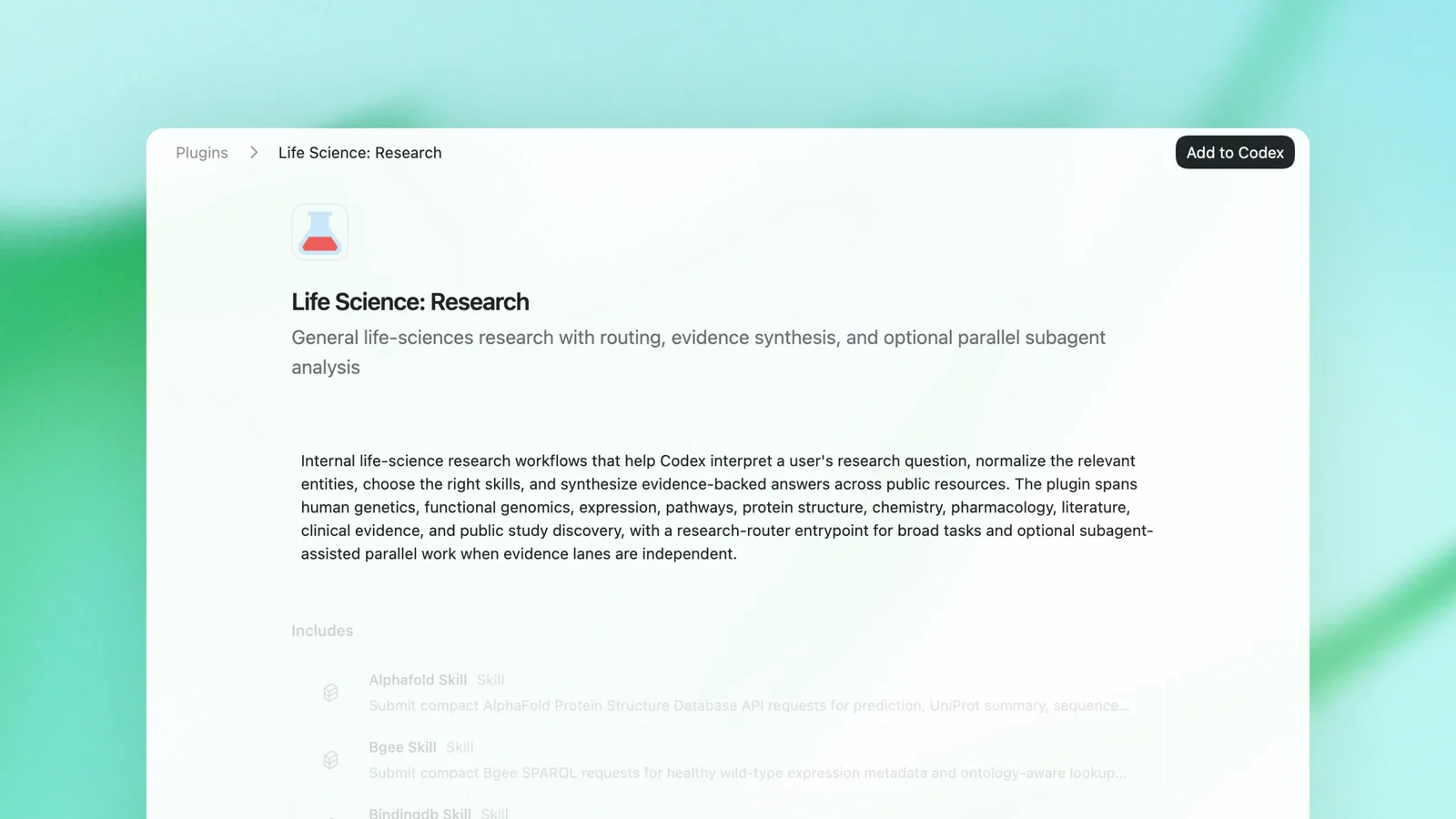
Along with the model, OpenAI released a research plugin for life sciences — the Life Sciences research plugin for Codex. It is available for free on GitHub and provides access to more than 50 public databases, literature sources, and biological tools. Among the supported areas are human genetics, functional genomics, protein structure, biochemistry, and clinical data.
Enterprise-level users can use the plugin together with GPT-Rosalind for deeper analysis. For others, the plugin is available when working with basic OpenAI models.
Who has access
In the initial stage, GPT-Rosalind is launched as part of a trusted access program for qualified Enterprise customers in the US. Organizations must conduct scientific research with clear public benefit, maintain compliance control mechanisms, and restrict access only to approved users within secure environments.
During the preliminary research period, using the model does not consume existing credits or tokens. Access can be requested on the OpenAI website.
The Tech on Telegram Follow The Tech on Telegram
Keep up with the latest technology and startup news.
Related reading




More from this author

Article Useful
How to protect your accounts from hacking: 8 settings you should check today
The Tech

Article Useful
500 Global: How the Accelerator Works and Who Can Receive Investments
The Tech

Article Interviews
Game Development in Central Asia: Arkady Moldavski on Developing Reverb and the Growth of the Industry
The Tech

Article Useful
Google, Tesla, BlackRock, and the IMF: Where to Apply for an Internship in Fall 2026
The Tech

News IT
Tesla unveiled the flying electric car Roadster
The Tech

News IT
Intero Biosystems startup won the Startup Battlefield at TechCrunch Disrupt 2026
The Tech