Nvidia is no longer alone: how Google, Amazon, and Meta are creating their own AI chips
Nvidia remains the dominant player in the AI chip market, but more and more major technology companies are seeking to reduce their dependence on it. Google, Amazon, and Meta are already developing their own accelerators and will actively expand their use in 2026. This article examines why Big Tech is creating its own AI chips, how they differ from Nvidia's solutions, and whether this could change the AI infrastructure market.
Why BigTech is creating its own AI chips
GPUs remain a universal tool for training and running AI models. But universality has a downside: the same accelerator must be adapted for many different tasks.
For Google, Amazon, and Meta, which perform huge volumes of similar AI operations daily, it is more cost-effective to create hardware tailored to specific scenarios.
The main reasons are energy efficiency, cost of computation, control over infrastructure, and optimization for proprietary software.
At the scale of hyperscalers, even a small improvement in performance per watt can yield significant benefits. Additionally, proprietary chips allow companies to reduce dependence on the availability of third-party accelerators and independently define hardware specifications for future workloads.
However, there is an important nuance: developing a proprietary processor does not mean an automatic abandonment of Nvidia. Proprietary ASICs make sense primarily where the workload is sufficiently predictable and massive.
Google bets on TPU
Google was one of the first major players to systematically develop its own AI accelerators.
The company is developing the Tensor Processing Unit (TPU) — specialized chips for machine learning, used both within Google itself and offered to customers via Google Cloud.
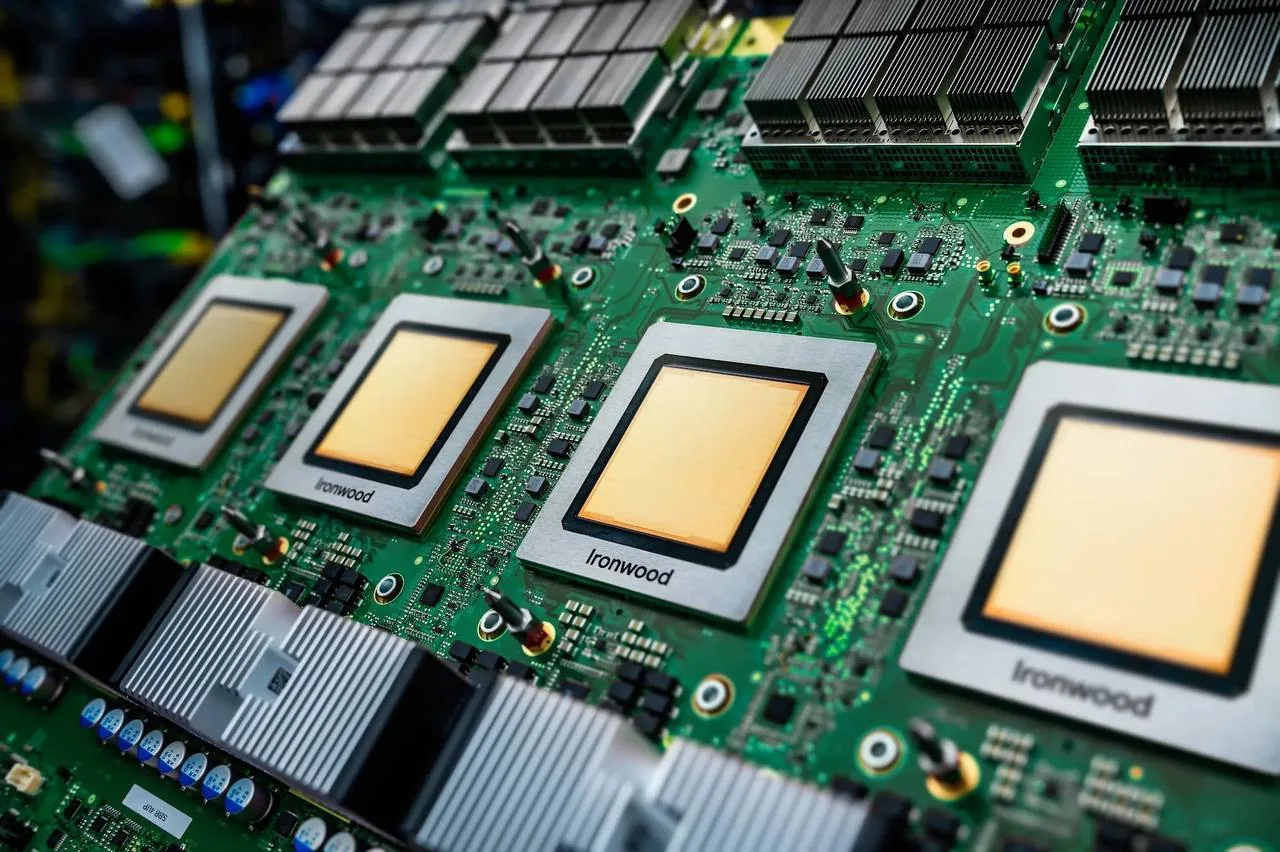
In 2025, Google introduced Ironwood — the seventh generation of TPU, primarily focused on inference, i.e., running already trained models. The system can scale up to 9,216 chips in a single superpod.
In April 2026, Google introduced TPU 8t and TPU 8i. The former is optimized for model training, while the latter is designed for fast and cost-effective inference, including for AI agents.
Meanwhile, Google is not framing the issue as “TPU vs. Nvidia.” The company continues to use and offer Nvidia GPUs to customers. In Alphabet’s Q1 2026 earnings report, it is stated that both proprietary TPUs and Nvidia GPUs remain part of Google Cloud’s infrastructure.
Thus, Google is effectively building a hybrid infrastructure, where different types of accelerators are used for different tasks.
Amazon develops Trainium and Inferentia
Amazon is developing its own line of AI accelerators through AWS.
The company has two main directions here: Trainium is primarily intended for training AI models, while Inferentia is for running them and inference.
Amazon promotes these chips as an alternative to universal GPUs for certain cloud workloads. In 2026, AWS continued to expand the software ecosystem around its proprietary accelerators: the Neuron SDK received new tools for model optimization and developing low-level kernels for Trainium and Inferentia.
This is an important point. Competition is no longer just about the chips themselves. Amazon is building its own hardware + software stack to make the transition to Trainium and Inferentia as convenient as possible for developers.
AWS is also gradually integrating these accelerators into a broader range of its services. For example, in 2026, Trainium and Inferentia became available in Amazon ECS Managed Instances.
Meta expands its line of proprietary chips
Meta is developing its own accelerator, the Meta Training and Inference Accelerator (MTIA).
Initially, the company created it primarily for ranking and recommendation workloads — for example, recommendation systems and advertising. Meta explained that for such specific tasks, universal GPUs do not always provide optimal efficiency. But now the company’s ambitions are much broader.
In March 2026, Meta announced that it plans to roll out four new generations of MTIA — MTIA 300, 400, 450, and 500 over two years. These are expected to expand the use of proprietary chips from recommendation inference to model training and GenAI workloads. The company also reported that it has already deployed hundreds of thousands of MTIAs in production.
At the same time, Meta is not abandoning Nvidia. In February 2026, Nvidia announced a multi-year partnership with Meta, which involves deploying millions of Blackwell and Rubin GPUs in the company’s infrastructure.
This clearly illustrates where the market is heading: proprietary ASICs do not necessarily have to displace Nvidia. They can complement GPUs, taking on the workloads best suited for them.
Why Nvidia remains the leader for now
Nvidia’s main advantage is no longer just the GPUs themselves.
It is the vast software ecosystem surrounding CUDA, libraries, compilers, development tools, and optimization utilities. For companies and developers, this means that switching to another type of accelerator may require additional engineering resources.
Nvidia itself continues to rapidly develop both hardware and software. In June 2026, the company announced leading results for Blackwell in MLPerf Training 6.0, including tests of modern MoE models.
Moreover, Nvidia has already moved on to the next generation — Rubin. The company states that the new platform is designed to further reduce the cost and energy consumption of inference for agentic AI systems.
This creates a sort of race: while Google, Amazon, and Meta are creating specialized chips, Nvidia continues to improve universal accelerators and simultaneously strengthen its software stack.
The Tech on Telegram Follow The Tech on Telegram
Keep up with the latest technology and startup news.
Related reading



More from this author

Article Useful
How to protect your accounts from hacking: 8 settings you should check today
The Tech

Article Useful
500 Global: How the Accelerator Works and Who Can Receive Investments
The Tech

Article Interviews
Game Development in Central Asia: Arkady Moldavski on Developing Reverb and the Growth of the Industry
The Tech

Article Useful
Google, Tesla, BlackRock, and the IMF: Where to Apply for an Internship in Fall 2026
The Tech

News IT
Tesla unveiled the flying electric car Roadster
The Tech

News IT
Intero Biosystems startup won the Startup Battlefield at TechCrunch Disrupt 2026
The Tech