A Chinese robot has broken the world record in running. What does this mean for robotics?
On April 19, 2026, in Beijing, a humanoid robot finished a half-marathon faster than the human world record for the first time in history. The result sparked widespread discussion—some called it a breakthrough in robotics, while others questioned the significance of the achievement. Let’s examine what actually happened and what it means for the industry.
What happened
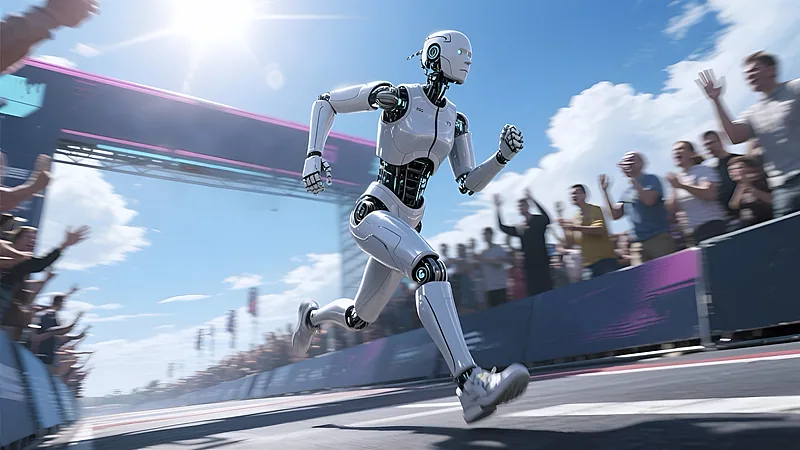
On April 19, 2026, the second humanoid robot half marathon, the Beijing E-Town Half Marathon, took place in Beijing. The Flash robot from the Chinese company Honor completed the 21-kilometer distance in 50 minutes and 26 seconds using autonomous navigation. This time is faster than the human world record of 57 minutes and 20 seconds, set by Ugandan runner Jacob Kiplimo at the Lisbon Half Marathon a month earlier.
More than 100 teams from various countries, including Germany, France, and Brazil, participated in the race. For comparison, in the first edition in 2025, only 20 teams participated, and the winner finished in 2 hours and 40 minutes. The progress made in just one year is tremendous.
How it was organized
The robots ran on the same course as the humans but in separate, fenced-off lanes. The competition was held in two formats: autonomous navigation and remote control. For teams using remote control, the finish time was multiplied by a factor of 1.2 to encourage the development of autonomous technologies. About 40% of the teams chose the autonomous mode.
The course was mapped out in advance and practiced by the teams. Each robot was accompanied by a group of engineers. During the race, Flash collided with a barrier, fell, and was picked up by the support crew.
What experts say
Opinions in the scientific community are divided.
Professor Rodney Brooks of the Massachusetts Institute of Technology, one of the founders of iRobot, evaluated the event sharply: in his view, the result proves nothing in terms of real-world application. The robots moved along a pre-known route, did not interact with people, and were not safe in a real environment. He draws a parallel: once there were races between horses and cars—this did not mean that cars were ready for the roads.
Professor Alan Fern from Oregon State University, who helped create the bipedal robot Cassie, agrees that there was no scientific breakthrough. According to him, what happened instead was a significant engineering leap and massive investments. Robots have become faster and more reliable, but the basic principles of locomotion have existed for a long time.
Professor Yanran Ding from the University of Michigan sees the main achievement elsewhere—in solving the overheating problem. Robot motors have long been capable of running short distances, but on longer distances, cooling became a bottleneck. Honor solved this using a liquid cooling system—the same technology used in high-end computers.
Why it still matters
Jonathan Hurst, one of the creators of Cassie and co-founder of Agility Robotics, considers the Beijing race a turning point—not scientific, but industrial. In 2021, when Cassie first ran five kilometers on the street with autonomous control, almost no one noticed. Now, dozens of teams around the world are replicating the same approach—cheaper and faster.
In one year, the number of participants grew from 20 to more than 100 teams. Robots stopped falling at the start and began finishing. This is not a revolution, but it is a scale at which the real work is just beginning.
Where the real boundary lies
Professor Ding formulates the main paradox precisely: people think that running a half marathon faster than a human is harder than folding laundry. For a robot, it is the opposite. Running at speed on a known course is a solvable engineering task. Moving among people, reacting to an unpredictable environment, and causing no harm—this is where robotics currently falls short.
The robot Flash can run fast. But sending it to a crowded market without a map and without a support crew is a different story.
The Tech on Telegram Follow The Tech on Telegram
Keep up with the latest technology and startup news.
Related reading




More from this author

Article Useful
How to protect your accounts from hacking: 8 settings you should check today
The Tech

Article Useful
500 Global: How the Accelerator Works and Who Can Receive Investments
The Tech

Article Interviews
Game Development in Central Asia: Arkady Moldavski on Developing Reverb and the Growth of the Industry
The Tech

Article Useful
Google, Tesla, BlackRock, and the IMF: Where to Apply for an Internship in Fall 2026
The Tech

News IT
Tesla unveiled the flying electric car Roadster
The Tech

News IT
Intero Biosystems startup won the Startup Battlefield at TechCrunch Disrupt 2026
The Tech