Kazakhstani FinTech startups raised $72 million over 5 years
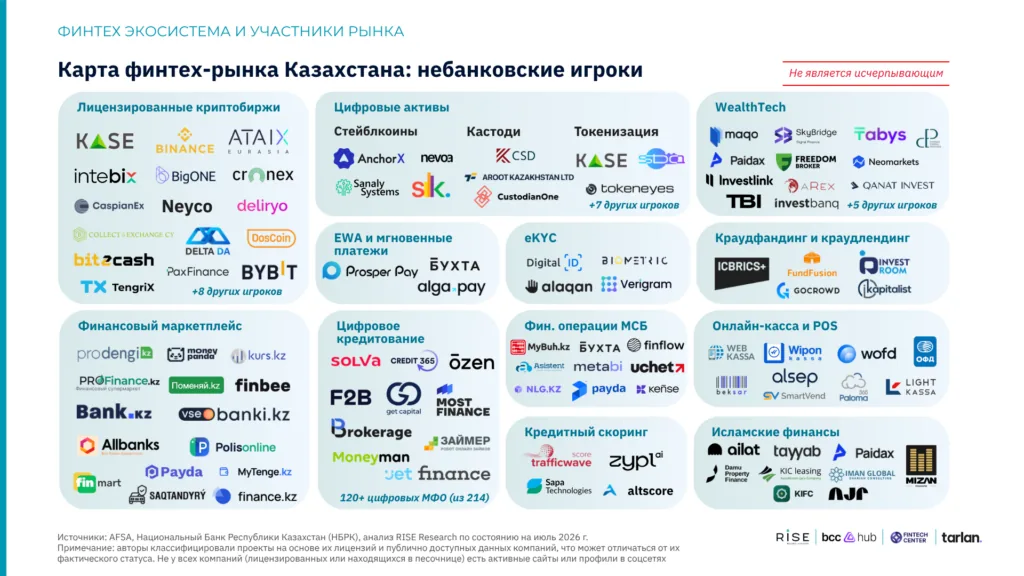
The Fintech in Kazakhstan 2026 study shows: the Kazakhstani FinTech market has formed around large banking ecosystems. Banks have captured a significant share of the mass consumer market, making it increasingly difficult for independent technology companies to compete for end customers. At the same time, the development of Open Banking, Banking-as-a-Service, unified payment infrastructure, and regulatory improvements are creating new opportunities for small technology businesses.
The Tech AI
Get the key points in seconds - a short summary from The Tech AI.
At the Central Asia Fintech Summit, the Fintech in Kazakhstan 2026 report was presented. Banks control 69% of assets and are narrowing niches for startups that attracted $72 million in 2021–2025. In 2026, interbank QR payments were introduced (the share of cashless transactions is 88%), the national regime for digital assets was launched, and regulatory oversight was strengthened. The market is shifting towards BaaS and AI: 75% of banks already use artificial intelligence.
RISE Research & Advisory, in partnership with Tarlan Payments, BCC Hub, and the Fintech Center, with the support of the National Bank of the Republic of Kazakhstan, presented the third annual national study of Kazakhstan’s FinTech market — Fintech in Kazakhstan 2026 — at the Central Asia Fintech Summit.
Banks captured the majority of the mass FinTech market
The five largest banks hold 69% of Kazakhstan’s total banking assets. Their apps combine payments, lending, e-commerce, travel, transport, government services, and other everyday utilities. Banks are also expanding their ecosystems in the small business segment. According to the study’s authors, they already offer solutions for 16 out of 19 key small business needs — from company registration and account opening to payments, lending, payroll processing, and accounting services. As a result, the space for independent FinTech companies and startups is shrinking.
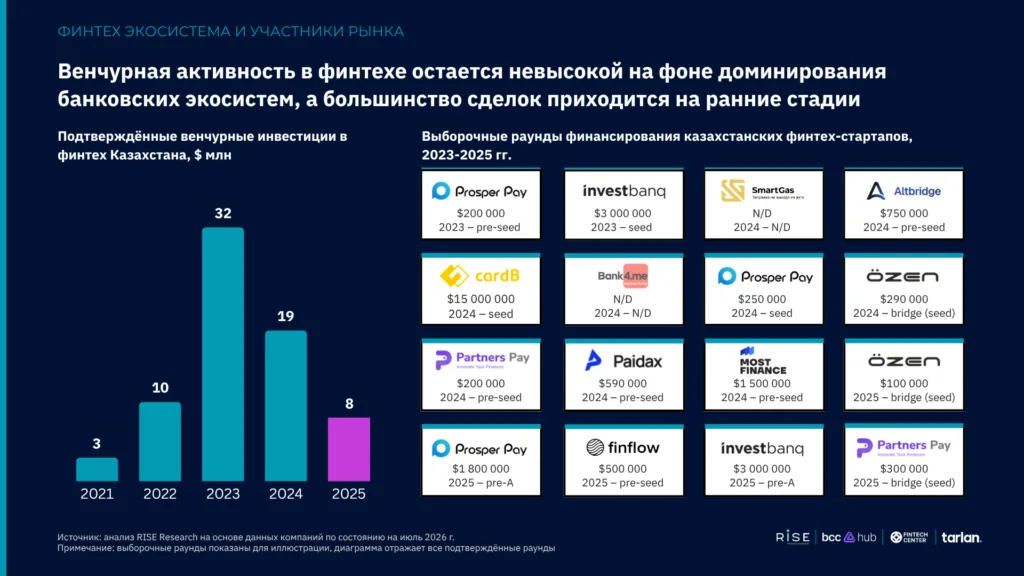
Between 2021 and 2025, Kazakh FinTech startups attracted approximately $72 million in venture capital investment. After a peak of $32 million in 2023, investment volumes declined to $19 million in 2024 and $8 million in 2025. Most deals occurred at early stages. Investment transactions are increasingly concentrated in B2B and infrastructure solutions.
2026 became a year of regulatory and infrastructure reset for Kazakhstan’s FinTech market
2026 was one of the most intensive periods for financial regulation in Kazakhstan — significant changes were adopted in banking, digital, and tax regulation; new rules for AI application were established; and a national regulatory regime for digital assets was created. At the same time, new important elements of financial infrastructure were launched — interbank QR payments and phone number-based transfers, scaling of the digital tenge in government spending, an Anti-Fraud Center, and others.
The new Law on Banks and Banking Activity in Kazakhstan introduces a two-tier licensing system, provides for the development of open banking and banking-as-a-service, and expands opportunities for interaction between banks and external technology companies. At the same time, requirements for risk management, cybersecurity, and data protection are strengthening. Thus, the financial infrastructure is becoming more open to small FinTech companies while simultaneously raising requirements for all market participants.
Kazakhstan is forming a unified payment infrastructure
Kazakhstan has already shifted to a predominantly cashless payment model: the share of cashless transactions reached 88% in 2026, compared to 67% in 2019. At the same time, the structure of payments is changing. The share of QR payments in the number of cashless transactions grew from 14% in 2023 to 28% in 2025. In January–May 2026, QR payment turnover reached approximately $17 billion, exceeding the turnover volume of POS terminal transactions for the second consecutive year.
On July 19, 2026, a unified interbank system for QR payments and phone number-based transfers became operational in all retail banks across the country. At the same time, infrastructure for data exchange between banks and technology companies via open APIs is being developed. For banks, this changes the nature of competition. As the basic payment infrastructure becomes standardized, proprietary payment solutions cease to be an independent competitive advantage. Product quality, customer experience, data utilization, and additional services are gaining increasing importance.
Andrey Sedenko, CEO of Tarlan Payments
When the basic payment infrastructure becomes common to all, the mere fact of accepting payments ceases to be an advantage. The winner is the one who solves business tasks quickly and transparently in a single interface and supports the client not only at the start but also during growth. For independent FinTechs, this is an opportunity to build specialized solutions on top of the common infrastructure and work with multiple banks simultaneously.
BaaS becomes a separate market segment
Banking-as-a-Service (BaaS) is gradually becoming a distinct market segment. If a few years ago such services were offered only by individual banks, today at least four banks provide external companies with access to licensed banking infrastructure, processing, and other necessary services. This allows FinTech companies and non-financial platforms to launch financial products based on their partner’s banking infrastructure.
Ruslan Yensebayev, General Director of BCC Hub
Access to banking infrastructure can now be obtained from several banks. The difference is not in the API, but in who takes on the operational side along with access: onboarding, KYB, handling inquiries, service levels, and division of responsibility with the interface owner. Responsibility to the client remains with the bank — therefore, for us, BaaS is an operational model, not a product line.
Digital assets are transitioning from pilot regimes to a national regulatory framework
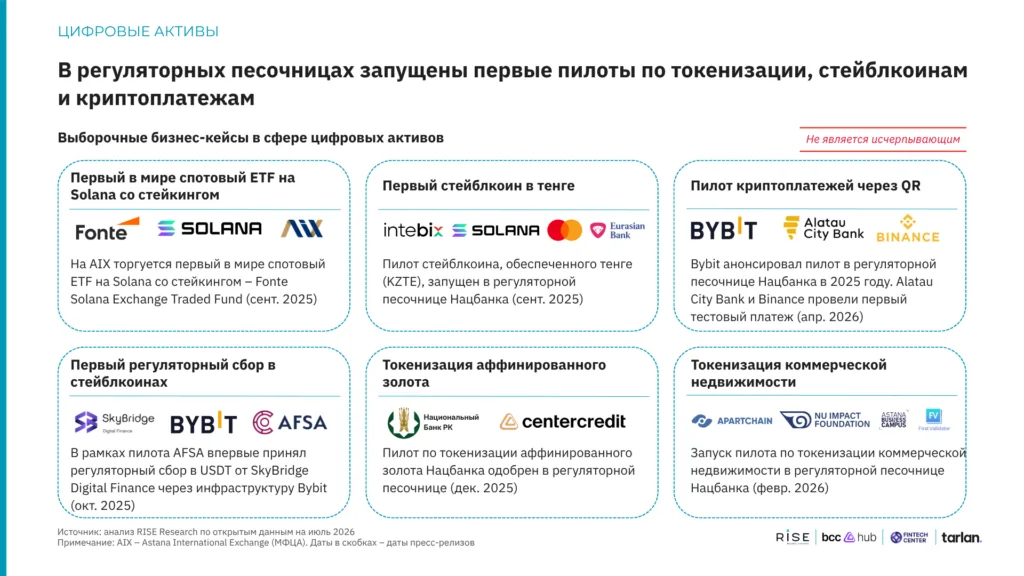
Since May 2026, Kazakhstan has implemented a national regulatory regime for digital assets, complementing the regime of the International Financial Center “Astana” (IFC “Astana”). In 2025, IFC “Astana”-licensed digital asset service providers processed $10.6 billion in transactions and served approximately 215,000 clients. Meanwhile, the market is gradually moving beyond cryptocurrency trading. In Kazakhstan, a tenge-backed stablecoin, tokenization of gold and commercial real estate, and payments using digital assets have already been launched or are undergoing testing. According to the study’s authors, the next stage of market development may involve scaling the tokenization of real-world assets and integrating them into traditional financial operations.
Dias Savetkanov, General Director of Fintech Center
Competition has shifted to the infrastructure level: open banking, BaaS, and digital assets represent a new frontier where leadership has not yet been established. Our report is the first to consolidate data from the national framework and IFC “Astana” into a single picture. This provides market participants and regulators with a common factual foundation for decision-making and developing a coordinated agenda.
A new market phase: Artificial Intelligence
Another important trend identified in the study is the deeper integration of AI into banking activities — from credit scoring and fraud prevention to software development and risk management.
Ainur Zhyanturina, Director of RISE Research & Advisory
About 75% of banks in Kazakhstan already use AI — for assessing customer creditworthiness, detecting fraudulent transactions, and in marketing. The next stage is the combination of AI with BaaS, i.e., external FinTech services that companies can embed into their products. This opens up opportunities for small technology startups to compete with large players not by scale, but by their ability to more accurately solve specific customer tasks.
The full version of the Fintech in Kazakhstan 2026 report is available on the RISE Research & Advisory website and on partner websites.
The Tech on Telegram Follow The Tech on Telegram
Keep up with the latest technology and startup news.
Related reading




More from this author

Article Useful
How to protect your accounts from hacking: 8 settings you should check today
The Tech

Article Useful
500 Global: How the Accelerator Works and Who Can Receive Investments
The Tech

Article Interviews
Game Development in Central Asia: Arkady Moldavski on Developing Reverb and the Growth of the Industry
The Tech

Article Useful
Google, Tesla, BlackRock, and the IMF: Where to Apply for an Internship in Fall 2026
The Tech

News IT
Tesla unveiled the flying electric car Roadster
The Tech

News IT
Intero Biosystems startup won the Startup Battlefield at TechCrunch Disrupt 2026
The Tech