How Claude Code Changed the Rules of Development in One Year
A year ago, Anthropic released a tool that looked strange—a black screen, no interface, just a text input. Many didn’t understand why it was needed at all. Today, this tool generates $2.5 billion in annual revenue for the company and is changing how teams launch products. Artyom Panfyorov discusses what has happened over the past year and why it matters.

In his Telegram channel, Artem shares his experience integrating AI into business and use cases for modern tools.
Artem Panfyorov, City — Tashkent, serial entrepreneur, founder of AI LAB and co-founder of the startup ecosystem Angel Connect
I am convinced that over the past year, many have heard about how significantly AI is changing the entire world around us. This is especially true for IT product development.
Currently, at AI LAB, we use Claude Code for approximately 70% of routine development for internal and external products. For us, this has become a standard workflow, not just a "convenient tool occasionally."
This is important because it fundamentally changes the cost of launching a product from scratch. Previously, launching an MVP or automation required tens of thousands of dollars and several months of work by an entire team. Now, AI agents help at every stage, from architecture to deployment, not in months, but in days and even hours. For those working in IT or managing products, this changes everything: the speed of hypothesis testing has become fundamentally different.
To be honest: if you have never done development, it will be difficult, but realistic and definitely interesting. And for those working in IT or managing products, this truly changes everything.
There are different development products on the market now, but in my experience, the most effective one currently is Claude Code. It was with this AI agent in the terminal from Anthropic that the global reshaping of the IT industry began.
We will discuss how this happened in this article.
February 2025: A Strange Start
In February 2025, Anthropic released the beta version of Claude Code along with the Claude 3.7 Sonnet model. To a "non-developer," it looked strange: not a beautiful editor with hints, but a tool in a standard terminal: a black screen, text input, almost no visual interface. You have probably seen a window with a black background and green letters from hacker movies. That is exactly what a "terminal" is.
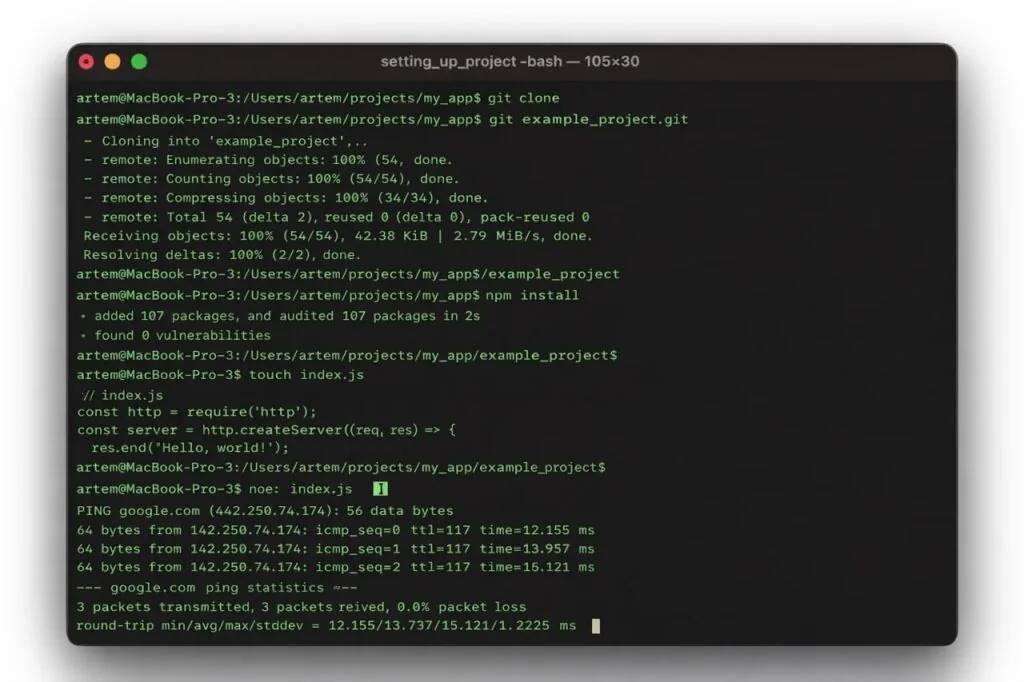
In fact, this was the essence of Anthropic's success. It is important to understand the difference between two approaches here.
At that moment, the entire market of AI tools for developers was competing in beauty: convenient code editors, beautiful hints, neat interfaces. Most competitors worked simply as plugins for IDEs.
In simple terms: you look at a line, and AI suggests what to write next. This works like T9 on your phone, but for code. It is convenient, but limited: such a tool does not see the entire project, does not remember context, and does not make decisions independently.
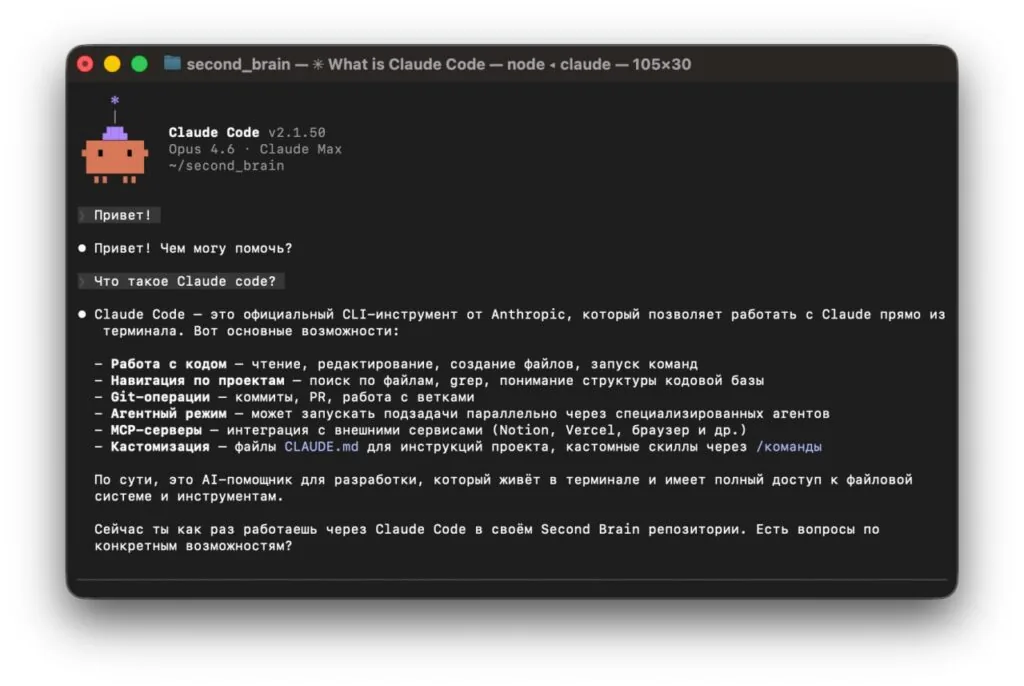
Anthropic chose a different path for Claude Code. It works as an agent: it receives a task at the level of "do this" and figures it out itself. It reads the necessary files, creates a plan, writes code, checks the result, and reports on it. This is closer to how a real employee works with a task than to auto-completion in a text editor.
The terminal here is not a concept, but simply the environment where developers already spend most of their time. Anthropic did not invent a new interface and try to convince everyone to move. They went where people were already working.
May 2025: Full Launch of Claude Code
In May, the full version of Claude Code was released for everyone. Along with it came the fourth-generation Claude models: Sonnet 4 for daily tasks and Opus 4 for complex ones. Additionally, integrations with VS Code and JetBrains appeared, as well as the Agents SDK for embedding AI agents into your own products.
Experienced developers quickly appreciated the benefits: the agent handled large, tangled projects, independently found real errors, and conducted major code refactoring without losing logic. According to independent tests, Claude 4 models showed over 72% accuracy on real tasks from GitHub. This was the best result on the market at that time.
How the Ecosystem is Unfolding
Summer opened with a small but important update to Plan Mode. What does this mean?
In simple terms: before Claude Code starts executing the tasks you have assigned, the agent studies the project and creates a detailed plan. This way, you see how it understood the task before anything changes in the code.
This changes the very nature of interaction with the AI agent. The focus shifts: instead of "How are we going to do this?", you start thinking about "What exactly do we want to get?". And this is much more important.
If you are just starting to work with Claude Code, I recommend implementing Plan Mode into the development process immediately. It will save a lot of time and effort on correcting AI mistakes.
Next came Subagents, specialized assistants within Claude Code. In fact, these are markdown files with a "job description": a Python developer agent, a tester, an SEO specialist, a marketer, and so on. When Claude Code sees a suitable task, it simply delegates it to the appropriate subagent. Multiple subagents can be run in parallel, which significantly speeds up the work process.
The key building block of all this is MCP, Model Context Protocol — a protocol for integrating external tools, developed by Anthropic a year earlier.
The simplest example is searching the internet or pulling data from Telegram, AmoCRM, Bitrix24, Trello, Notion, and so on. Most integrations can already be found ready-made on the internet. But if there is no ready solution, there is good news: agents themselves handle writing code for MCP servers quite well.
Parallel to this, important events occurred in the competitive landscape: a large part of users left the popular development tool Cursor for Claude Code after rate limits were increased on tariff plans. Meanwhile, Google and OpenAI released similar terminal agents: Gemini CLI and Codex CLI.
We will not compare their effectiveness in this article, but the very fact of their appearance shows how seriously the release of Claude Code has impacted the IT landscape of code-writing software.
Skills and the Flagship Model
In September, Claude Sonnet 4.5 was released, after which work with long tasks significantly improved and the frequency of errors dropped. By October, Claude Code appeared on phones and in browsers, and the number of users grew 10 times compared to the May launch.
The most resonant event of the autumn was the release of Skills. The news literally crashed the shares of many software companies by hundreds of billions of dollars in total. Note: simply by the fact of its existence. Why is that?
Because Skills is the ability to teach the agent to do anything a human could do at a computer. Each skill consists of two components: a markdown instruction and a folder with scripts. The agent reads the instruction, understands when to apply it, and runs the necessary script. No magic — just competent automation.
Here is a concrete example: the skill "Creating a PDF presentation." The instruction explains the logic to the agent: first, create an HTML file, correctly adapting it to the A4 format. In the folder with scripts, there is a ready-made Python script that converts any HTML to PDF. When a user asks to "make a presentation," the agent reads the instruction, writes the HTML, runs the script, and returns the finished PDF. No extra steps. Wonderful, isn't it?
By October, Claude Code's revenue reached ~$500 million ARR.
In November, Claude Opus 4.5 was released, the flagship model at that time, becoming a qualitative turning point: the agent began to work longer in autonomous mode, errors noticeably decreased, and the desired result was increasingly obtained from the first request without back-and-forth iterations.
What does all this mean and why you should think about it right now
In seven months since the full launch of Claude Code, it has traveled a path that other products did not even go through in years:
— December 2025 — $1 billion ARR, six months from launch to a billion. Such a pace was not seen even with ChatGPT.
— February 12, 2026 — $2.5 billion ARR: revenue doubled since January 1.
— recently, the company raised $30 billion in investments at a valuation of $380 billion.
In a year, Claude Code has gone from an incomprehensible terminal experiment to a product with $2.5 billion in annual revenue. Today, more than 500 companies spend more than a million dollars a year on Anthropic. But behind the figures lies a much more important shift. And it has two sides.
The first is uncomfortable. Tasks that previously required a team of developers for several weeks are now solved by an agent in a few hours. Routine development is being automated right now, not in some abstract future. The IT labor market is already feeling the pressure: demand for "hands" is falling, while requirements for understanding architecture, product thinking, and the ability to work with AI agents are rising.
The second is the scale of opportunities. The barrier to launching products has collapsed. An idea that previously took months and a hypothetical $20,000 to test can now be validated in a few days with a budget of $20. Entrepreneurs are no longer hitting the wall of "no CTO" or "no money for development." This opens up opportunities for a new generation of fast, cheap-to-launch startups, validated in real time.
Currently, Claude Code is one tool from one company. But the agent-based approach to development will become the norm in the coming years, product creation speed will grow exponentially, and the boundary between "developer" and "non-developer" will continue to blur.
Those who learn to work with these tools now gain an advantage not because it is trendy, but because the market has not yet restructured, while the opportunities already exist.
By the way, about how to use Claude Code in practice, we will discuss on February 26 at 19:00 in a live stream on the The Tech YouTube channel. I will show live examples and working scenarios.
Join us!
The Tech on Telegram Follow The Tech on Telegram
Keep up with the latest technology and startup news.
Related reading




More from this author

Article Useful
How to protect your accounts from hacking: 8 settings you should check today
The Tech

Article Useful
500 Global: How the Accelerator Works and Who Can Receive Investments
The Tech

Article Interviews
Game Development in Central Asia: Arkady Moldavski on Developing Reverb and the Growth of the Industry
The Tech

Article Useful
Google, Tesla, BlackRock, and the IMF: Where to Apply for an Internship in Fall 2026
The Tech

News IT
Tesla unveiled the flying electric car Roadster
The Tech

News IT
Intero Biosystems startup won the Startup Battlefield at TechCrunch Disrupt 2026
The Tech