How to get a job at Microsoft: Sukhrob Goliboev's experience
In our interview, a senior software engineer and data engineer at Microsoft discussed his journey from being a student and delivering food in San Francisco to working at one of the world's largest technology companies. Find out how his interviews went, what skills and technologies help him in his work, how the international team is structured, and what growth opportunities the company offers.
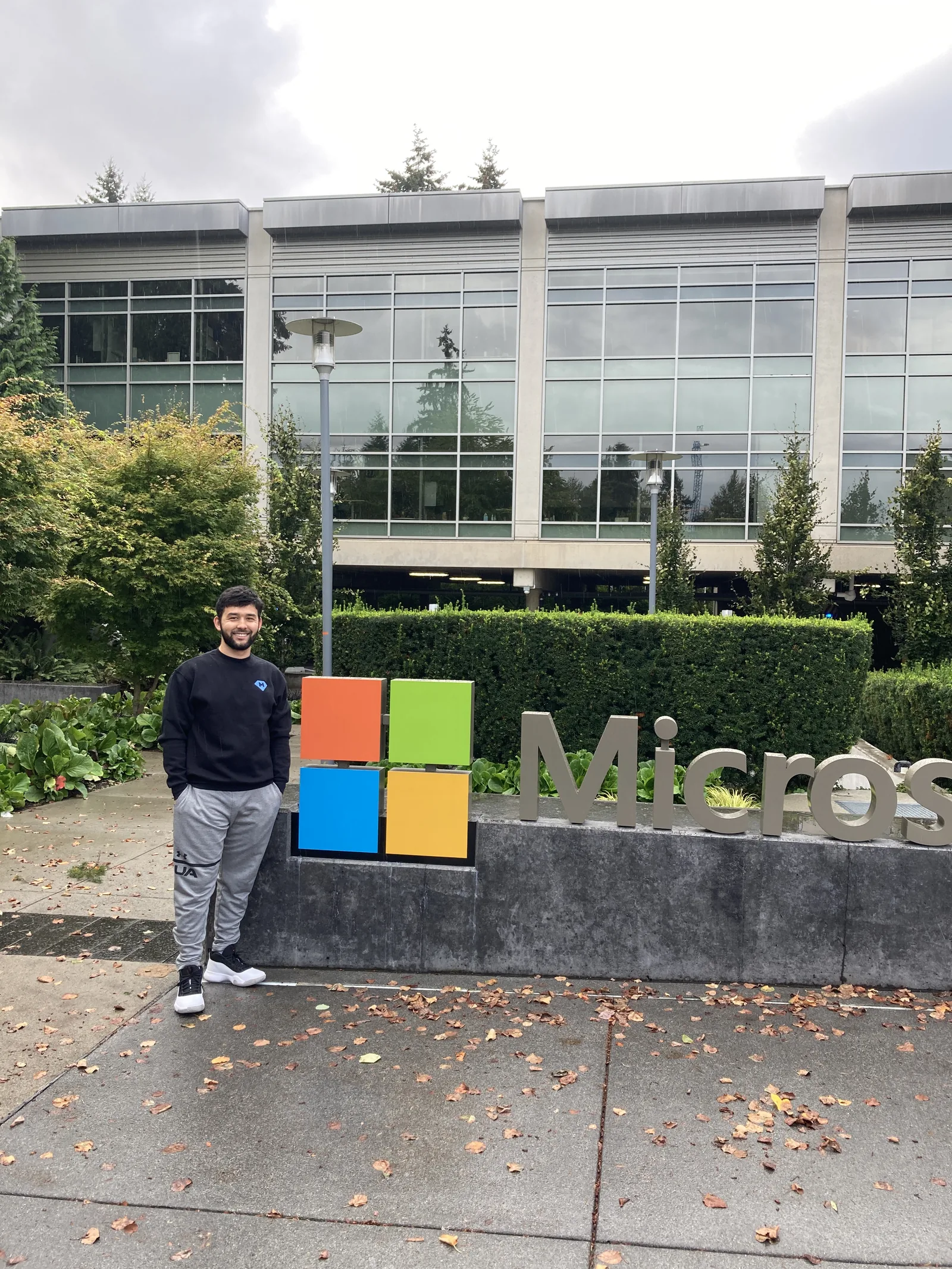
Suhrob Goliboev, City — San Francisco, Senior Software Engineer and Data Engineer at Microsoft, Instagram
About Me
I was born and raised in Tashkent in a typical middle-class family: my father served in the army, and my mother worked as a high school teacher.
I am a Senior Software Engineer and Data Engineer at Microsoft. My specialization is building scalable data infrastructure and ML systems for corporate financial platforms. I am also the founder of a GenAI startup for e-commerce, fbaflow.io.
Beyond my engineering work, I juggle several roles. I am currently completing an Artificial Intelligence certificate at Stanford University, focusing on machine learning and conversational AI. I consult for the Ministry of Employment and Poverty Reduction of Uzbekistan as an AI expert, participating in the development of national initiatives, including voice services for employment. I also run a content platform on Instagram for Uzbek-speaking audiences, helping students from Central Asia navigate the tech world. My journey from delivering food to offices in San Francisco to working at Microsoft has shown me that access to information and mentorship can change lives—so I strive to pass that support on to others.
I have been working at Microsoft since August 2020—over five years. I started right out of university as a junior engineer in financial big data. Our systems process financial data worth over $120 billion annually, which requires 100% accuracy and strict adherence to legally mandated deadlines.
How to Get into Microsoft
My path to Microsoft was unconventional. I moved to the US from Uzbekistan at the age of 20 with no programming experience and began learning to code at City College of San Francisco. Later, I transferred to Dominican University of California, where I earned a degree in Applied Informatics with a concentration in Data Science.
In my final year, the university’s recruiting service directed me to Microsoft. I spent eight months preparing—solving problems on LeetCode and studying system design. After several rounds of technical and behavioral interviews, I received a job offer.
I applied as a new graduate, so the process may differ for mid-level and senior specialists.
The first stage is a phone interview. We discussed my resume and university projects. The interviewer selected one project and delved into the details, asking technical questions about why I chose certain frameworks or databases. This helped assess my thinking and fit for the team.
The second stage is the final loop: three technical interviews, each lasting one hour. The first 15 minutes are dedicated to behavioral questions, followed by 45 minutes of solving a LeetCode medium-level problem and code review. In early 2020, due to the COVID-19 pandemic, whiteboard interviews moved online—a format that many tech companies still use today.
I submitted my application in late February, completed the final round in early April, signed the offer in May, and started work in August 2020.
The key is to demonstrate both technical competencies and reasoning skills. Microsoft values collaboration and growth—so behavioral questions are just as important as programming skills.
Tips for Those Who Want to Work in an International Company
- First, master the basics before moving on to complex topics. Data structures, algorithms, and system design patterns are universal across all major tech companies. Platforms like LeetCode and NeetCode are excellent for structured practice.
- Treat behavioral interviews as seriously as technical ones. International candidates sometimes underestimate their importance. Prepare five to six detailed stories in the STAR format that demonstrate leadership, conflict resolution, and impact. Practice delivering them concisely.
- An interview is a conversation, not a test. Interviewers want to see how you think, how you communicate, and whether you are pleasant to work with. Explain your reasoning out loud, ask clarifying questions, and stay calm under pressure.
- Leverage your unique experience. Coming from another country or having a non-traditional path is not a weakness; it is a distinguishing feature. Companies value diversity. Do not hide your story; explain how it shaped your approach to problem-solving.
- Persistence is more important than perfection. Interviews are a numbers game. I was rejected by more than 15 companies before I received an offer. Each rejection teaches something.

Work Specifics
I work in two main areas of Microsoft’s financial data infrastructure. The first is a payment aggregation system that tracks payments to companies collaborating with Microsoft. This requires understanding complex business rules, translating them into technical solutions, and implementing pipelines that process billions of records with 100% accuracy. The second is anomaly detection systems that monitor payment flows totaling $3 billion annually. These systems identify data quality issues before they affect real payments, reducing incidents by 99%.
My role covers technical implementation and cross-functional leadership. I work with teams in the US, India, and Ireland, coordinating with business analysts, financial controllers, and operations teams to ensure our systems meet both technical and business requirements.
For my work, I use Python, Scala, and SQL. The infrastructure runs on Microsoft Azure—Synapse for analytics, Data Factory for orchestration, and Kubernetes for containerized applications. Apache Spark is used for big data processing. Recently, we have started using AI programming assistants like Microsoft Copilot and Claude Code to accelerate development.
Key challenges in my position include:
- Data quality at scale. When processing huge volumes, even a small error becomes a major problem. Building validation systems without false positives requires constant refinement.
- Cross-functional coordination. Our systems serve the needs of engineering, finance, and operations. Coordinating with global stakeholders requires translating technical constraints into business language and vice versa.
- Rapid technological change. The emergence of AI tools has sharply accelerated innovation. To remain effective, one must constantly learn and invest in oneself.
Three skills are crucial for successfully performing these duties:
- Systems thinking—understanding the interaction of components, bottlenecks, and the propagation of changes. This is more important than knowing a single technology.
- Communication with both technical and non-technical audiences. I frequently explain systems to financial partners and translate business requirements into technical specifications.
- Adaptability. The technologies I use today did not exist five years ago. To remain effective, one must constantly update skills.
Microsoft actively invests in employee development: budgets for training, certifications, and conferences. I used this to obtain a Stanford AI certificate while working full-time. The company pays up to $10,000 per year for education directly related to current work.
There are also Microsoft Learn resources, regular knowledge-sharing sessions within teams, participation and presentations at conferences, mentorship programs, and internal mobility opportunities.
Working in an international team has its own specifics. The team spans several countries and time zones. Pros: diverse approaches, a global network of contacts. Cons: the need for schedule flexibility, differences in communication styles, and the importance of written documentation.
Advantages of working in an international company: access to best global practices, large-scale projects, career growth, and good compensation. Disadvantages: the adaptation period, coordination across different time zones, and differences in work styles.
Among memorable moments for me:
- Internal hackathons—an opportunity to learn new technologies and work with colleagues outside my own team.
- Two-week company coffee chats—colleagues share hobbies and interests, making a large company feel more human.
Success in the tech field requires mastering the fundamentals and consistency. Systematic problem-solving, the ability to explain concepts, and discipline are more important than talent.

About Life Abroad
I moved first and then found a job. This path allows time to adapt, build a network, and access internships, although it requires financial planning. Microsoft supports international employees comprehensively: the company provides visa sponsorship, relocation payments, temporary housing, tax and immigration support consultations, and support groups for employees from different countries.
Corporate culture in the US differs from what is common in Uzbekistan, but the differences are gradually diminishing. Here, direct communication and open discussions are valued, whereas in Uzbekistan, more attention is paid to relationships, context, and respect for hierarchy.
Tips for those planning to live and work abroad:
- Invest in professional-level English proficiency.
- Build a community and maintain connections with home.
- Use your unique experience as an advantage.
- Be patient with yourself—cultural adaptation takes years.
- Help others when you can—it makes the path easier for those who follow.
The Tech on Telegram Follow The Tech on Telegram
Keep up with the latest technology and startup news.
Related reading




More from this author

Article Useful
How to protect your accounts from hacking: 8 settings you should check today
The Tech

Article Useful
500 Global: How the Accelerator Works and Who Can Receive Investments
The Tech

Article Interviews
Game Development in Central Asia: Arkady Moldavski on Developing Reverb and the Growth of the Industry
The Tech

Article Useful
Google, Tesla, BlackRock, and the IMF: Where to Apply for an Internship in Fall 2026
The Tech

News IT
Tesla unveiled the flying electric car Roadster
The Tech

News IT
Intero Biosystems startup won the Startup Battlefield at TechCrunch Disrupt 2026
The Tech