Recently, we provided a detailed overview of Tomorrow School — the first peer-to-peer school in Kazakhstan. In the broadcast, mentor Bauyrzhan and student Amir shared insights into how the learning process works, what skills are developed through peer-to-peer interaction, how the selection process unfolds, and what results students have already achieved.
Bauyrzhan Saliev, Senior Technical Mentor at Tomorrow School
Amir Zhakyshev, Student in the Core Program at Tomorrow School
About Us
Bauyrzhan. I am a technical mentor at Tomorrow School, where I support students throughout their learning journey. I also write scripts and internal services. If a server needs to be set up, or backend or frontend development is required — that’s essentially what I do. Additionally, I am a first-year master’s student at Astana IT University, majoring in Applied Artificial Intelligence.
Amir. By profession, I am an economist, and I have always worked in traditional business, which is not closely related to IT. I have long wanted to work in the technology sector, and now I am a student at Tomorrow School.
What is Tomorrow School
Bauyrzhan. Tomorrow School is the first peer-to-peer school in Kazakhstan. We do not have teachers, lecturers, or traditional lectures: every student is simultaneously a learner and a teacher. There are many tracks, but the main focus is on artificial intelligence.
The key difference lies in the learning format. Peer-to-peer means that if you have a question, you can turn to another student. If no one knows the answer, you search for it together.
Another highlight is the social life: more than 20 student clubs, weekly events, workshops, and tournaments. We develop not only hard skills but also soft skills.
Amir. Peer-to-peer learning means “equal teaching equal.” If traditional education is vertical, here it is horizontal: everyone learns and teaches simultaneously. If you cannot explain something, it means you do not understand it yourself. I have been a student since November 2024. For the first six months, I studied Golang, then moved on to JavaScript, and now I am focusing on artificial intelligence.
Learning Format and Student Support
Bauyrzhan. The program is designed for people with no prior knowledge or background. The most important thing is the desire to learn. A technical education is not required. Many students start from scratch and achieve excellent results. The education is free, offline only, with 24/7 access. You can combine it with work or other activities.
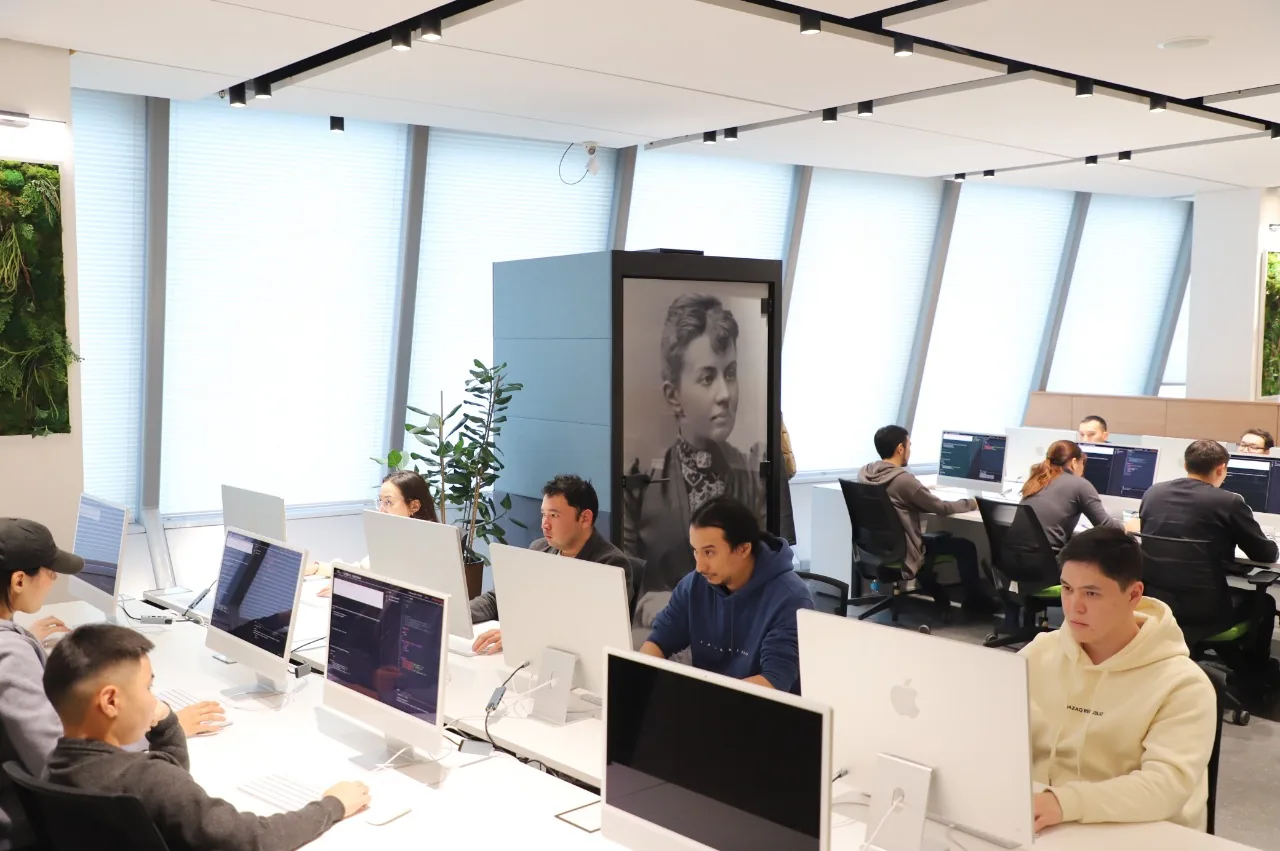
Amir. I moved to Astana specifically for the school. Classes run from morning until evening: I read news on technical Twitter, work on projects with deadlines, and communicate with classmates, discussing questions and sharing knowledge. Studying takes about 30 hours a week. The school is open 24/7, with more than 100 computers and all necessary conditions for learning.
Application and Selection Process
Bauyrzhan. Anyone can apply. You need to visit the TomorrowSchool.ai website, create an account, complete two cognitive games, and fill out an application form. Programming knowledge is not required.
Amir. The selection process takes about 26–27 days and is called the “pool.” It is an intensive period where you test your skills and motivation. The first three days are the most challenging — you just need to persevere.
Real-World Cases and Student Results
Amir. The first few days were shocking: a large volume of information, continuous questions, and peer-to-peer interaction. But gradually, you get into the flow and start enjoying the learning and coding process.
Bauyrzhan. Students are already achieving excellent results: some are finding jobs in IT, participating in hackathons, and winning prizes.
Internships and Employment
Bauyrzhan. Every student completes internships at IT companies. Upon successful completion, there is a possibility of receiving a job offer.
Learning Tracks:
— Backend: GoLang
— Frontend: JavaScript
— Systems Programming: Rust
— Artificial Intelligence: Python
— Cybersecurity, DevOps, Fullstack on Java, Game Development, and Mobile App Development.
Each student chooses a track based on their interests.
Cohousing and Accommodation
— Provided to active students with high academic performance
— Completely free, for out-of-town students
— Provided only during the core learning period.
Knowledge of English is not mandatory but is beneficial. Communication is possible in Kazakh, Russian, or English.
If a student struggles, they continue their studies and receive a second chance through subsequent projects.
The age requirement is 18 years and older, with no upper limit.
Recommendations for Prospective Students
Amir. You must definitely try it. During the 26-day pool period, you will understand whether this learning style suits you. You will constantly encounter new tasks, communicate with peers, discuss ideas, review code and projects. This experience helps develop the skill of solving unknown problems, which will be crucial in the future when you need to independently find solutions, navigate new technologies, and apply knowledge in practice.
Bauyrzhan. The first three days are the hardest — hang in there. You are literally “thrown into the pool” of new knowledge: it won’t always be clear what to do, how to solve problems, and much may seem unfamiliar or confusing. I recommend preparing in advance — solve a few easy problems on LeetCode, learn the syntax of the language if you have programming experience. Definitely establish a routine — days and nights may be fully dedicated to learning. The main thing is to get through this initial stage, because after that, learning becomes more productive and conscious.
The Tech on Telegram Follow The Tech on Telegram
Keep up with the latest technology and startup news.
Related reading




More from this author

Article Useful
How to protect your accounts from hacking: 8 settings you should check today
The Tech

Article Useful
500 Global: How the Accelerator Works and Who Can Receive Investments
The Tech

Article Interviews
Game Development in Central Asia: Arkady Moldavski on Developing Reverb and the Growth of the Industry
The Tech

Article Useful
Google, Tesla, BlackRock, and the IMF: Where to Apply for an Internship in Fall 2026
The Tech

News IT
Tesla unveiled the flying electric car Roadster
The Tech

News IT
Intero Biosystems startup won the Startup Battlefield at TechCrunch Disrupt 2026
The Tech