How a Guy from Karshi Became a Netflix Engineer: Tahir Saidov on His Journey in IT
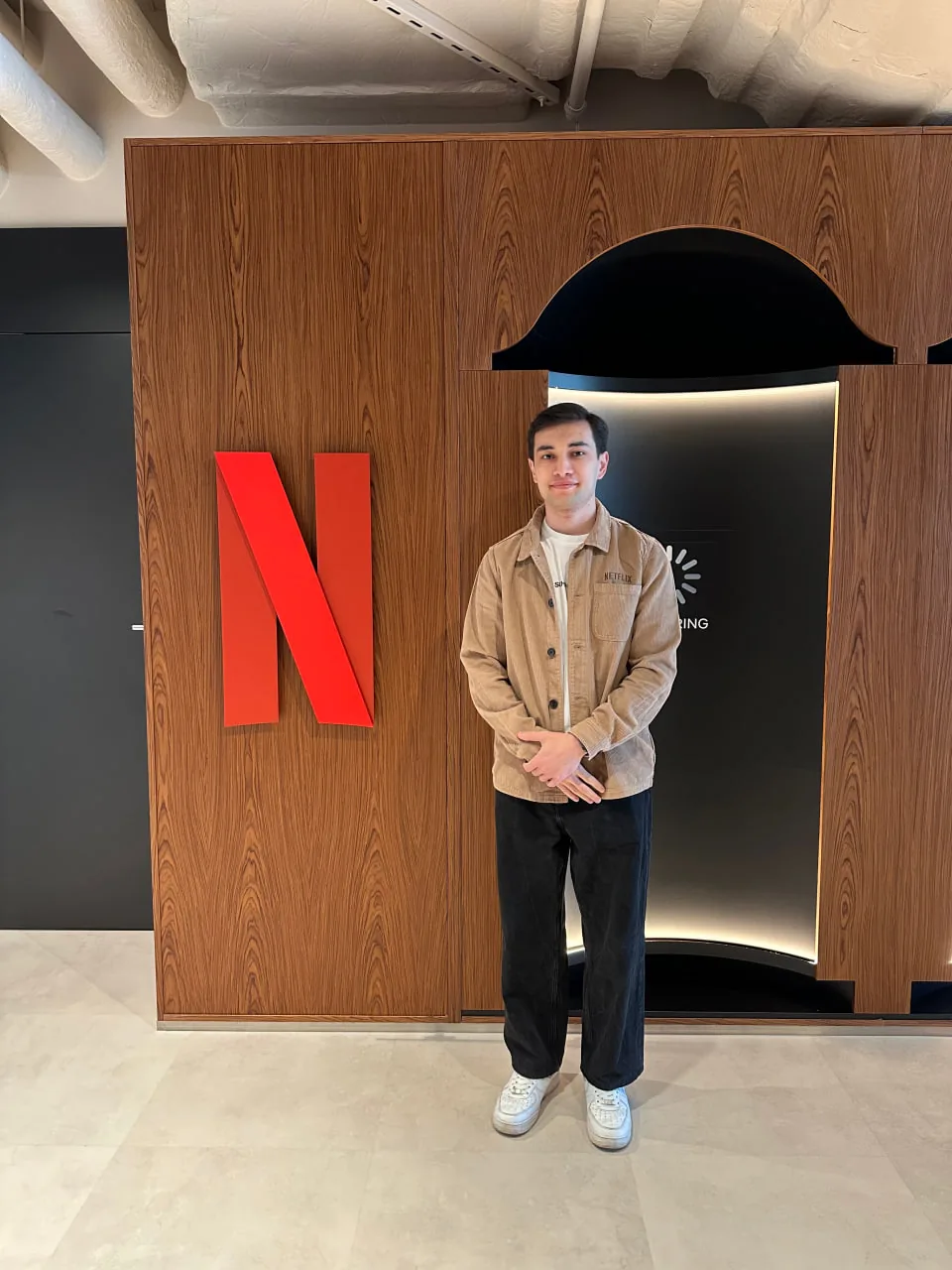
The journey from a self-taught YouTuber to an engineer at Netflix: how to enter the industry without connections or experience, turn rejections into rehearsals, and master the skill that even experienced developers often overlook — the skill of passing interviews.
Tahir Saidov, city — Warsaw, Software Engineer @ Netflix, Instagram, LinkedIn
About Me
I was born in 2003 in Karshi. I have been living in Poland since 2021. I spent the first four years in Łódź, where I studied Computer Science at the Faculty of Mathematics and Computer Science. Since autumn 2025, I have been living in Warsaw.
I graduated from a regular school without an in-depth focus on computer science, so I taught myself programming. After school, I decided to apply to a university abroad. I was drawn to European education, which is highly valued in the international market, and the university I chose was ranked in the top 1000 worldwide. Additionally, I wanted to get to know a new culture, broaden my horizons, and gain more opportunities for professional development. In autumn 2021, I moved to Poland and enrolled at the University of Lodz.
Currently, I work as a Software Engineer at Netflix, but the path to this role began long before writing the first line of code. I have had a computer at home for as long as I can remember. As a child, my brother and I spent a lot of time playing games. Over time, my interest in them began to fade. At that time, games were mostly on discs, and the selection was limited. By the time I reached sixth grade, I became more interested not in playing, but in understanding how a computer works: how it operates, what can be done via the console, and what capabilities it offers.
My brother had a significant influence on me. In his school, he was one of the best in computer science and was already able to create websites. Around the tenth grade, I learned that websites could be written with code, not just assembled using builders. At first, it seemed too difficult, but while watching tutorial videos on YouTube, I realized a simple truth: if you approach learning systematically, you can master it. It takes time, but solving each difficult problem brought immense satisfaction. That is when programming truly captivated me.
I studied independently using materials on YouTube. By then, almost everything was available online, including in Russian. At first, I created small websites using Wix and WordPress and believed that programming was a pursuit for exceptionally gifted people. Later, videos appeared in my recommendations where authors wrote small programs. They were relatively simple but interesting in functionality. I was fascinated by watching how something useful could be created with a small amount of code.
The more I watched such content, the less fear I felt and the stronger my interest grew. After some time, I stumbled upon a large React course consisting of 110 videos, where everything was explained in simple language. I simply repeated the author's actions. At that time, I didn't have a specific goal or expectations — I was just curious. Ultimately, this course shaped the approach to learning and the mindset that help me to this day and ultimately led to my first job.
Since there was no one nearby to offer guidance, I had to figure everything out on my own. Sometimes it took hours to solve a single problem, but that didn't stop me. Each new task turned out to be more difficult than the previous one. Sometimes I felt that I wasn't good enough and should give up. I took short breaks but always returned because I was genuinely fascinated by the process itself. It was perseverance and the desire to understand that helped me find solutions and move forward.

About My First IT Job
I found my first job by chance — through a Telegram chat where they were recruiting interns for IT. I submitted an application without high expectations, but soon a recruiter called me and invited me for an interview. Thus, at 18, I started an internship at Exadel. After a month of working on a project, I successfully passed the final interview and received a position as a frontend developer. It was there that I gained my first real experience in commercial development and understood things that cannot be learned without practice.
For the first four months, I worked part-time and specifically left myself time for studies. In fact, I started working around the same time I moved and enrolled in university, balancing both. The salary was barely enough to live on, but entering the industry and gaining experience meant much more to me than money.
To be honest, by the time I got hired, my university education played a lesser role than what I had built on my own. Universities typically provide fundamentals — they are important, but real projects require deeper knowledge of a specific direction. The main thing my self-study gave me was the habit of approaching unfamiliar tasks structurally and seeing them through to a solution.
Among my personal qualities, perseverance, the ability to learn without a mentor, and the ability not to give up when something doesn't work out for a long time helped me the most. It was these traits, not my diploma, that helped me in my first job and at every subsequent interview.
How to Get Into Netflix
I approached preparing for interviews at Netflix and Google differently. I set a goal to receive an offer from one of these companies and created a detailed roadmap. First, I identified the requirements for my position and understood what knowledge and skills I lacked. Then, I developed a detailed plan that I followed for several months. It included:
— 250 problems on LeetCode and another 175 problems in JavaScript — I solved many of them two or three times
— System design — there is noticeably less high-quality material for frontend than for backend, so finding good resources was more difficult
— two books on JavaScript to deepen my understanding of the language and grasp low-level details
— ChatGPT — a useful tool if you know how to ask the right questions. I used it to understand low-level topics: network interaction at all levels of the OSI model, how the browser engine works, and other aspects
— Behavioral or soft skills. Many think this stage is just about polite communication, but in practice, it is much broader: it is important how you behave in stressful situations, how you communicate with colleagues, give and receive feedback, and how you act when faced with a large and not fully understood task.
It is worth noting that almost a third of this list was not needed during actual interviews — time could have been spent on other topics. However, interviews at Netflix and Google differ significantly. At Google, as in many large tech companies, the main focus is on algorithms and data structures. At Netflix, on the other hand, great attention is paid to soft skills, and technical tasks are closer to those engineers face in real projects.
When preparation was almost complete, I decided to go through several interviews at other BigTech companies to test my level and get feedback. Such interviews help identify knowledge gaps and reduce anxiety before truly important selection stages.
Of all the companies, only Box responded, where I successfully passed the interview for a Senior Software Engineer position. After that, I realized I was ready to try my luck at Netflix and Google.
I submitted applications through the companies' official websites. But today, a single application is often not enough: competition has increased, there are more candidates, and fewer vacancies. Therefore, if possible, it is better to apply via an employee referral. In my case, an interview invitation came after a standard application.
Ultimately, the selection process at Netflix consisted of seven interview rounds, and at Google — of four, excluding communication with recruiters. I received offers from both companies. In the end, I chose Netflix because it was the company I initially considered my main goal and had studied their work approaches in advance. Additionally, at Google, developers are not divided by specializations — they are simply engineers, whereas at Netflix, there are specializations by areas, which allows, for example, to gradually transition from frontend to FullStack development.

Challenges
The main difficulty for beginners is the lack of experience: without it, it is hard to find a job, and without a job, it is impossible to gain experience. Therefore, it is important to start with the first opportunity rather than looking for the perfect company.
With the advent of AI, the market has narrowed slightly: fewer vacancies are opening, and some companies have stopped hiring at the entry level. Therefore, it is important not to stand still and constantly develop. Tools are useful for productivity, but one should not forget about fundamental knowledge — interviews test exactly that. Moreover, in actual work, AI at the current stage cannot fully replace a person, so it is important to make decisions based on your own knowledge and experience.
A separate story is rejections. Here I learned an important lesson: working as a programmer and passing interviews for a programmer are two different skills. Many think that with experience, interviews become easy, but they often ask things that rarely appear in daily work. When I was looking for my second job, the first interviews were disastrous. But after a month and a half of practice, I already had several offers. A rejection is not a verdict, but a free rehearsal and a list of topics to improve. This is exactly how it influenced my strategy: I stopped fearing rejections and started treating them as a source of feedback.
There were difficulties within the work itself. On the very first week at any new place, a huge amount of information hits you at once — and the skill of filtering out the unnecessary and focusing on priorities turns out to be more important than it seems. I coped simply: I didn't try to understand everything at once, but dealt with tasks as they arose and was not afraid to ask colleagues questions.

3 Tips to Help You Find a Job in IT
Learn English and build your network. English is not a "plus," but a foundation, even if you start learning with Russian-language materials. An international language gives access to the international market, where there are many more opportunities.
Plan and act systematically. Often, people at the beginning spend a lot of time choosing a direction or change it and stretch out the job search. The main thing is to choose one path, plan a roadmap, and follow it. If you don't understand how to do this, find someone who already works in IT and ask for advice. Perhaps you will create a learning plan together.
Don't stop and don't compare yourself to others. Entering university or passing a certification is not the finish line, but one step. After each goal, there should be the next one. Comparing yourself to others is useless — you don't know what they have been through. It is more useful to work on your weaknesses.
And a separate piece of advice that many underestimate: don't stop going to interviews, even when you are not looking for a job — it is a separate skill that needs to be kept in shape to be ready at any moment.
The Tech on Telegram Follow The Tech on Telegram
Keep up with the latest technology and startup news.
Related reading



More from this author

Article Useful
How to protect your accounts from hacking: 8 settings you should check today
The Tech

Article Useful
500 Global: How the Accelerator Works and Who Can Receive Investments
The Tech

Article Interviews
Game Development in Central Asia: Arkady Moldavski on Developing Reverb and the Growth of the Industry
The Tech

Article Useful
Google, Tesla, BlackRock, and the IMF: Where to Apply for an Internship in Fall 2026
The Tech

News IT
Tesla unveiled the flying electric car Roadster
The Tech

News IT
Intero Biosystems startup won the Startup Battlefield at TechCrunch Disrupt 2026
The Tech