Ivan Doronin from Presight discussed which IT professions will be in demand in 5-10 years.
Ivan Doronin, Program Manager at Presight, in an interview with The Tech, explained how work in the "smart cities" sector is organized, why LinkedIn became the key to his relocation, and which skills are becoming critical in the era of artificial intelligence.

The Tech AI
Get the key points in seconds - a short summary from The Tech AI.
Ivan Doronin is a Program Manager at Presight (Abu Dhabi) and a career consultant with an audience of over 60,000 people. In the company, he implements projects on AI adoption in the UAE, including the successful rescue of a project for an energy company within four months. He considers proactivity and domain understanding to be key skills, and also notes the increase in work efficiency thanks to the use of generative AI.
Ivan Doronin, City — Abu Dhabi, Program Manager, LinkedIn
About Me
I am a program manager at Presight, a company present in Kazakhstan, including in Astana, which provides smart city solutions. Previously, I worked with the local branch of the company several years ago. Currently, I work for Presight in Abu Dhabi and have been living here for almost three years.
The second part of my professional activity is related to this: I am a career consultant specializing in LinkedIn development and job search—I help people find jobs and build their careers. At the same time, I run a blog on this topic.
I have an audience of more than 60,000 people: 13,000 on Telegram, 45,000 on LinkedIn, and about 3,000 on YouTube.
How to Join Presight
At Presight, I am implementing several projects—these are classic IT projects. We are deploying artificial intelligence, Data Science, machine learning, and generative AI technologies in state-owned companies in the UAE, specifically in Abu Dhabi and Dubai. Projects are being carried out in both cities. This is a standard project lifecycle, including planning, risk management, monitoring, as well as resolving issues arising at all stages of implementation.
I joined Presight thanks to LinkedIn—I found a specialist who already worked there. Before that, I was not familiar with the company and simply studied its activities on the website. Then I used a referral recommendation: I asked for support, and it worked. In July 2023, I passed the interview, received an offer, and subsequently relocated.
The selection process consisted of three stages.
The first stage was an HR phone call lasting about 15 minutes. This is a standard interview: general information about the candidate, motivation, reasons for job search, salary expectations, current location, and readiness to relocate.
The second stage was a technical interview. It focused on process-related questions: project management, client interaction, handling crisis situations, and task prioritization. The main emphasis was placed on assessing soft skills, communication, and approach to problem-solving.
The third stage was a meeting with the manager. Formally, it was supposed to last about an hour and take the format of a general discussion regarding fit. However, in reality, the conversation took about 15 minutes, after which a hiring decision was made, and I was immediately informed about the further offer processing.

Advice for Those Who Want to Join an International Company
Many things depend on the company and country, but two key aspects can be highlighted.
The first is self-presentation. Specialists from Russia, Kazakhstan, and CIS countries are characterized by a restrained presentation of their achievements: there is often an imposter syndrome and a generally more modest communication style. This is not a universal trait, but it is encountered quite often as a cultural feature.
Therefore, it is important to pay attention in advance to preparing for the answer to the question “Tell me about yourself.” It is desirable to bring it to a confident and structured level—in Russian if the team is Russian-speaking, and in English if the team is international, ideally—immediately in English. Self-presentation should be based on facts, figures, and specific results. This is a basic professional skill.
The second important aspect is understanding cultural nuances. The approach to interviews varies significantly depending on the region: different candidate evaluation models are used in Middle Eastern countries, the US, Europe, and CIS countries. Often, candidates interpret the process through their own cultural context, which can reduce communication effectiveness.
Work Features
I cannot disclose project details in depth. However, I can provide one case that was completed about eight months ago. We implemented a generative AI-based solution for a large energy company in Abu Dhabi. The solution included backend and frontend components and was integrated with local language models deployed in the UAE infrastructure.
My role was that I joined the project at a stage when it was practically in a state of difficult implementation. It was necessary to bring it out of crisis, reformat the team and processes, and essentially restart the project to ensure successful implementation.
Over four months, we completely rebuilt the process: we reassembled the team, updated the reporting system, revised the technical architecture, and ensured successful implementation of the solution. The main goal of the project—improving operational efficiency through the use of generative artificial intelligence—was achieved.
During implementation, both technical and organizational difficulties arose, including information security and infrastructure issues. An additional challenge was that for part of the team, this was their first experience working with such AI projects.
In this regard, it was necessary to establish effective team coordination, strengthen the managerial function, and ensure a high level of proactivity. The client was demanding, with high expectations for deadlines and quality, so any risks required prompt and careful management.

If we talk about key skills, the first is proactivity. It is important to know how to work with a team—this includes empathy, the ability to motivate people, as well as negotiation and persuasion skills. Essentially, these are basic competencies of an IT and project manager.
The second component is understanding team dynamics and interaction between roles, since projects are built on the coordination of various specialists.
The third is understanding domain specifics. Before joining Presight, I did not have experience specifically in the AI field: I had experience working with data and data warehouses, but not with artificial intelligence as a separate area. Therefore, I acquired a significant portion of knowledge already during the work process.
Understanding the domain—in this case, AI and data areas—significantly simplifies interaction with teams: data engineers, data analysts, and data scientists, and also helps to correctly establish communication and expectations.
The Future of IT and the Impact of AI
Artificial intelligence is already beginning to replace certain tasks, primarily for entry-level specialists: code review, manual testing, basic analytics, simple design tasks, and part of marketing operations. For example, AI helps me prepare presentations for a LinkedIn webinar: I provide context, references, and the product's design code, and it generates a draft. As a result, the presentation can be assembled in an hour with minor edits, whereas it used to take several days, which noticeably increases efficiency.
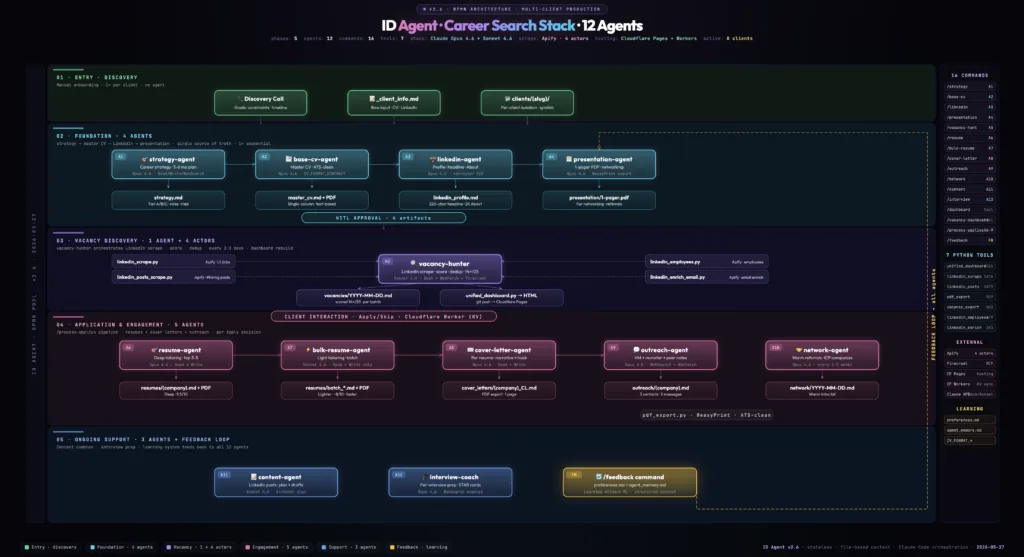
I also have a personal pet project—an AI agent for job search, which I am developing outside of my main job as part of my consulting activities. This is no longer just an idea, but part of my portfolio and practical experience, where I combine the roles of program manager and product developer.
Essentially, this is a system of approximately 12 AI agents that partially or fully automate the job search process: they form a strategy, select vacancies according to profile and market, adapt resumes and cover letters, and help prepare for interviews. The entire system is built as a single workflow with customization for a specific user and a dashboard with visualization of progress and recommendations. This is not full automation, but a semi-automated assistant that reduces time and effort at all stages—from search to offer—and I continue to develop it.
If we talk about IT professions for the next 5-10 years, three key directions will remain. The first is data specialists: data engineers, data analysts, and data scientists, since data remains the foundation of AI and ML.
The second is cybersecurity: architects, engineers, and analysts, as this is one of the fastest-growing and critically important areas.
The third is infrastructure specialists ensuring the operation of AI systems: DevOps, SRE, and related roles responsible for deployment and system stability. In general, these are the most stable and in-demand areas for the coming years.
The impact of AI is already quite noticeable and, primarily, is expressed in increased efficiency. Today, one can perform a significantly larger volume of work independently: for example, I am developing my startup, combining the roles of frontend and backend developer, designer, marketer, and copywriter.
At work, this is also manifested—tasks that used to take hours or days are now completed in 20-30 minutes. I export tasks from JIRA, pass them to Copilot, use dashboard or presentation templates, the system updates the materials, after which I spend 5-10 minutes on final verification and send it to the client. As a result, productivity increases several times over.
What a Specialist Needs to Know in the AI Era
The key skill today is the ability to work not just with ChatGPT as a search engine, but to understand how prompts, roles, and context are structured. When you assign a role—for example, “I am a professional project manager” or “I am a professional designer”—and know how to manage generative tools, as well as create simple agents for tasks, you become significantly more efficient than most specialists.
And this is already beginning to be actively required in the market. I work with people who are looking for jobs, and in almost every second or third interview, they are asked how they use AI at work: to show prompts, cases, portfolio, experience in implementing generative AI, vibe coding, and so on.
This is especially important for managerial positions, but gradually it is becoming a mandatory skill for other roles as well.
I am confident that the value of this skill will only grow.
The Tech on Telegram Follow The Tech on Telegram
Keep up with the latest technology and startup news.
Related reading



More from this author

Article Useful
How to protect your accounts from hacking: 8 settings you should check today
The Tech

Article Useful
500 Global: How the Accelerator Works and Who Can Receive Investments
The Tech

Article Interviews
Game Development in Central Asia: Arkady Moldavski on Developing Reverb and the Growth of the Industry
The Tech

Article Useful
Google, Tesla, BlackRock, and the IMF: Where to Apply for an Internship in Fall 2026
The Tech

News IT
Tesla unveiled the flying electric car Roadster
The Tech

News IT
Intero Biosystems startup won the Startup Battlefield at TechCrunch Disrupt 2026
The Tech