AI already writes nearly 40% of new music. What should now be considered true authorship
The music industry is undergoing a quiet but fundamental revolution: AI has ceased to be merely a studio assistant and has begun to mass-replace creators themselves. According to new data from the platform SubmitHub, nearly 40% of all global tracks released in July 2026 were created with the involvement of algorithms, while 97% of listeners can no longer distinguish a generated track from one made by a human. As streaming services rush to update their moderation rules, a serious rift is emerging among artists themselves.
The Tech AI
Get the key points in seconds - a short summary from The Tech AI.
A SubmitHub study revealed that 38.5% of music released in a month contains AI-generated elements. Platforms like Bandcamp and Spotify have introduced bans and labeling requirements for such content. Artists are divided in their opinions: some use AI as a tool, while others oppose its use without the consent of the original creators.
What the study revealed
SubmitHub, a platform specializing in promoting music to playlists and blogs, analyzed over a million tracks using its own SH Labs detector. The results are as follows: 23.2% of compositions were entirely generated by artificial intelligence, and another 15.3% contained AI-audio elements refined by humans. Together, this accounts for 38.5% of all music released in a month.
SH Labs was launched this summer to draw attention to the issue of disclosing the use of artificial intelligence in music. The detection technology is already being used by platforms Bandcamp and Traxsource, as well as the copyright protection organization GEMA, which recently won a legal case against the music generation service Suno.
SubmitHub founder Jason Grishkoff stated that he sees the solution to the problem in disclosing the use of AI, so that listeners can decide for themselves whether they are willing to engage with such music.
The trend is confirmed by other platforms
Earlier, the Deezer service reported that in June, the share of AI tracks exceeded half of all new daily uploads on the platform. According to a 2025 study, 97% of people are unable to distinguish between music created by humans and that generated by artificial intelligence.
How platforms are responding
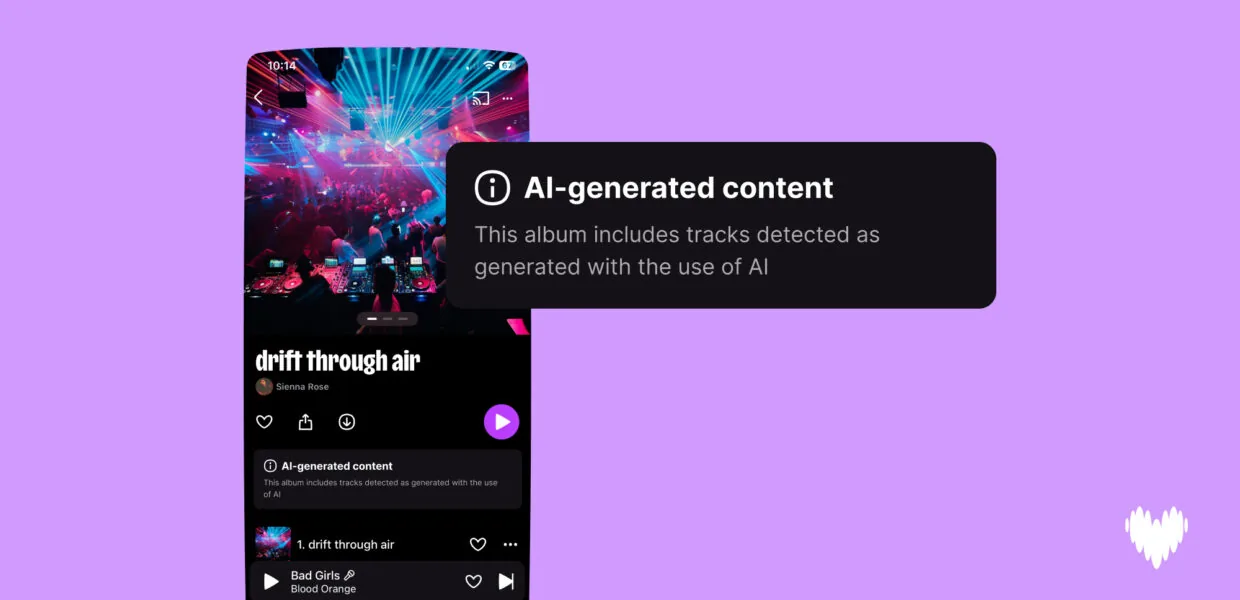
Some companies have already reacted to the growing volume of AI content. Bandcamp has banned the placement of music created by artificial intelligence since the beginning of 2026 and reserved the right to remove tracks if there is suspicion of AI use. Spotify announced the introduction of a special AI Persona badge for artist profiles whose music may be created with the help of artificial intelligence, starting in September.
What artists say
Artists' positions on this issue vary. Kate Bush and Queen member Brian May previously spoke out against the use of their works for training generative artificial intelligence without the authors' consent. At the same time, some musicians openly admit to using the technology — among them are Luke Steele from Empire Of The Sun and Boy George. Rapper Tyga confirmed that he used artificial intelligence to create retro-synthesizer parts on his album $tarface, comparing the tool to Auto-Tune technology — however, the album received extremely negative reviews from critics. Producer and rapper Timbaland launched the Stage Zero project and introduced its first artist — an AI character named TaTa.
Conclusion
While some artists use AI as a new tool, others see it as a threat to the profession itself. Platforms are trying to find a compromise between openness, copyright protection, and listeners' interests.
But the question is no longer whether AI will come to music. It has already arrived. Now the industry must decide where the line lies between tool and author — and whether the listener should know who is truly behind the track.
The Tech on Telegram Follow The Tech on Telegram
Keep up with the latest technology and startup news.
Related reading




More from this author

Article Useful
How to protect your accounts from hacking: 8 settings you should check today
The Tech

Article Useful
500 Global: How the Accelerator Works and Who Can Receive Investments
The Tech

Article Interviews
Game Development in Central Asia: Arkady Moldavski on Developing Reverb and the Growth of the Industry
The Tech

Article Useful
Google, Tesla, BlackRock, and the IMF: Where to Apply for an Internship in Fall 2026
The Tech

News IT
Tesla unveiled the flying electric car Roadster
The Tech

News IT
Intero Biosystems startup won the Startup Battlefield at TechCrunch Disrupt 2026
The Tech