AI assistant for business: which 3 tasks can you assign to it today
Companies are already using artificial intelligence not only for text generation. AI agents respond to customers, analyze calls, and perform routine tasks in CRM systems.

Artem Novoselov, co-founder of ONELAB, has been engaged in development, business process automation, and the implementation of AI solutions for over 20 years. His clients and partners include the "Baýterek" Holding, Kazakhstan Housing Company, "QazAvtoJol," and "Otbasy Bank." In an interview with The Tech, he discussed which tasks businesses can delegate to AI today.
Artem Novoselov, co-founder of the web studio ONELAB
According to the SPOTIO State of Field Sales report, administrative tasks and data entry account for approximately 21% of a field sales specialist's workweek. For a team of 10 people, this is equivalent to roughly 4,368 working hours per year.
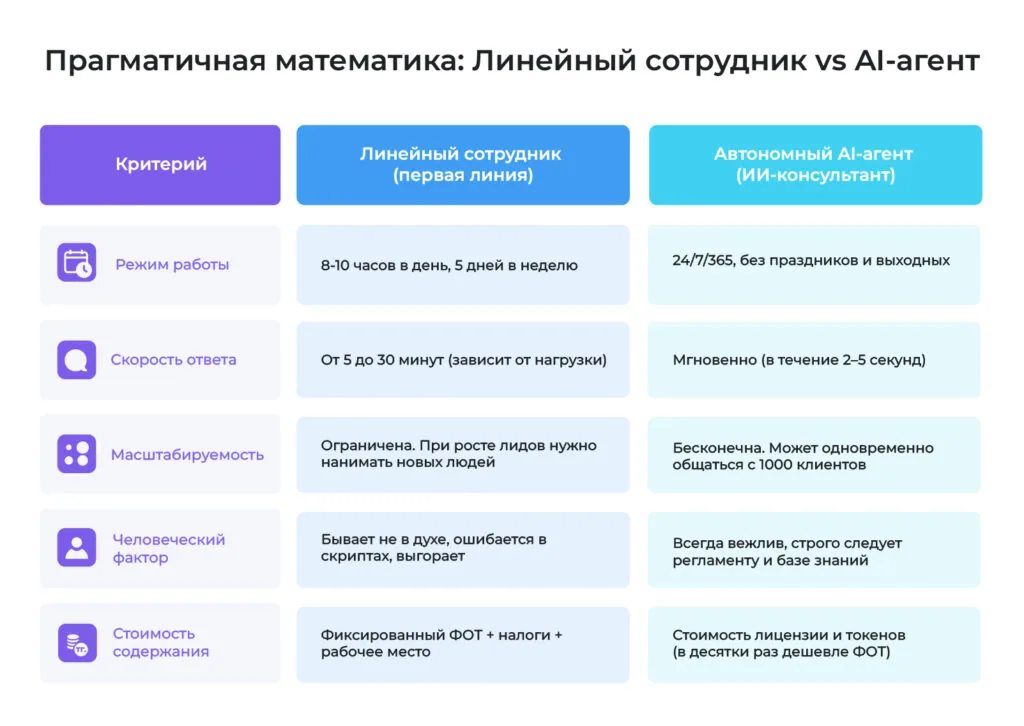
An AI assistant for business is a system that understands customer inquiries, works with company data, and performs specified actions in CRM and other services. It is primarily a way to reduce administrative burden and free up employees' time for customer interaction.
Today, an AI assistant can already be tasked with three functions: responding to customers and routing inquiries, analyzing calls, and automating routine actions in CRM.
AI responds to customers outside of working hours
One of the main problems for sales departments during peak seasons or outside of working hours is the delay in the first response. If a customer writes late in the evening or on a weekend, and the manager only responds during the next shift, the risk of losing the inquiry increases significantly.
An AI consultant helps reduce the risk of losing inquiries and speeds up the first response. With an up-to-date knowledge base—such as price lists, catalogs, delivery terms, and regulations—it can operate around the clock, answer standard questions, collect initial data, qualify inquiries, and fill in CRM fields. Complex or ambiguous requests are forwarded by the bot to a manager along with the conversation history.
How AI distributes inquiries between cities
For a company with two sales departments in different cities, inquiries from WhatsApp previously went to a random manager. The employee would clarify the city and manually transfer the dialogue, which could lead to lost leads. The ONELAB team implemented an AI bot integrated with WhatsApp and Bitrix24. The AI recognizes the customer's city and routes the inquiry to the appropriate group. According to the client, erroneous routing has disappeared, and the time to transfer the dialogue to a manager has decreased by approximately one-third.
The choice of platform reflects the situation in the local market: according to research by BISAM Central Asia and gro.now, Bitrix24 is used by about 40% of Kazakhstani companies working with CRM.
AI helps control call quality
Call quality control is a traditional responsibility of the Head of Sales and the business owner. Continuous manual review of thousands of hours of recordings requires significant resources, and selective listening does not always provide a complete picture of the department's performance.
After a call, the built-in Bitrix24 AI tool, BitrixGPT, transcribes the conversation, creates a summary, and checks the manager's performance against a checklist: did they greet according to the standard, identify customer needs, handle objections, and record the next step?
BitrixGPT scores the call and highlights problem areas in the CRM. These results should be used as a signal for training and selective review, rather than as the sole basis for employee evaluation.
AI takes over routine tasks within CRM
Employees regularly spend time filling out customer cards, recording meeting outcomes, and manually assigning tasks. Some of these operations can be handed over to AI.
Within CRM, AI can transcribe calls, analyze correspondence, create summaries, fill out customer cards, and generate tasks based on the conversation. After a video meeting, it helps record agreements and next steps. Final decisions and actions remain under the employee's control.
How AI assistants work in real companies
ONEHOST is a hosting provider for which the ONELAB team integrated an AI assistant with Bitrix24, WhatsApp, billing, and technical checks. The assistant verifies payment and service status, diagnoses website availability, and creates tickets. According to internal data from ONEHOST, up to 85% of standard inquiries are now handled without employee involvement, while managers receive non-standard and technically complex cases.
GERAT Distribution is a Kazakhstani supplier of automotive spare parts under its own GERAT brand. The AI assistant identifies the car by VIN number or a photo of the vehicle registration certificate, checks part compatibility and availability, and forwards complex requests to a manager. As a result, the initial inquiry processing time decreased from 10–15 minutes to 2–3 minutes without increasing staff.
Where to start implementing AI
Start with one clear process—for example, processing incoming messages or transcribing calls. Before launch, the company must prepare an up-to-date knowledge base, assign responsible persons for its updates, and verify what data the system receives, where it is stored, and who has access to it.
In August 2026, discounts on Bitrix24 tariffs are available for clients from Kazakhstan—the discount size depends on the chosen solution and can reach 35%. Detailed terms can be viewed on the promotion page.
Artificial intelligence is not a replacement for humans but a tool that takes over part of the routine. The greatest effect is achieved by teams that combine the speed of automation with employee experience, control, and accountability.
The Tech on Telegram Follow The Tech on Telegram
Keep up with the latest technology and startup news.
Related reading



More from this author

Article Useful
How to protect your accounts from hacking: 8 settings you should check today
The Tech

Article Useful
500 Global: How the Accelerator Works and Who Can Receive Investments
The Tech

Article Interviews
Game Development in Central Asia: Arkady Moldavski on Developing Reverb and the Growth of the Industry
The Tech

Article Useful
Google, Tesla, BlackRock, and the IMF: Where to Apply for an Internship in Fall 2026
The Tech

News IT
Tesla unveiled the flying electric car Roadster
The Tech

News IT
Intero Biosystems startup won the Startup Battlefield at TechCrunch Disrupt 2026
The Tech