Gemini 3.5 Flash: overview of Google's new model — what's new and how it differs
What it is and when it appeared
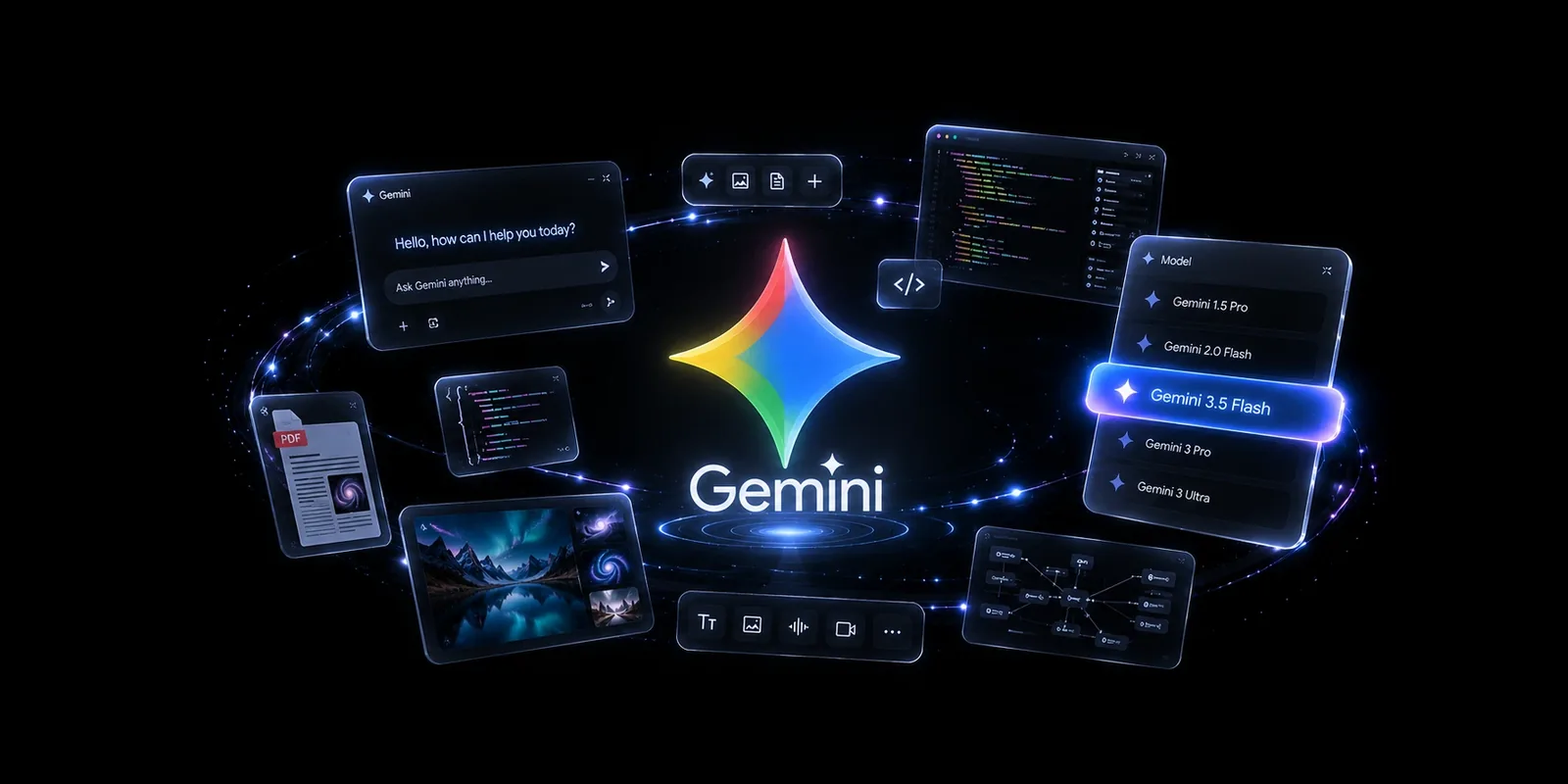
Gemini 3.5 Flash is the first model of the new 3.5 generation from Google DeepMind. It was presented on May 19, 2026, at the Google I/O conference, and, unlike many "future-oriented" releases, the model immediately launched in General Availability status — meaning it is available to everyone without closed testing.
The model is already integrated into:
— the Gemini app and AI Mode in Google Search
— Google AI Studio, Android Studio, and the Gemini API
— Google Antigravity — an agentic development platform
— Gemini Enterprise and the Gemini Enterprise Agent Platform.
An important contextual detail: Gemini 3.5 Pro, the flagship model of the line, was still in internal Google testing at the time of the Flash release — meaning Flash was specifically released first to test the 3.5 generation on a mass audience.
Main feature: Flash surpasses Pro for the first time
Previously, the Gemini lineup always had a clear hierarchy: Pro was for complex tasks and maximum quality, while Flash was for speed and cost-efficiency, but with a noticeable drop in quality. Gemini 3.5 Flash breaks this hierarchy: on most agentic and coding benchmarks, it outperforms the previous flagship, Gemini 3.1 Pro, which was released just three months earlier and led the Artificial Analysis index for complex visual and multimodal tasks at the time of its release.
This is the first case where a "fast and cheap" Flash-level model is practically on par with a flagship — meaning professional AI becomes accessible without the computational costs typical of Pro models.
Key figures and specifications
Speed — approximately 278-289 tokens per second, which is roughly four times faster than other top models in terms of generation speed.
Context window — 1,048,576 input tokens — this is around 750,000 words, with a maximum output of 65,536 tokens. This volume is sufficient to fit an entire codebase, a voluminous regulatory document, or a complete log of a long-running autonomous agentic task into a single session.
Multimodality — the model understands text, images, video, audio, and PDF files.
Flexible "thinking" — supports different levels of reasoning, allowing users to balance cost, speed, and response quality according to the specific task.
API pricing — approximately $1.50 per million input tokens and $9 per million output tokens.
Specific use cases
Based on cases from Google and its partners, the model's strengths include:
— long agentic chains: planning, execution, and iterative correction of multi-step tasks without human intervention — from app development to preparing financial documents
— parallel agent work: for example, a "builder + player" pair that simultaneously refines a game in real-time within the Antigravity environment
— working with large data sets: clients in the life sciences sector report significant improvements in accuracy during data extraction and calculations
— interface and graphics generation: the model quickly creates UI variants, interactive animations, and branding concepts — literally in tens of seconds.
How it fundamentally differs from previous versions
| Parameter | Gemini 3 Flash | Gemini 3.1 Pro | Gemini 3.5 Flash |
| Positioning | Fast, but weaker than Pro | Flagship | Flash-level, but surpasses Pro on agentic tasks |
| Speed | Average | Low | Very high |
| Context | Smaller | Smaller | 1,048,576 tokens |
| Agentic tasks | Lower | 78.2% | 83.6% |
The Tech on Telegram Follow The Tech on Telegram
Keep up with the latest technology and startup news.
Related reading




More from this author

Article Useful
How to protect your accounts from hacking: 8 settings you should check today
The Tech

Article Useful
500 Global: How the Accelerator Works and Who Can Receive Investments
The Tech

Article Interviews
Game Development in Central Asia: Arkady Moldavski on Developing Reverb and the Growth of the Industry
The Tech

Article Useful
Google, Tesla, BlackRock, and the IMF: Where to Apply for an Internship in Fall 2026
The Tech

News IT
Tesla unveiled the flying electric car Roadster
The Tech

News IT
Intero Biosystems startup won the Startup Battlefield at TechCrunch Disrupt 2026
The Tech