What is RISC-V and why do Google, Alibaba, and developers around the world need it?
While ARM and x86 are familiar to many, RISC-V was known only to specialists until recently. Today, the architecture is widely discussed thanks to Google's support, Alibaba's developments, and growing interest in technological sovereignty. Let's break down in simple terms what RISC-V is and why it has become one of the most talked-about technologies in recent years.
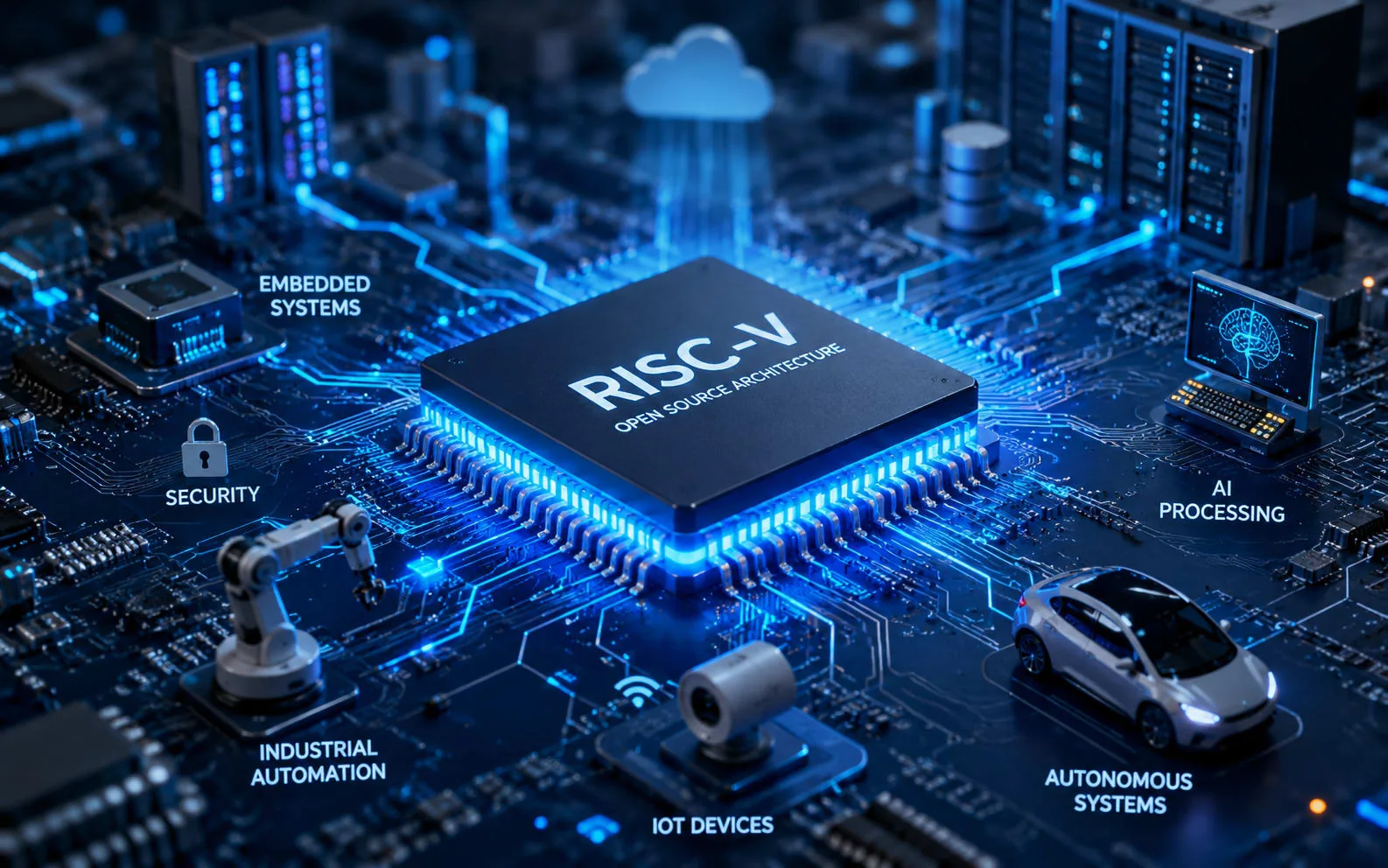
RISC-V is an open processor architecture standard that allows any company to freely design its own chips. It is precisely this openness and independence that have made it one of the key topics of 2025–2026.
What is RISC-V in simple terms
RISC-V, pronounced “risk-five,” is an open and free processor instruction set standard. In simpler terms, it is the language through which a processor understands what to do: add numbers, access memory, or move to the next instruction. The same type of language is used by ARM, which powers most smartphones, and x86, which underpins most computers with Intel and AMD processors.
The difference is that ARM and x86 are closed standards. To release a processor based on them, a manufacturer must purchase a license or enter into an agreement with the owner of the architecture. RISC-V works differently: the specification is publicly available, so any developer or company can create its own processors without paying licensing fees.
The name refers to the fifth generation of architectures in the RISC family, created at the University of California, Berkeley. The architecture emerged in 2010, and since 2015 it has been developed by the international non-profit organization RISC-V International, registered in Switzerland. This approach helps maintain the independence of the standard.
How RISC-V differs from ARM and x86
Like ARM, the RISC-V architecture is based on the principle of a reduced set of simple instructions. Each instruction executes quickly and predictably. In contrast, x86 uses more complex instructions.
The main difference of RISC-V lies not so much in its technical implementation as in its open development model. Any company can use the base architecture and extend it with its own instructions, for example, to accelerate artificial intelligence computations or signal processing. ARM and x86 offer significantly less freedom in this regard.
Why RISC-V started being discussed now
Google accelerates RISC-V support in Android
In 2026, Google announced that Android is ready for broader use of RISC-V-based devices. The company continues to develop the architecture as one of the key platforms for Android, expanding support for development tools, emulators, and the application ecosystem. This should make it easier for manufacturers to release smartphones and other devices based on RISC-V and accelerate the appearance of such products on the market.
Alibaba unveils one of the most powerful RISC-V processors
In spring 2026, Alibaba introduced the 64-bit Xuantie C950 core, aimed at cloud computing and artificial intelligence. According to industry experts, the new processor demonstrated that the open architecture is already capable of competing with solutions from major manufacturers.
RISC-V has even attracted Ethereum’s attention
Ethereum co-founder Vitalik Buterin proposed using RISC-V as the basis for a new Ethereum virtual machine. In his view, this would make the infrastructure simpler, more efficient, and more secure.
The architecture has become a tool for technological sovereignty
Since RISC-V does not belong to any single company or state, many countries view it as a way to reduce dependence on foreign technologies. In particular, China is actively expanding the use of RISC-V, and European countries are also showing interest in the architecture.
The ecosystem is growing rapidly
Today, RISC-V-based solutions are being developed by SiFive, Andes Technology, SpacemiT, Synopsys, Alibaba via DAMO Academy, StarFive, Espressif Systems, and Raspberry Pi. Support for the architecture has already appeared in several major Linux distributions.
Where RISC-V is already used
So far, the architecture is most often used in microcontrollers and embedded electronics: sensors, IoT devices, industrial automation, and consumer electronics.
Gradually, RISC-V is also entering the market for higher-performance devices. Server and desktop processors based on this architecture already exist, but in terms of performance, they still lag behind the best solutions from Intel, AMD, and Apple. Nevertheless, the gap is closing rapidly.
Advantages and limitations of RISC-V
The main advantages of the architecture:
— an open standard without licensing fees
— the ability to adapt the architecture to specific tasks
— a rapidly growing international ecosystem
— independence from any single company or state.
The main drawback currently relates to the younger ecosystem. Development tools, drivers, and software are still actively evolving, and the highest-performance RISC-V processors still lag behind flagship solutions from Intel, AMD, and Apple. Despite this, the number of participants in RISC-V International has already exceeded 4,500 organizations, making the architecture one of the fastest-growing in the industry.
The Tech on Telegram Follow The Tech on Telegram
Keep up with the latest technology and startup news.
Related reading




More from this author

Article Useful
How to protect your accounts from hacking: 8 settings you should check today
The Tech

Article Useful
500 Global: How the Accelerator Works and Who Can Receive Investments
The Tech

Article Interviews
Game Development in Central Asia: Arkady Moldavski on Developing Reverb and the Growth of the Industry
The Tech

Article Useful
Google, Tesla, BlackRock, and the IMF: Where to Apply for an Internship in Fall 2026
The Tech

News IT
Tesla unveiled the flying electric car Roadster
The Tech

News IT
Intero Biosystems startup won the Startup Battlefield at TechCrunch Disrupt 2026
The Tech