Chips, robots, and power grids: why venture capital is moving from apps to "atoms"
For over a decade, venture capital has focused on software—SaaS, product growth, asset-light scaling. The AI boom is changing this logic: as code ceases to be a scarce resource, investors are forced to seek new defensible positions.
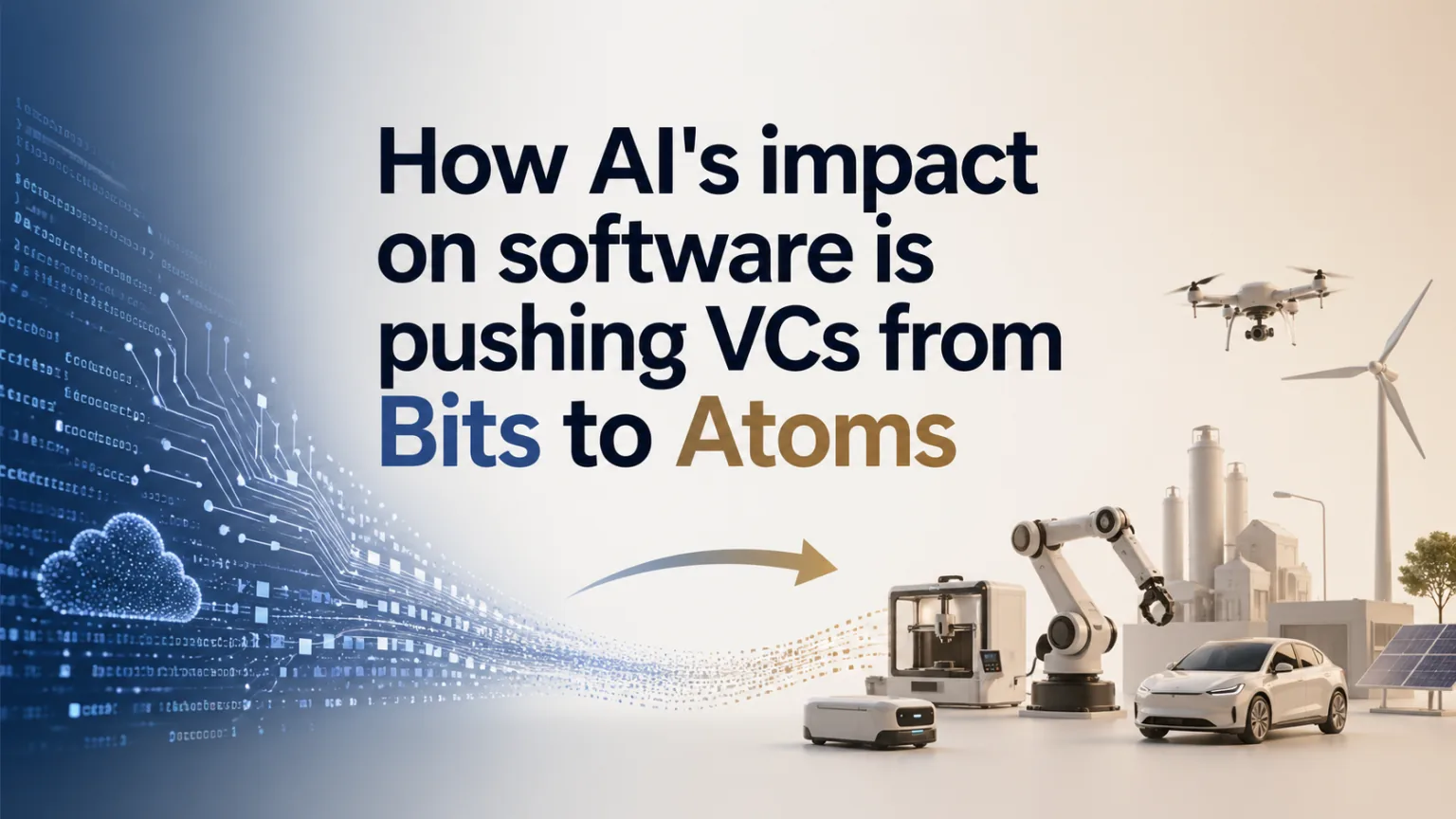
The market is undergoing a fundamental reassessment of which investments will withstand the wave of commoditization—the transformation of technology into a mass-market commodity.
The End of the Software Era
Software was valuable precisely because it was scarce. Engineering talent was a bottleneck, and technical knowledge was a hard-to-access resource. Today, AI coding assistants and open-source frameworks have turned code into a mass-produced commodity. If a model can write a program or design a product overnight, software ceases to be a scarcity. Sundar Pichai stated that 75% of all new code at Google is now generated by AI and approved by engineers.
As a result, code and the engineers who create it are no longer the primary competitive advantage. It is estimated that any corporate software product from the last decade can be recreated in less than six months. The interface-level moat is also disappearing: AI agents perform tasks directly, bypassing the UI, meaning visual product differentiation is losing its significance.
Where the Money is Going
When software becomes ubiquitous, venture capital begins to seek new scarcity. It finds it in physical infrastructure—where AI cannot simply copy a solution: data centers, robotics, energy, space, defense, and advanced manufacturing.
The shift from "bits to atoms" is already visible in the market: deals in corporate software are slowing down, while funding for AI hardware, defense technologies, and robotics is hitting record rounds.
Notable examples include Mind Robotics, a spin-off from electric vehicle manufacturer Rivian, which raised $500 million in its Series A round in April 2026. The company develops robots for manufacturing facilities. Beijing-based Robot Era, which creates humanoid robots for industrial applications, raised $145 million in March 2026 and joined the unicorn club.
Why Hardware Became the Primary Defense for Investors
Historically, investors avoided hardware because it was too slow and risky. But hardware provides what software cannot: presence, permanence, and genuine defensibility.
When equipment is literally embedded into urban infrastructure or a factory production line, switching costs are enormous. This is not just a technological barrier, but a financial and logistical hurdle that pure software rarely manages to provide.
Physical constraints create sustainable competitive positions—a combat system or a satellite network cannot simply be generated by a language model. In the defense sector, Anduril, Shield AI, and Chaos Industries are building strong positions based on sovereign demand. In space, Stoke Space and Astranis are creating infrastructure scarcity that the commoditization of software cannot destroy.
Finally, AI needs a "body." To become truly useful, artificial intelligence must move beyond the text box and acquire a physical shell to gather context from the real world—whether that is glasses capturing hand movements for robot training or wearable devices tracking biomarkers.
New Rules of the Game for Investors
"Hardware is Hard" has long been a mantra among startup founders, and investors have learned it too well. Compared to SaaS, hardware is further from money: long development cycles, supply chain risks, and high initial investments. Familiar metrics like CAC and MRR growth simply do not work here.
However, the economics of hardware have changed. Global contract manufacturing, rapid prototyping, and recurring revenue models layered on top of physical devices have completely rewritten the rules. Today, a single unit of equipment is a constant source of software upsells and renewals.
Investors can no longer ignore hardware out of habit. The next generation of tech giants will build their positions not on code, but on silicon, steel, and infrastructure.
Source: vccafe.com
The Tech on Telegram Follow The Tech on Telegram
Keep up with the latest technology and startup news.
Related reading




More from this author

Article Useful
How to protect your accounts from hacking: 8 settings you should check today
The Tech

Article Useful
500 Global: How the Accelerator Works and Who Can Receive Investments
The Tech

Article Interviews
Game Development in Central Asia: Arkady Moldavski on Developing Reverb and the Growth of the Industry
The Tech

Article Useful
Google, Tesla, BlackRock, and the IMF: Where to Apply for an Internship in Fall 2026
The Tech

News IT
Tesla unveiled the flying electric car Roadster
The Tech

News IT
Intero Biosystems startup won the Startup Battlefield at TechCrunch Disrupt 2026
The Tech