Do you need to automate your business: how to reduce hidden costs
The Tech AI
Get the key points in seconds - a short summary from The Tech AI.
The article explains that savings on automation lead to hidden losses: loss of employees' and customers' time, and duplication of services. For effective implementation of systems, it is necessary to first analyze processes and eliminate gaps between departments. An example of the Bitrix24 platform is given, with a discount of up to 35% when paying for an annual tariff until August 31, 2026, in Kazakhstan.
When forecasting the economic situation becomes difficult, businesses begin to carefully calculate every expense. Companies review their budgets, cut non-essential costs, and postpone hiring new employees or starting new projects. Spending on technology may also appear as an area for cost reduction. Decisions might be made to continue working in Excel and messengers, delaying the transition to automation.
However, working with old methods also has its price. A manager forgot to call the client back. An employee spent several hours preparing a report. The team is paying for five different services simultaneously. Time is spent manually transferring information from one system to another. All of this represents a cost to the business. However, such costs are not always explicitly listed as separate line items in financial reports.
Therefore, alongside the question "How much does automation cost?", it is also important to ask "How much does it cost us to operate without automation?"
How much does "free" work cost?
In the early stages of a small business, Excel, messengers, and the manager's memory may be sufficient. There are few clients, the team is small, and everyone understands who does what.
As the business grows, the situation changes. For example, a client submits a request via WhatsApp. The manager enters it into an Excel spreadsheet. The contract is stored on another employee's computer. Tasks are discussed in a work chat. Meanwhile, the manager personally asks the manager whether the client has paid the invoice.
At first glance, everything seems to be working. But behind this, there are dozens of actions performed manually by employees.
In the article "Breaking the Cost Barrier: Affordable Automation for Small and Medium Businesses Worldwide", a simple calculation is provided: if a team spends just 10 hours a week on tasks that could be automated, it amounts to over 500 working hours per year. This is approximately equivalent to three months of work by one employee.
Thus, the goal of automation is not to add another technology to the company. Its goal is to free up employees' time from repetitive tasks, allowing them to focus on important responsibilities.
A lost lead is wasted marketing budget
Another cost that is not immediately obvious is the lost client. The company spends money on advertising and receives a request. However, the manager responds late or forgets to call back. The client goes to a competitor. At first glance, the company simply failed to make a sale. But in reality, the money spent to attract that client was also wasted.
The article "Why Small Businesses Delay Implementing CRM for Too Long?" provides several examples of such losses: overlooked leads, forgotten follow-up contacts, multiple employees contacting the same client simultaneously, and information remaining in individual employees' memories rather than being stored in a shared system.
Of course, CRM does not fix an ineffective sales strategy or improve a low-quality product. However, it helps organize customer work: it allows collecting all requests in one place, assigning responsible employees, storing communication history, and monitoring next steps.
If communication between departments breaks down, the business loses money
Losses can also occur when work passes from one employee to another or from one department to another. The marketing department received a lead but did not pass it to the sales department on time. The manager closed the deal, but the information did not reach the team continuing work with the client. The project was completed, but the accounting department did not receive the data needed to issue an invoice.
The authors of the article "Startup Budget for Growth Tools: Invest Where Process Connections Break" recommend paying attention to such aspects when choosing technology. The main idea is to direct the budget not to another trendy tool, but to streamline processes where the company is losing time or revenue.
Solving such problems does not necessarily require purchasing another large system. The most important thing is to connect work stages with each other. For example, after one action is completed, a responsible employee can be automatically assigned, and the next task or notification can be created.
It is better not to start automation with purchasing software
Purchasing a CRM system alone does not solve all business problems. If the company does not know how requests are processed, who is responsible for the client, where work is delayed, and which tasks take the most time, the new platform may simply migrate the previous disorder to a new system. Therefore, it is advisable to first analyze how work is currently being done in the company.
For this, a few simple questions are sufficient. What tasks do employees repeatedly perform manually? Where do requests get lost? What information needs to be manually transferred from one service to another? At what stage do deals most often stall? How many programs is the company paying for simultaneously? Are there any among them that perform the same functions?
By answering these questions, it is possible to determine exactly where automation can save time and money.
One platform instead of several services
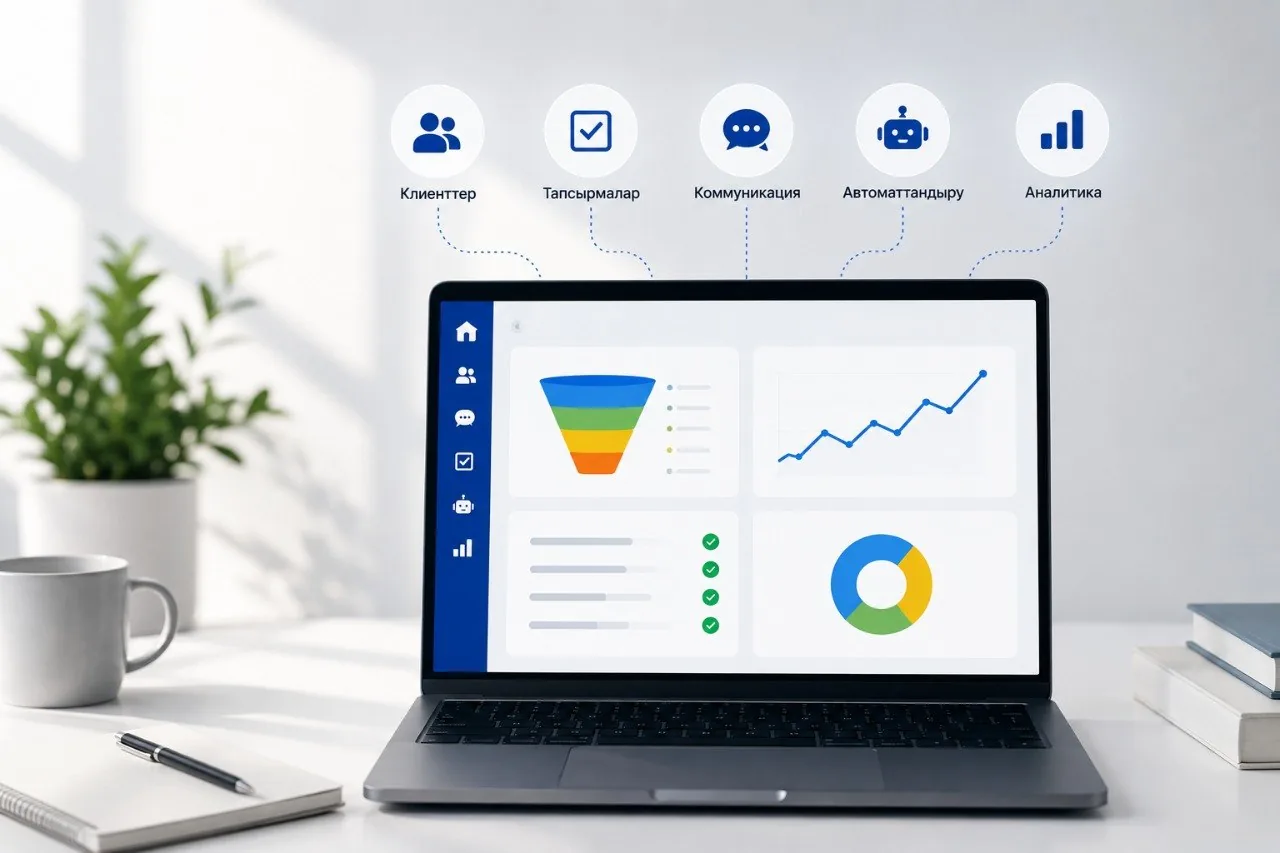
The idea of comprehensive platforms for business is also based on this. For example, Bitrix24 combines CRM, tasks and projects, corporate communications, automation, analytics, and AI tools in one place.
This allows the company to save in several areas simultaneously. The number of individual services decreases, part of the daily repetitive work is performed automatically, and client requests are stored in the CRM system. The manager no longer needs to collect information about the team's work from each employee individually.
Therefore, calculating savings only by license price is insufficient. How many working hours were saved? How many requests were no longer lost? How much work that was previously done manually was automated? These indicators should also be taken into account.
How much does doing nothing cost?
Ineffective processes may go unnoticed for a long time while the business operates steadily. However, when the company begins to carefully calculate expenses, lost clients, wasted working hours, and services with overlapping functions become clearly visible.
Therefore, it is incorrect to view automation only as an additional expense during periods of difficult economic forecasting. If implemented correctly, it can, on the contrary, help reduce costs.
Now there is an opportunity to switch to more favorable terms for automation. Until August 31, 2026, a special offer for Bitrix24 is valid in Kazakhstan: you can get up to a 35% discount when purchasing annual cloud tariffs for the first time. Terms depend on the tariff and purchase history.
But even with a discount available, the most important question remains unchanged: it is necessary to calculate not only how much the new system costs, but also how much it costs the business to continue working with old methods.
The Tech on Telegram Follow The Tech on Telegram
Keep up with the latest technology and startup news.
Related reading



More from this author

Article Useful
How to protect your accounts from hacking: 8 settings you should check today
The Tech

Article Useful
500 Global: How the Accelerator Works and Who Can Receive Investments
The Tech

Article Interviews
Game Development in Central Asia: Arkady Moldavski on Developing Reverb and the Growth of the Industry
The Tech

Article Useful
Google, Tesla, BlackRock, and the IMF: Where to Apply for an Internship in Fall 2026
The Tech

News IT
Tesla unveiled the flying electric car Roadster
The Tech

News IT
Intero Biosystems startup won the Startup Battlefield at TechCrunch Disrupt 2026
The Tech