Anthropic released a playbook for founders: what has changed in launching a startup in 2026
Launching a startup used to mean finding funding, assembling a team, and learning to code—or hiring someone who could. By 2026, this formula has become obsolete. Anthropic released a guide for founders, and analysts have documented new market entry rules. We examine exactly what has changed and why a great product no longer guarantees survival.
The Tech AI
Get the key points in seconds - a short summary from The Tech AI.
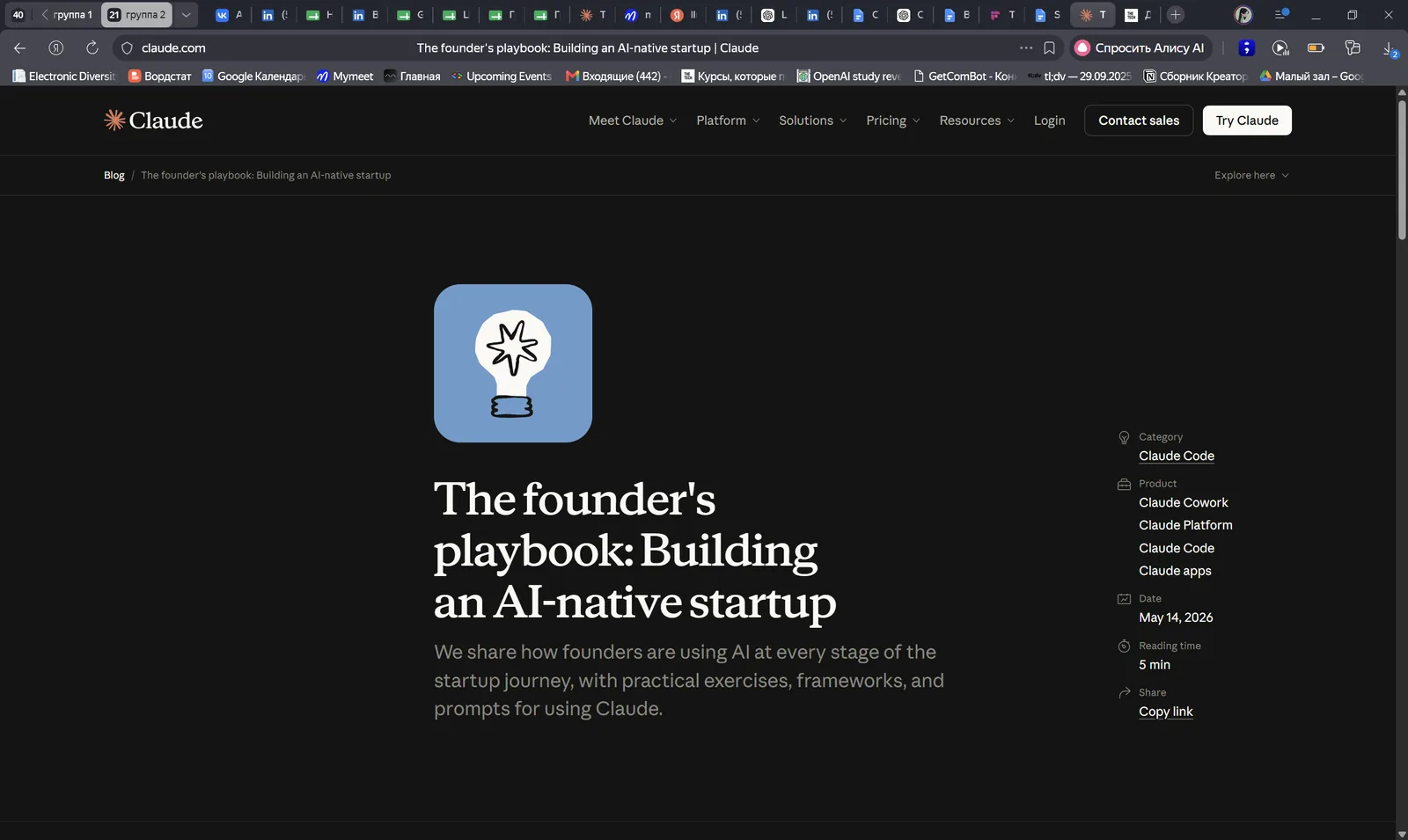
On May 14, 2026, Anthropic published the document "The Founder's Playbook: Building an AI-Native Startup," which outlines four stages of building a company. AI has eliminated barriers to capital and skills, enabling a single founder to develop a product; however, 43% of startups fail due to a lack of product-market fit. A go-to-market (GTM) strategy is critically important for growth: SaaS startups that spend more than 20% of their revenue on marketing grow three times faster, and the LTV to CAC ratio should be at least 3:1.
What is a startup playbook and why is it needed
A startup playbook is a set of rules and principles by which a founder builds a company: from the first idea to scaling. On May 14, 2026, Anthropic published the document «The Founder's Playbook: Building an AI-Native Startup».
The guide rethinks the traditional startup path — validation, fundraising, hiring, development — and divides it into four stages: idea, MVP, launch, and scaling.
The central thesis of the document: AI has eliminated three barriers that historically blocked the transition between stages — capital, team size, and technical skills. Now, a single founder with the right tools can do what previously required an entire team.
The main mistake of founders has not changed
Despite all technological shifts, the reason for the failure of most startups remains the same. According to updated 2026 data from CB Insights, 43% of startups fail due to a lack of product-market fit.
Meanwhile, the phrase "ran out of money" — cited by 70% of closed companies — is now viewed not as an independent cause, but as a consequence of the same lack of product-market fit. In other words, money runs out precisely because the product did not find its buyer.
Here, the Anthropic playbook also warns of a trap created by AI itself. When a prototype can be built in a day instead of a quarter, founders often confuse the fact of creating a prototype with proof that it is needed by anyone. The document calls this "confusion between creation and validation" — and it is one of the key mistakes of the new era.
Without a go-to-market strategy, the product won't save you
Most founders are excellent at building products — but significantly worse at building the system that sells them. They improve features, hire engineers, and deeply study the market — yet treat go-to-market as something that will naturally fall into place once the product becomes good enough.
SaaS startups that spend 20% or more of their revenue on sales and marketing in the early stages grow three times faster than those who invest minimally in GTM. Startups that have achieved product-market fit grow five times faster than those still searching for it. Meanwhile, 85% of startups that launch an MVP first are more likely to achieve successful scaling.
Three sales models: which one to choose at the start
In 2026, there are three main GTM models for B2B startups, and the choice between them largely determines the fate of the company.
Product-Led Growth — the product sells itself through free versions and viral mechanics. It works when a user can evaluate the product's value independently, without the involvement of a sales department. Target metrics: CAC payback in 6–12 months and NRR above 120%.
Sales-Led Growth — salespeople manage deals from qualification to closing. It is suitable when the average check is above $25,000 and the purchase decision is made by several people within the company.
Account-Based Motion — coordinated outreach to 50–500 target accounts. It is suitable for enterprise sales with long sales cycles and high switching costs. It requires the most operational infrastructure but yields the highest average check and the most stable customer relationships.
For most B2B startups in the first 12 months, the right choice is founder-led sales. The founder personally conducts every customer conversation not because it scales, but because each such conversation provides an understanding of product-market fit that no research can replace.
Metrics that matter
To understand how effectively the sales strategy is working, founders track several key indicators. CAC is the cost of acquiring one customer, i.e., how much money the company spends on marketing and sales to close one deal. LTV is the total revenue that this customer will bring over the entire time of working with the company.
The ratio between these two numbers shows whether the business earns more than it spends on acquisition. A healthy indicator is at least 3:1: for every dollar spent, the company should earn three. This is the basic expectation of the market and investors in 2026.
Acquiring customers is becoming increasingly expensive: the average CAC for B2B companies grew by 60% in 2026. Against this backdrop, control over the LTV to CAC ratio becomes not just a metric, but a matter of survival.
What is the bottom line
The new 2026 startup playbook is built on two parallel theses.
The first: AI has lowered the barrier to entry. Now, one person with the right tools can do what previously required an entire team — this is a fact confirmed by real-world cases.
The second: precisely because of this, validation and discipline in sales have become more important, not easier. The speed of building a prototype does not eliminate the need to verify demand. A good product built in a week will still fail without a system that sells it.
The Tech on Telegram Follow The Tech on Telegram
Keep up with the latest technology and startup news.
Related reading




More from this author

Article Useful
How to protect your accounts from hacking: 8 settings you should check today
The Tech

Article Useful
500 Global: How the Accelerator Works and Who Can Receive Investments
The Tech

Article Interviews
Game Development in Central Asia: Arkady Moldavski on Developing Reverb and the Growth of the Industry
The Tech

Article Useful
Google, Tesla, BlackRock, and the IMF: Where to Apply for an Internship in Fall 2026
The Tech

News IT
Tesla unveiled the flying electric car Roadster
The Tech

News IT
Intero Biosystems startup won the Startup Battlefield at TechCrunch Disrupt 2026
The Tech