AI Digest: Firebird, victories at international olympiads, and Anthropic's record
We’ve gathered the top news from the world of artificial intelligence from August 10 to 21 — new models, investments, regional AI initiatives in Central Asia and beyond.
The Tech AI
Get the key points in seconds - a short summary from The Tech AI.
On August 8, the largest AI factory Firebird was launched in Razdan with the participation of Nikol Pashinyan. Gemini reached one billion monthly users, catching up with the growth rate of ChatGPT. SpaceXAI released the Grok 4.6 model for long-lived agents. DeepSeek introduced the Harness framework for autonomous AI agents. Cursor joined SpaceX, gaining access to GPUs. FINCA Bank launched a voice assistant in the Kyrgyz language. Google offers students a free annual AI Pro subscription until December 2026. Anthropic surpassed OpenAI in revenue in the second quarter of 2026 ($11.6 billion vs. $6.7 billion). Google introduced new educational tools in Search and Gemini. OpenAI launched ChatGPT for Teens with a Study Mode.
Firebird launched the largest AI factory in Armenia
On August 8, Firebird officially launched the country's largest AI factory in the Armenian city of Razdan. The opening ceremony was attended by Armenian Prime Minister Nikol Pashinyan, Kazakh Vice Prime Minister Zhaslan Madiev, and the U.S. Chargé d'Affaires ad interim in Armenia, David Allen. The construction of the first phase took a little over six months.
Gemini reaches one billion monthly users
The app became the 14th Google product to reach this milestone. Google CEO Sundar Pichai announced that Gemini has surpassed one billion active monthly users and is among the company's fastest-growing services. In terms of growth rate, the app has caught up with OpenAI's ChatGPT, which reached the same milestone in June 2026. Google is consistently integrating Gemini into its products—from Search and Workspace to Android and a standalone app.
SpaceX AI releases new Grok 4.6 model
Grok 4.6 is designed for "long-running" agents—systems capable of working on a given task for extended periods, restarting independently, and progressing toward their set goals. The model performs tasks in multiple stages, works with unfamiliar codebases, and tests its own results before proceeding further. These improvements resulted from a longer additional training cycle, the use of higher-quality engineering data, and expanded reinforcement learning for programming and intellectual labor.
Kyrgyzstan launches the first voice AI assistant in the Kyrgyz language
FINCA Bank announced the launch of a voice AI assistant in the Kyrgyz language. The system operates in the bank's Contact Center and handles incoming and outgoing inquiries: clients explain their questions using natural speech, without navigating through button menus or using predefined commands. The voice assistant consists of two key components—speech recognition and synthesis. The first converts the client's spoken words into text, while the second transforms the generated response into audible speech.
DeepSeek releases Harness—a tool for creating autonomous AI agents
The Chinese artificial intelligence company DeepSeek is entering a new market beyond large language models, presenting the long-awaited beta version of Harness—a software framework that helps developers transform AI models into autonomous agents. The launch of Harness on August 13 marks a strategic shift for DeepSeek toward building foundational digital infrastructure for autonomous AI agents—systems capable of using AI models to interact with external software, execute code, and independently perform complex tasks.
The developer of the AI code editor has joined SpaceX. The deal was initiated in April when the companies announced a partnership with SpaceX AI to accelerate model training. Cursor gains access to the world's largest fleet of graphics processing units. This will enable the training of more powerful models and reduce operational costs, allowing customers to access more capable tools at a lower price.
Google launches free annual AI Pro subscription for students
Google has launched a promotion allowing students to receive a free annual subscription to Google AI Pro. The standard subscription price is $19.99 per month, or approximately $240 per year. The offer is valid until December 31, 2026. To activate it, users must provide a payment method; after the free period ends, the subscription will automatically renew at the full price unless canceled. Google AI Pro provides four times the usage limits for Gemini compared to free accounts, access to the Gemini Spark agent platform, Gemini integration into Workspace apps including Gmail and Google Docs, 5 TB of cloud storage, and a Google Health Premium subscription.
Anthropic surpasses OpenAI in quarterly revenue for the first time
Anthropic has surpassed OpenAI in quarterly revenue for the first time. In the second quarter of 2026, the company more than doubled its performance compared to the previous quarter, generating $11.6 billion. Over the same period, OpenAI's revenue grew by 18%—from $5.7 billion to $6.7 billion. This gap marks the first instance where Anthropic's quarterly revenue exceeded that of OpenAI.
Google launches new study tools in Search and Gemini
Google introduced a range of new educational tools in Search and Gemini, including AI-generated interactive visualizations, 3D simulations, a dedicated section for students, and personalized practice tests. The launch of these new features represents another attempt by Google to position Gemini as an AI-powered assistant that students turn to during their studies. The company is competing with OpenAI and educational startups like Knowt and Gauth, which also offer their own learning and practice tools. In Search, students can now create personalized tools and simulations to better understand complex topics.
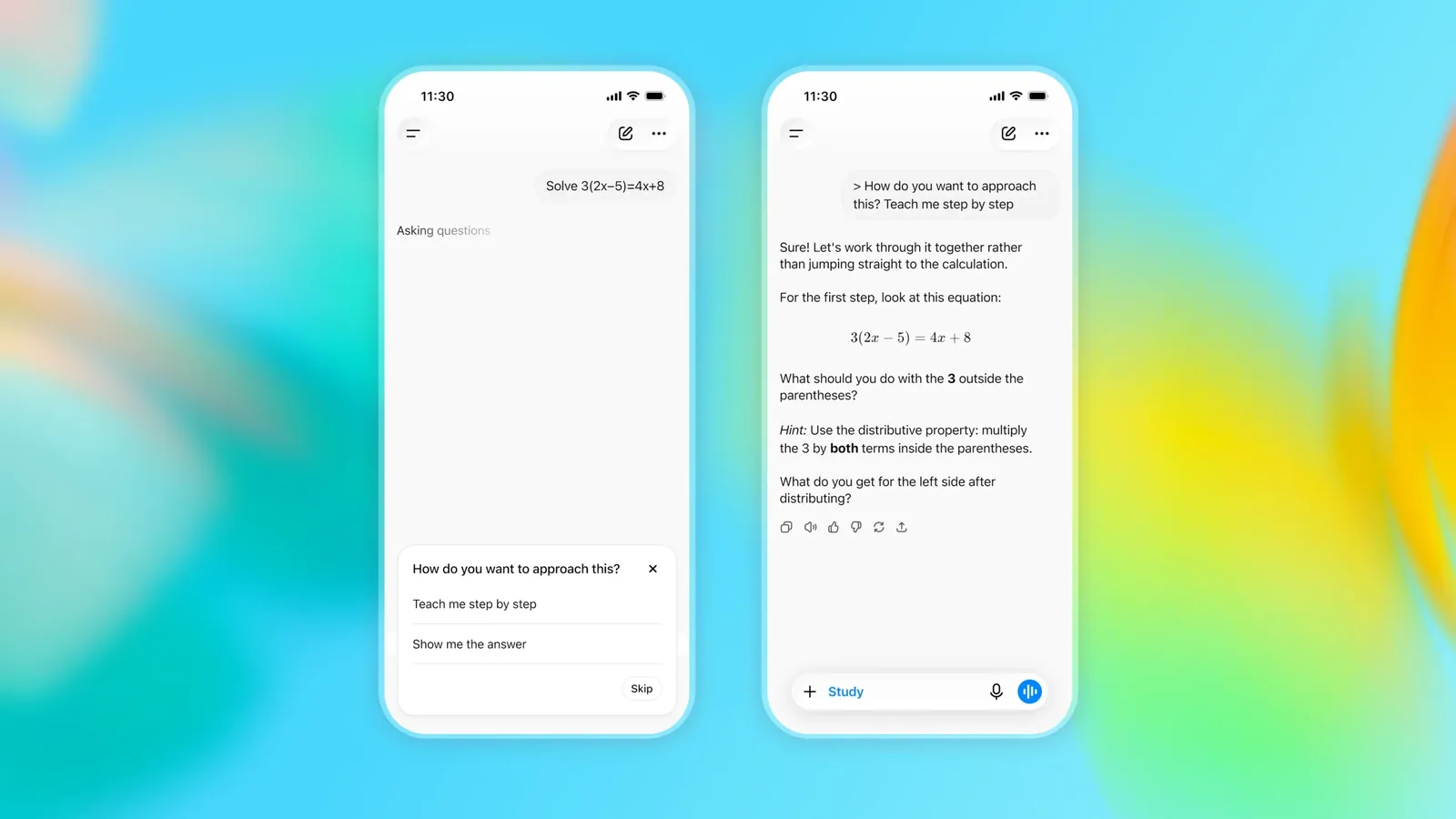
OpenAI launches ChatGPT for Teens—a chatbot version focused on learning
The new version is automatically enabled for users aged thirteen to seventeen—if the system detects an age under eighteen or if the teenager specifies it themselves. ChatGPT for Teens includes a Study Mode feature that breaks down problems step-by-step through guiding questions rather than providing direct answers. If a teenager asks for a solution directly, the chatbot encourages them to work through the topic independently—a feature OpenAI refers to as "responsible homework reminders."
The Tech on Telegram Follow The Tech on Telegram
Keep up with the latest technology and startup news.
Related reading




More from this author

Article Useful
How to protect your accounts from hacking: 8 settings you should check today
The Tech

Article Useful
500 Global: How the Accelerator Works and Who Can Receive Investments
The Tech

Article Interviews
Game Development in Central Asia: Arkady Moldavski on Developing Reverb and the Growth of the Industry
The Tech

Article Useful
Google, Tesla, BlackRock, and the IMF: Where to Apply for an Internship in Fall 2026
The Tech

News IT
Tesla unveiled the flying electric car Roadster
The Tech

News IT
Intero Biosystems startup won the Startup Battlefield at TechCrunch Disrupt 2026
The Tech