5 ways for businesses to save money while Kazakhstani citizens count every tenge
75.4% of respondents are now consciously reducing their expenses—meaning three out of four Kazakhstani citizens. These results were revealed by the ZimaBlue agency's study "Kazakhstani Consumer 2026," presented at the Shanyraq forum. While everyone is discussing how consumers are saving money in this context—on coffee, travel, delivery, etc.—the other half of the same story remains behind the scenes: businesses in this economy face the exact same challenge. We share the conclusions drawn by the study authors and highlight five areas where businesses can find reserves without changing the price for the customer.

The Tech AI
Get the key points in seconds - a short summary from The Tech AI.
A study of 1,432 Kazakhstani residents (July) showed that 75.4% are consciously reducing expenses. Businesses are advised to review internal processes: cut routine instead of salaries, consolidate cloud services (savings up to 94%), and implement auto-replies in CRM. Customer trust (43.6%) and willingness to pay for quality (78.1%) require optimizing subscription costs and service speed.
Spoiler: the solution is not to cut services or save on salaries. You need to examine your own processes with the same scrutiny that customers now apply to their receipts. Are you ready to find where your business is unknowingly losing money? Let’s break it down step by step.
Aigerim Beisen, PR Manager at Bitrix24 Kazakhstan
1. Conduct an expense audit as rigorously as your customers do
What does cost-cutting actually look like in Kazakhstan in 2026? A survey conducted in July among 1,432 Kazakhstani residents shows that 75.4% of respondents are currently consciously reducing their expenses, and they are doing so across a broad front: 20% are cutting spending in 11 out of 16 categories simultaneously. This is not panic—material well-being has deteriorated for only 29.7% of people. People have simply started asking themselves more often, “Do I really need this?” across all expense categories.
Businesses often make the opposite mistake: budgets for development, marketing, and personnel are the first to be cut—precisely the areas that drive the company forward. Meanwhile, manual labor and routine processes that could have been automated long ago remain untouched. Logically, it would make more sense to cut routine tasks rather than growth.
Recommendation: Conduct such an audit quarterly, just as buyers now do monthly—reviewing every expense category, not just “large” budgets.
Why it works: Customer savings are not about refusing to buy, but about not paying for unnecessary things. Applying the same principle to business frees up budget without a single layoff.
2. Do not buy a separate subscription for features already available in your main tool
One of the most invisible expense items is file storage and fragmented cloud services. According to industry research by iKS-Consulting, companies with up to 500 employees spend on average 16 times more on a set of separate cloud services than a comparable unified platform would cost—meaning that up to 94% of this budget is essentially an overpayment. The more workflows and data are consolidated on a single platform, the fewer reasons there are to pay extra for individual services. Companies have been paying for cloud storage for documents, presentations, and photos for years, even though this functionality is often already included in the CRM platform the business already uses.
A recent example: Bitrix24 expanded the cloud disk volume on all tariff plans while keeping the price the same—resulting in a multiple increase on every tariff, from 5 times on the free plan to dozens of times on paid plans, where the count is now in terabytes. Nothing needs to be purchased or configured—new limits are applied automatically for everyone already on cloud tariffs.
Recommendation: Before renewing another subscription to a cloud storage service, check how much space is already provided by the tool you are already paying for.
Why it works: Research shows that buyers have clear logic—77.4% are willing to pay for composition and security. Value matters more than price. The same principle—increasing volume without raising the price—now works for both the customer and the business itself.
3. Automate the first response—it is cheaper than hiring more people
A familiar situation: a customer writes on WhatsApp, but the response comes only an hour later. It seems like a small thing, but the survey says otherwise. 42.2% of buyers expect a seller’s response within half an hour, and 15.6% leave after just five minutes. This is not about ill-mannered customers—it is a new speed norm, and businesses that learn about it last pay for it in lost sales.
Hiring another manager for round-the-clock responses is expensive and not always justified. Setting up an automatic first response in a messenger or CRM is not expensive at all.
Recommendation: Enable auto-replies or chatbots for initial contact so that customers receive an immediate reaction, even if the manager becomes available only 20 minutes later.
Why it works: It closes the gap between “customer wrote” and “customer waited” without increasing the payroll fund.
4. Collect reviews through CRM—it is cheaper than a separate reputation budget
When prices are equal, Kazakhstani consumers most often decide where to buy based on reviews from other buyers—43.6% of respondents answered this way. For small businesses, this is especially sensitive: doubts about quality are cited as a barrier by 54.1%, and the lack of guarantees and returns by 47.8%. Small businesses lack trust, and it cannot be bought through a separate advertising campaign.
Recommendation: Set up automatic review requests after a deal directly in the CRM, and present return conditions at the beginning of the offer, not in fine print.
Why it works: Trust in 2026 is built on reviews and deal terms, not on the budget of an SMM agency—meaning it can be grown using standard tools that businesses already have.
5. Look for reserves where your customers do
78.1% of buyers are willing to pay more for product durability. This means one thing: customers do not intend to receive a worse product. They expect the same quality from business—only they want to understand what they are paying for. At the same time, saving is not the same as refusing to buy. Discounts and promotions are important to 87.8% of respondents, and 50.3% explicitly admit that they deliberately postpone purchasing a desired item, waiting for a discount or promotion. In other words, people do not cross items off their lists—they simply wait for a more favorable moment.
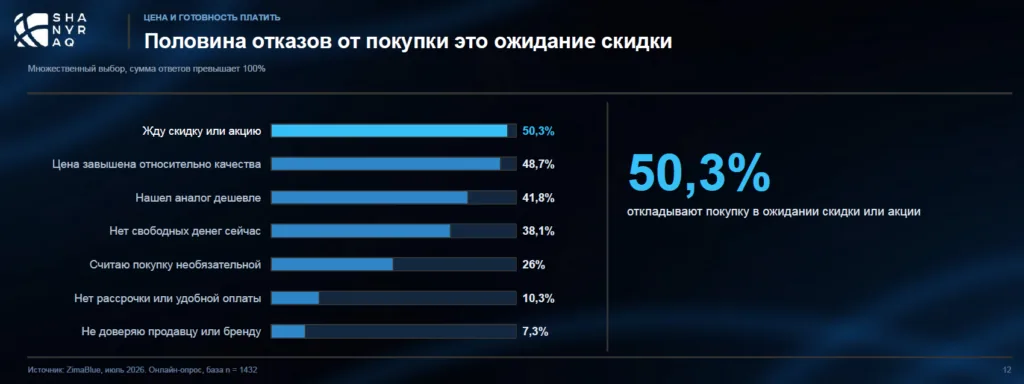
Businesses can provide this quality without raising prices in only one way—by finding reserves within themselves: in manual routine, in unnecessary subscriptions, in slow responses, and in the lack of systematic work with reviews. These are exactly the four points we discussed above.
Recommendation: Do not start optimization with salaries or product assortment—start with processes that could have been automated long ago.
Why it works: Customers in 2026 count their money more carefully than before, but they are willing to pay—if they see what for. Businesses that organize their own expenses will have something to show.
Conclusions
The 2026 economy is symmetrical: buyers count every tenge, and businesses must do the same—not at the expense of the customer, but through their own processes. The winner is not the one who lowers prices first, but the one who organizes their internal operations first: eliminating manual labor, unnecessary subscriptions, and slow responses. Whether in Bitrix24 or any other tool serving as a business workflow system, the principle is the same: reserves are almost always found not in the customer’s receipt, but in your own processes, which have simply not been addressed yet.
The Tech on Telegram Follow The Tech on Telegram
Keep up with the latest technology and startup news.
Related reading



More from this author

Article Useful
How to protect your accounts from hacking: 8 settings you should check today
The Tech

Article Useful
500 Global: How the Accelerator Works and Who Can Receive Investments
The Tech

Article Interviews
Game Development in Central Asia: Arkady Moldavski on Developing Reverb and the Growth of the Industry
The Tech

Article Useful
Google, Tesla, BlackRock, and the IMF: Where to Apply for an Internship in Fall 2026
The Tech

News IT
Tesla unveiled the flying electric car Roadster
The Tech

News IT
Intero Biosystems startup won the Startup Battlefield at TechCrunch Disrupt 2026
The Tech