36% of financial organizations in Central Asia have already implemented AI
The AI agent market by technology from 2021 to 2038 in billions of US dollars

The prepared report “Artificial Intelligence in the Financial Markets of Central Asia” is the largest study on AI development issues in the region, based on a survey of 232 organizations from the financial sectors of Kazakhstan, Kyrgyzstan, and Tajikistan. The material presents an overview of the evolution of artificial intelligence in 2024–2025, including the transformation of global financial systems and an assessment of strategic initiatives and progress by Central Asian countries in the field of AI.
For the global artificial intelligence industry, 2025 became a turning point. Global investments in AI reached record levels, and the technology moved from pilot projects to mass industrial application. The dominance of generative AI and transformer architecture opened the era of autonomous AI agents capable of independently solving complex business tasks. It is expected that over the next five years, the AI agent market will grow at a compound annual growth rate of 45%
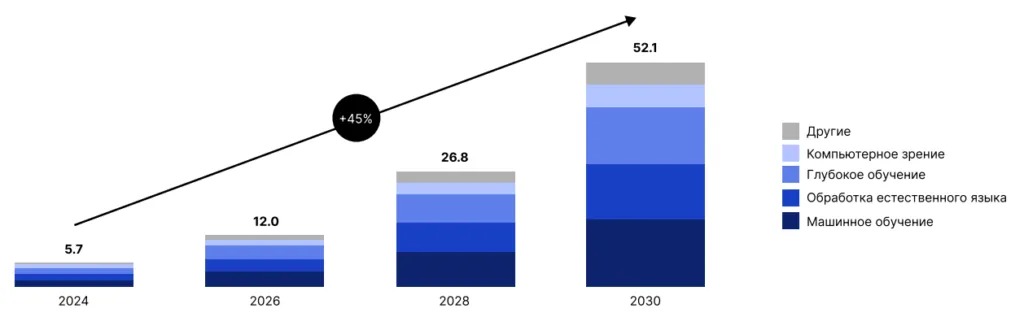
Source: BCG
The financial sector has become a leader in AI adoption, moving from automating routine operations to predictive analytics in lending, fraud prevention, and process optimization. However, the high potential of AI is accompanied by significant challenges, including requirements for data quality and protection, integration with legacy IT systems, and increased legal risks.
Central Asian countries currently lag behind global leaders in readiness for AI implementation, particularly regarding integration into public services. A comparison of positions in theOxford Insights 2023–2024 index demonstrates that a relatively weak technology sector, innovation potential, market maturity, and human capital remain the main long-term challenges on the path to full AI utilization for all countries in the region.
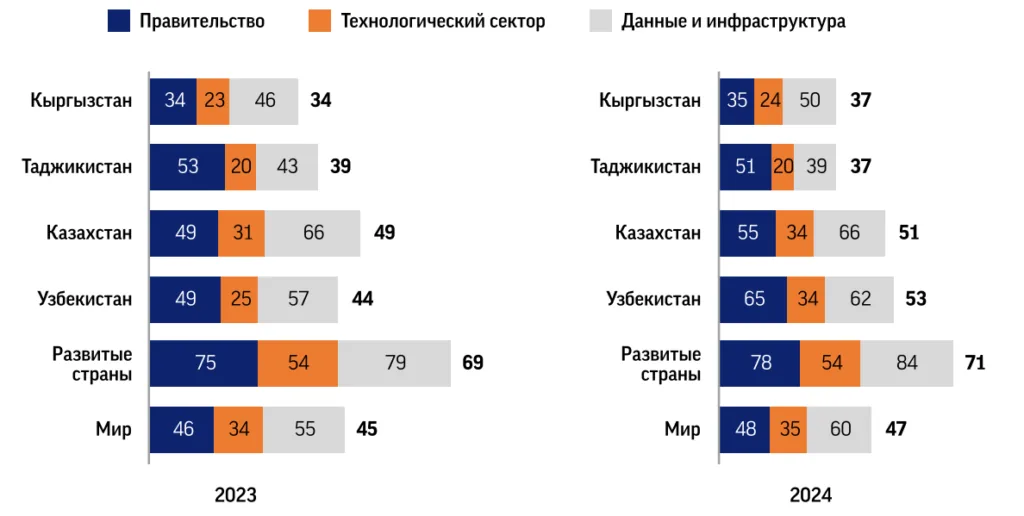
Comparison of Central Asian countries' readiness for AI integration based on 2023 and 2024 data
Source: Oxford Insights
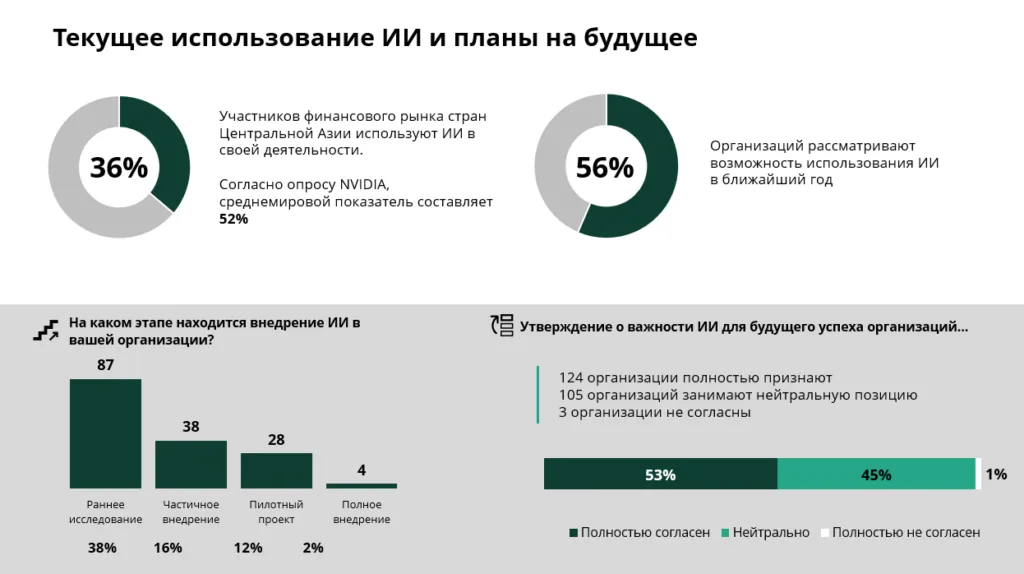
According to the research, 36% of financial market organizations in Central Asia already use artificial intelligence technologies, while according to the globalNVIDIA survey, this figure stands at 52%. 56% of organizations are considering implementing AI in the coming year. However, most participants are at early stages of maturity: 38% are conducting research, 16% are implementing partial adoption, 12% are running pilot projects, and only 2% have achieved full AI integration. Despite this, the importance of AI for the future development of the sector is recognized by the majority of respondents—53% fully agree with its critical role, while 45% hold a neutral position.
Kazakhstan demonstrates an institutionally structured approach to AI development, holding a strong position in the region in terms of implementation readiness. The creation of a specialized ministry and the launch of a national supercomputer form the foundation for technological leadership and the country’s potential as a future AI hub.
AI is already used by 39% of financial sector organizations, with the focus shifting from customer-facing solutions to internal projects aimed at improving efficiency and automation. Banks are leaders in AI adoption, demonstrating positive return on investment; however, the market still faces constraints related to data quality, cybersecurity, and a shortage of skilled personnel, which determine priorities for future investments.
Kyrgyzstan is consistently moving from digitalization to systematic AI integration, combining technological development with humanitarian priorities. The AI platform project in the Kyrgyz language is aimed at preserving cultural and linguistic heritage, while the Regional AI Hub initiative reflects the desire to integrate into the regional innovation ecosystem. The High Technologies Park and plans to create a national computing center strengthen the infrastructure base.
In the financial sector, 35% of organizations use AI, including 52% of banks and 27% of payment companies. Meanwhile, 48% of organizations consider AI technologies a critically important factor for competitiveness, and 69% plan to implement them within the year. Practical use of AI is focused on operational efficiency, analytics, marketing, and customer service, despite persistent barriers related to personnel, risks, and regulation.
Tajikistan demonstrates a strategic and proactive approach to AI development, adopting the region’s first AI Strategy until 2040 and initiating a UN General Assembly resolution on regional cooperation in this field. The creation of the Area AI technopark and a “green” AI cluster based on H200 GPUs forms the infrastructure foundation for developing Tajik-language LLMs and specialized AI solutions.
AI is already used by 33% of financial sector organizations, with 58% planning to implement it, and 65% of respondents considering AI critically important for future success. The main focus of application is optimizing internal processes and improving efficiency, despite persistent barriers such as personnel shortages, limited budgets, data issues, and regulation, which increase demand for training and AI competency development.
Turkmenistan is implementing a phased and controlled approach to digitalization, emphasizing education, SmartClass with Huawei, AI development in strategic industries, primarily oil and gas, and the formation of a national Turkmen language corpus for localized AI solutions. The transition to a digital economy under the strategy until 2030 is accompanied by the development of cashless payments and electronic banking services.
AI use in the financial sector remains limited and fragmented; however, cooperation with international partners and consistent digitalization create a foundation for further AI integration while maintaining state control and system stability.
Uzbekistan demonstrates one of the most dynamic rates of AI development in the region, aiming to enter the top 50 countries in the global readiness index. The AI Strategy until 2030, partnerships with the UAE and China, the development of data centers and laboratories form the basis for growing the AI services market to $1.5 billion, including the creation of a national language model and the development of financial inclusion.
Consolidating efforts among Central Asian countries enhances their potential as a promising global AI hub.
The Tech on Telegram Follow The Tech on Telegram
Keep up with the latest technology and startup news.
Related reading



More from this author

Article Useful
How to protect your accounts from hacking: 8 settings you should check today
The Tech

Article Useful
500 Global: How the Accelerator Works and Who Can Receive Investments
The Tech

Article Interviews
Game Development in Central Asia: Arkady Moldavski on Developing Reverb and the Growth of the Industry
The Tech

Article Useful
Google, Tesla, BlackRock, and the IMF: Where to Apply for an Internship in Fall 2026
The Tech

News IT
Tesla unveiled the flying electric car Roadster
The Tech

News IT
Intero Biosystems startup won the Startup Battlefield at TechCrunch Disrupt 2026
The Tech