# How the "West-East" hyperhighway will strengthen connectivity in regions and international data transit
In Kazakhstan, the construction of the national optical hyperhighway "West-East" continues. It will run from Aktau to the Khorgos border crossing and will become part of an alternative data transmission route between Europe, Central Asia, and China.
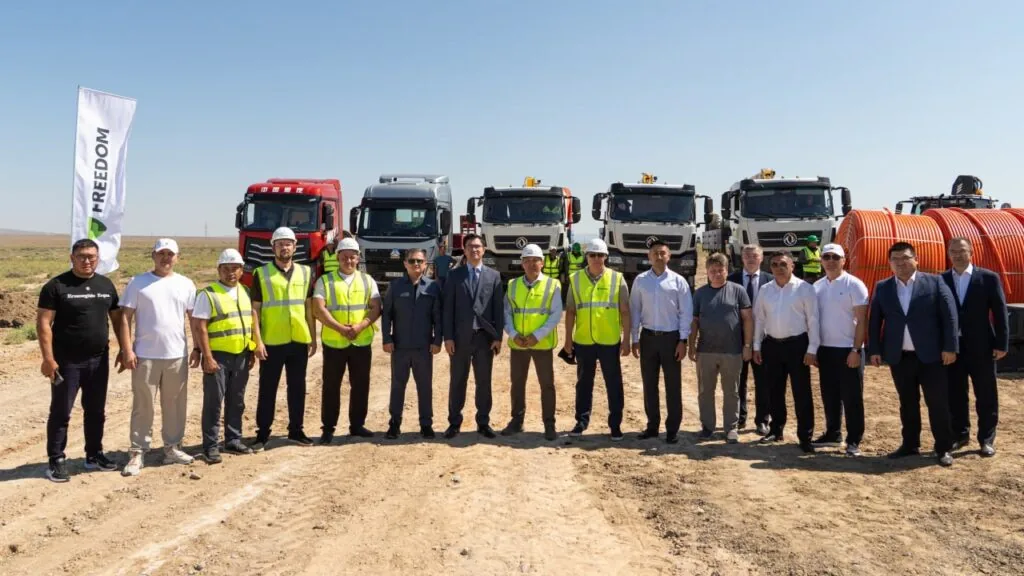
On August 4 and 5, Doszhan Musaliyev, Vice Minister of Artificial Intelligence and Digital Development of the Republic of Kazakhstan, visited the Kyzylorda region, where he reviewed the progress of construction on a section of the mainline. The trip was also dedicated to monitoring communication quality and the development of the region's digital infrastructure.
The project is being implemented under a memorandum between the Ministry of Artificial Intelligence and Digital Development of the Republic of Kazakhstan and Freedom. Freedom Cloud Holding and JSC "ASTEL" are responsible for the project's implementation.
**What is being built**
The "West-East" project is a main fiber-optic communication line from Aktau, where construction of the Trans-Caspian mainline is being completed, to Khorgos. The total length of the route will be approximately 4,500 km. More than 2,200 km of fiber-optic cable (FOC) has already been laid.
The basic route passes through seven regions of Kazakhstan. Freedom Holding is also considering the possibility of expanding the infrastructure to 13 regions.
 **Why the mainline is needed**
At the direction of the Head of State, Kazakhstan is focusing on developing infrastructure that will serve the country in the long term. The "West-East" hypermainline is part of this approach: Kazakhstan is not just updating domestic communication networks but is establishing a route that can enhance its role in international data exchange.
The mainline will create an alternative traffic transmission channel between Europe, Central Asia, and China. Together with the Trans-Caspian FOC, the project forms a more resilient communication architecture in the region and strengthens Kazakhstan's position as a digital hub of Eurasia.
**What this will bring to the regions**
At the same time, the ministry is simultaneously addressing practical tasks of regional digitalization: expanding broadband access, modernizing networks, transitioning from 2G and 3G to 4G, eliminating "white spots," and launching public digital services, including Free Wi-Fi in populated areas.
For the Kyzylorda region, the mainline opens up opportunities for organizing high-speed channels with neighboring regions and international operators, as well as for connecting distributed data centers and remote computing resources based on AI.
 **What technologies will operate based on the hypermainline**
The new infrastructure is expected to provide a capacity of at least 12 Tbit/s. This is important for services that require fast exchange of large volumes of data.
Upon completion of the project, Kazakhstan will have a modern optical infrastructure for the development of the digital economy, AI solutions, digital services, and international data transit.